
Bimagrumab After Treatment: What the BELIEVE Trial Reveals
What happens when an investigational obesity treatment produces unusually high fat loss, but then treatment stops? The BELIEVE trial of bimagrumab plus semaglutide offers an intriguing answer: substantial improvements in body composition during treatment, followed by partial reversal during withdrawal. The headline is not just how much weight was lost. It is how much remained off, and what happened to lean tissue along the way.
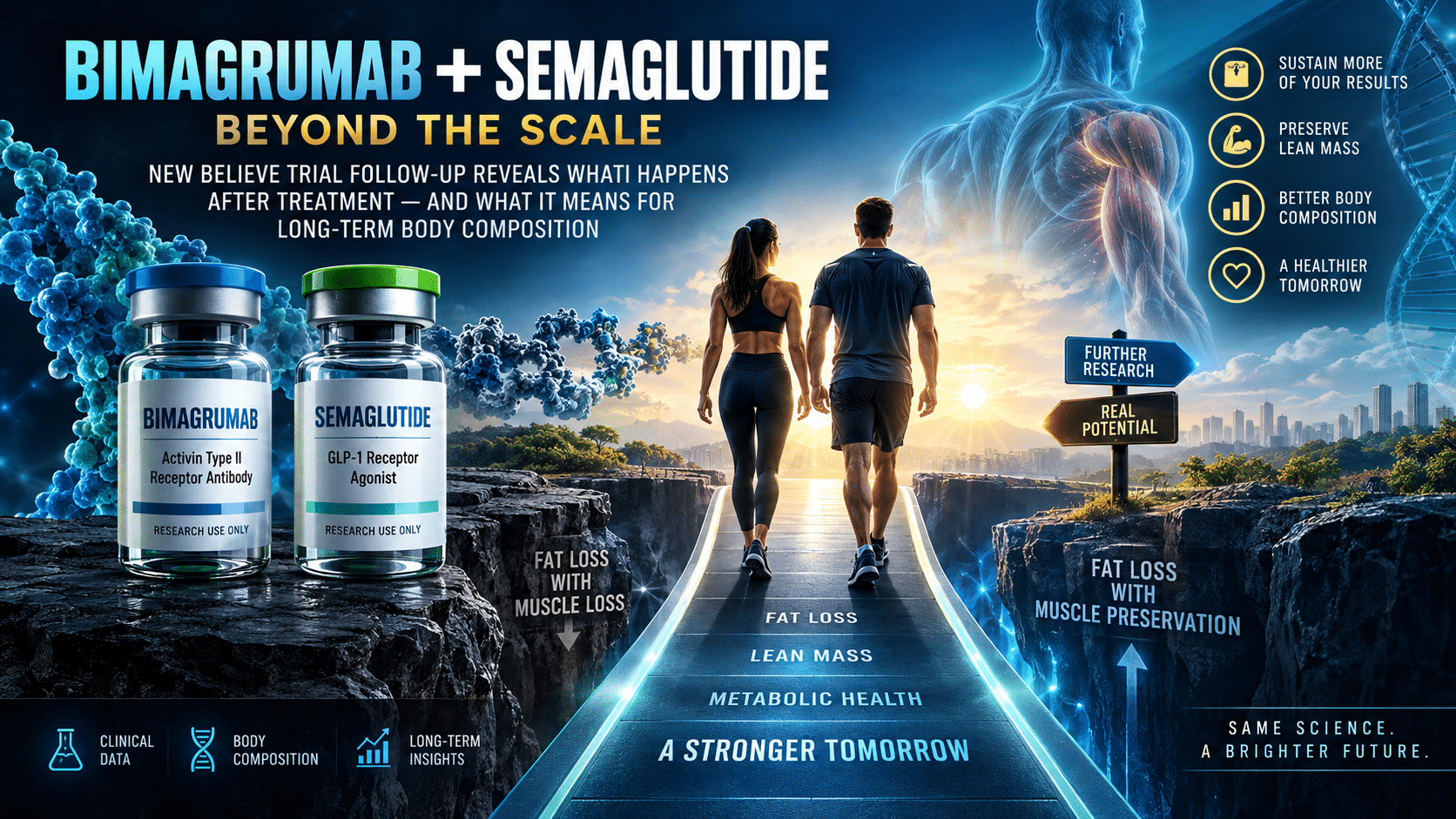
First, the BELIEVE trial results that started the conversation
The randomized Phase 2 BELIEVE study enrolled 507 adults with obesity or overweight and an associated complication, excluding diabetes. Participants received bimagrumab, semaglutide, combinations, or placebo during the initial 48-week period, with an extension to week 72. Bimagrumab is an investigational antibody directed at activin type II receptors; semaglutide activates the GLP-1 receptor. At week 72, the highest-dose combination showed an estimated 22.1% body-weight reduction, compared with 15.7% for semaglutide 2.4 mg alone, using the published paper’s efficacy estimand. The withdrawal presentation used a different analysis and reported 21.3% for the combination at week 72; these estimates should not be treated as identical. Its body-composition profile was even more interesting: 92.2% of weight lost was attributable to fat mass, versus 75.6% in the semaglutide group. These are group-level estimates, not promises for individual patients.| Week 72 measure | Semaglutide 2.4 mg | High-dose combination |
|---|---|---|
| Body-weight change | −15.7% | −22.1% |
| Lean-mass change | −7.4% | −2.9% |
| Share of lost weight attributable to fat | 75.6% | 92.2% |
| Estimated visceral-fat change | −35.8% | −58.2% |
What happened after treatment stopped?
Research checkpoint: The most useful question is not simply how much weight came back, but how fat mass, lean mass and function were actually measured after withdrawal. Group averages do not establish an individual maintenance strategy. For the companion mechanisms, see the myostatin and GLP-1 research review; for the broader evidence landscape, visit the clinical pipeline tracker.
After 72 weeks of treatment, BELIEVE included a planned 32-week withdrawal follow-up through week 104. A September 30, 2026 EASD presentation by the study investigators, reproduced by Lilly, provided a renewed look at the durability of weight loss. Lilly sponsored the study, so its presentation is a primary source for the reported findings, not independent confirmation. The withdrawal findings are conference-presented results; the earlier peer-reviewed paper reports the treatment period through week 72. Importantly, some body-composition withdrawal findings had already been presented at the European Congress on Obesity in May 2026. The October reporting is an update, not the first-ever disclosure of withdrawal data. In the EASD follow-up, the high-dose combination group was reported to retain approximately 54% of its earlier average weight loss at week 104. The semaglutide 2.4 mg group retained about 51%, while the high-dose bimagrumab-alone group retained about 76% of its respective earlier loss.| Study group | Reported at week 104 |
|---|---|
| High-dose combination | Approximately 54% |
| Semaglutide 2.4 mg | Approximately 51% |
| High-dose bimagrumab alone | Approximately 76% |
These are conference-reported group averages after the withdrawal period. The groups did not start withdrawal with the same amount of weight lost.
The numbers need context
The combination had more weight to regain because it had lost more during treatment. According to the reported follow-up, the high-dose combination was about 21.3% below baseline at withdrawal and 11.5% below baseline at week 104. Comparing retention percentages alone can therefore mislead. Likewise, the conference estimates reflect group averages, and detailed denominators for every later follow-up visit were not fully available in the public summary reviewed here. Crucially, this was a planned research withdrawal period, not a trial proving a particular maintenance or discontinuation strategy. It cannot tell any individual when or how to stop medication.What happened to lean mass?
Body-composition changes are not necessarily permanent. The earlier May 2026 conference summary reported that lean-mass gains seen with bimagrumab alone had reversed by week 96. The same summary described partial recovery of lean mass lost during semaglutide treatment. That means weight regain and lean-tissue changes can move in different directions after treatment stops. There is another distinction worth protecting: DXA-measured lean mass includes more than contractile skeletal muscle. Preserving lean mass on a scan does not, by itself, prove improved strength, mobility, or long-term physical function. Future research needs to connect imaging findings to outcomes people actually feel.Why the research still matters
The concept behind combining a GLP-1 agonist with an activin-pathway antibody remains compelling. Rather than treating all pounds lost as interchangeable, researchers are studying the balance between adipose tissue and lean tissue. The BELIEVE results support continued investigation of this strategy, while the withdrawal data make the unresolved maintenance question impossible to ignore.How this builds on our earlier coverage
Our May 25 research overview explained why combining bimagrumab with semaglutide attracted attention in the first place. This article addresses the next question: what remains after treatment ends? Read the original Bimagrumab + Semaglutide research overview for the mechanism and initial body-composition discussion.Frequently asked questions
Does weight come back after stopping bimagrumab and semaglutide?
In BELIEVE’s planned withdrawal follow-up, participants regained some weight on average. The high-dose combination group retained about 54% of its previously achieved weight loss at week 104.Does bimagrumab permanently preserve muscle?
No permanent muscle-preservation effect has been established. Earlier withdrawal data showed reversal of lean-mass gains in the bimagrumab-alone group, and lean mass is not the same thing as measured muscle strength.Was the October 2026 follow-up a new Phase 3 trial?
No. It was follow-up reporting from the Phase 2 BELIEVE trial. Some withdrawal findings were presented earlier in May 2026.Is bimagrumab approved for weight loss?
No. Bimagrumab remains an investigational therapy, and these trial findings should not be interpreted as treatment instructions.References and research sources
- Heymsfield SB et al. Bimagrumab plus semaglutide alone or in combination for the treatment of obesity: a randomized phase 2 trial. Nature Medicine. March 2, 2026.
- ClinicalTrials.gov: BELIEVE, NCT05616013.
- ECO 2026 conference summary: body-composition changes during withdrawal.
- October 1, 2026 reporting on the EASD withdrawal presentation, including limitations.