

Eloralintide is an investigational peptide compound studied in controlled laboratory research involving amylin receptor-associated systems. Research applications may include examination of its molecular characteristics, receptor interactions, signaling behavior, assay performance, and stability under defined experimental conditions.
Amylin-associated signaling is distinct from GLP receptor-related, GIP receptor-related, and glucagon receptor-related signaling systems. Laboratory studies may use Eloralintide and other investigational compounds as separate reference materials when examining differences among these receptor frameworks. Such comparisons are limited to experimental characteristics and do not establish safety, effectiveness, superiority, or suitability for any applied use.
Researchers may evaluate Eloralintide’s structure, receptor-engagement characteristics, concentration-response behavior, observed signaling activity, and analytical reproducibility in preclinical, cellular, or in vitro research models. Observations are specific to the conditions of the individual experiment and should not be interpreted as evidence of clinical, therapeutic, nutritional, or physiological outcomes.
Eloralintide and Multi-Receptor Research Compounds
Multi-receptor research compounds may be studied in connection with GLP receptor-related, GIP receptor-related, and glucagon receptor-related systems, while Eloralintide is studied in connection with amylin receptor-associated systems.
Because these compounds involve different molecular targets, laboratory comparisons may focus on molecular structure, receptor interactions, signaling behavior, stability, and assay characteristics. Such comparisons do not imply interchangeability, combined use, or superiority.
Eloralintide and Other Amylin Research Compounds
Eloralintide and other investigational amylin receptor compounds may share a general research classification while differing in molecular structure, formulation characteristics, signaling behavior, and other experimentally observed properties.
Comparative studies may examine receptor interaction, chemical stability, concentration-response characteristics, and performance within defined assays. Results may vary according to the research model, methodology, concentration, and experimental conditions.
Eloralintide may also be referenced alongside GLP receptor-related, GIP receptor-related, glucagon receptor-related, and multi-receptor research compounds. Such references are intended only to distinguish receptor targets, molecular characteristics, and analytical classifications.
Overall, Eloralintide serves as an investigational reference compound for laboratory research involving amylin-associated receptor systems, receptor interactions, molecular signaling, peptide stability, and related experimental characteristics.
Summary of Characteristics
| Property | Details |
|---|---|
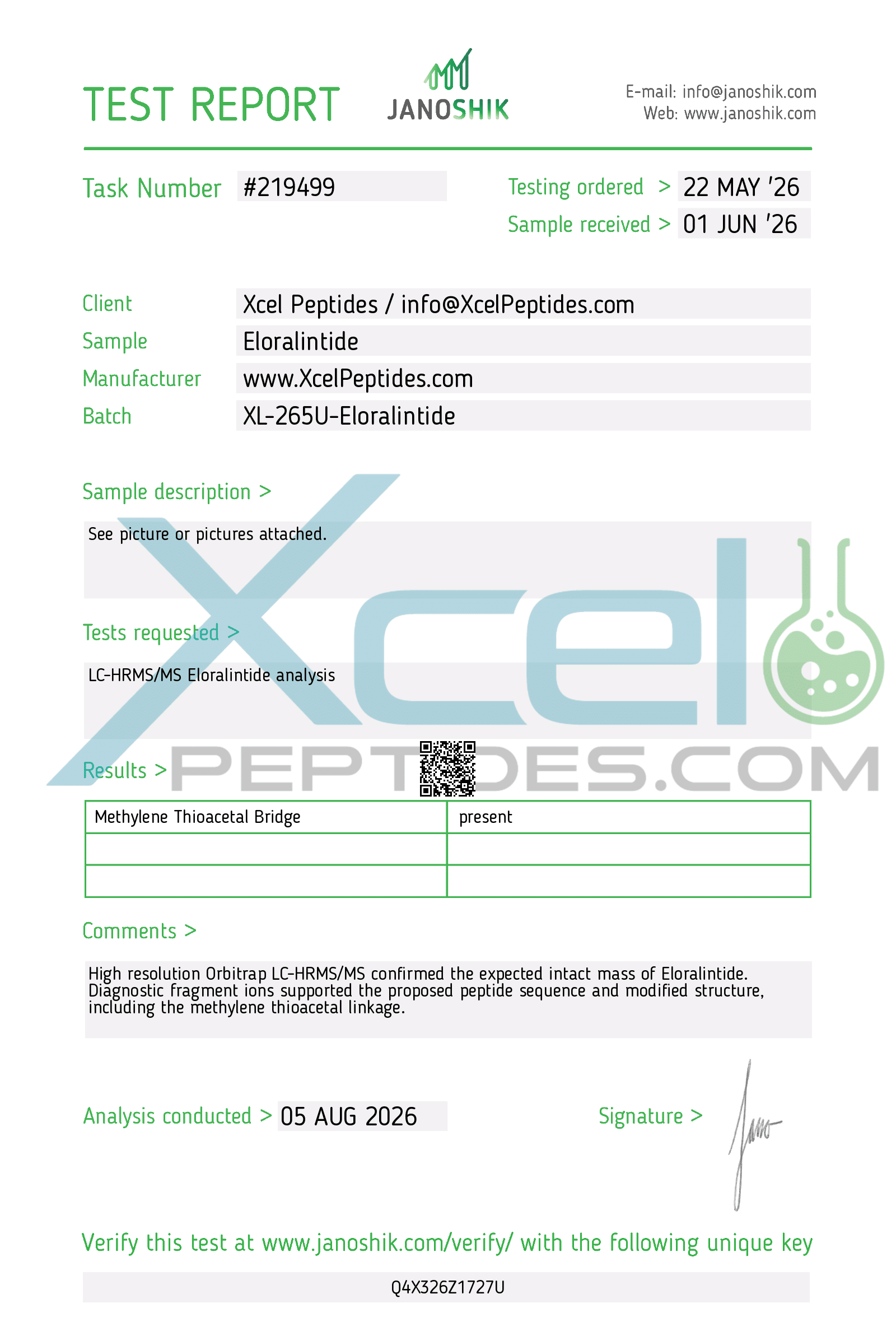
| Chemical Sequence of Amino Acids | {γGlu}-Cys-Asn-Thr-Ala-Thr-Cys-Ala-Thr-Gly-{Orn}-Leu-Ala-Glu-{(α-Me-Phe)}-Leu-Val-Arg-Ser-Ser-Asn-{(N-Me-Asn)}-Phe-Gly-Pro-{Lys(γGlu-γGlu-C20 diacid)}-Leu-Pro-Pro-Thr-Glu-Val-Gly-Ser-Asn-Thr-Tyr-NH2 (Methylene bridge: Cys2-Cys7) |
| CAS Number | 2883634-40-8 |
| Molecular Formula | C201H319N49O65S2 |
| Molecular Weight | 4526.10 |
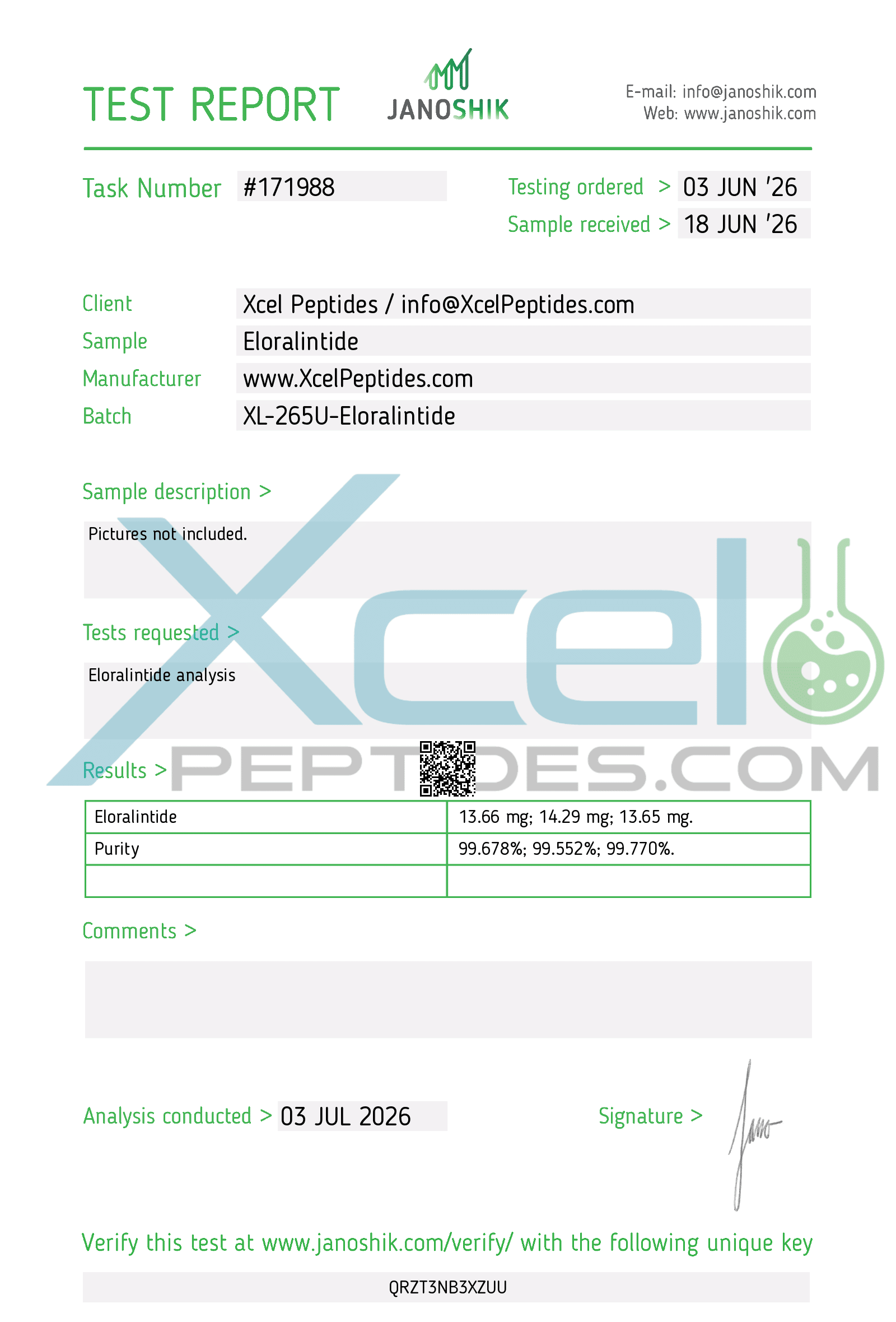
| Purity | ≥99%, verified by independent third-party testing |
| Storage | Store lyophilized at -20°C, protected from light and moisture. Once reconstituted, store at 2-8°C and use within the timeframe indicated in the accompanying documentation. Keep the container tightly sealed. |
| Other Known Titles | LY 3841136, Eloralintide |