
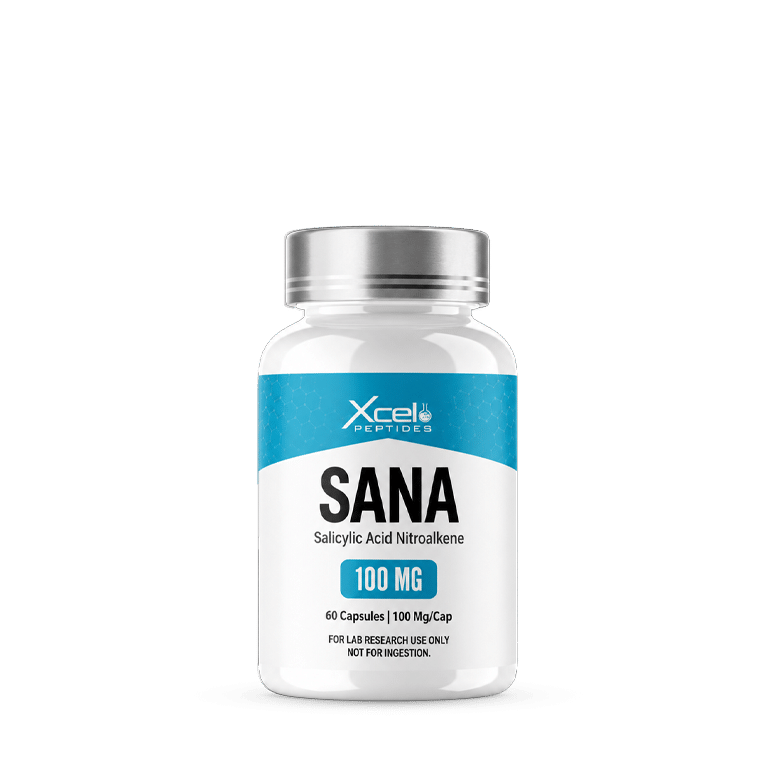


SANA (MVD1) | Salicylic Acid Nitroalkene Research Compound
SANA (MVD1), chemically known as 5-(2-nitroethenyl)salicylic acid, is an investigational small-molecule nitroalkene derivative of salicylate studied in cellular bioenergetics, mitochondrial respiration, and creatine-dependent thermogenesis. SANA is not a peptide; its distinctive chemical scaffold has made it an emerging subject in experimental metabolic pathway research.
In straightforward terms, thermogenesis is the conversion of stored chemical energy into heat. Laboratory scientists investigate this process by measuring oxygen consumption, mitochondrial activity, energy expenditure, and changes in gene expression. SANA provides an additional research reference for exploring these processes in controlled experimental systems.
A 2025 peer-reviewed study published in Nature Metabolism investigated SANA (MVD1) using cultured adipocytes and controlled preclinical murine models. Researchers evaluated mitochondrial respiration, creatine-associated enzymatic activity, adipose tissue bioenergetics, and molecular signaling pathways under defined experimental conditions, including thermoneutral environments.
The findings identified associations with creatine-dependent thermogenic mechanisms, including experimental responses that did not require uncoupling protein 1 (UCP1) activity or AMP-activated protein kinase (AMPK) signaling. These observations provide a scientific foundation for further laboratory investigation of cellular energy pathways, mitochondrial function, and creatine-related biochemical processes.
Research areas described in the literature include:
- Creatine cycling: Experimental assessment of creatine-associated energy turnover and thermogenic signaling.
- CKMT1 and Ckm: Investigation of mitochondrial creatine kinase expression and related enzymatic activity.
- Cellular respiration: Oxygen-consumption analysis in isolated adipocytes and other defined laboratory preparations.
- Adipose-tissue models: Characterization of white and brown adipose tissue responses in published mouse experiments.
- Molecular pathway profiling: Evaluation of UCP1-independent signaling, transcriptional markers, and mitochondrial bioenergetics.
Importantly, observations in intact adipocytes should not be assumed to represent direct uncoupling of isolated mitochondria. That distinction is central to interpreting SANA’s proposed mechanism.
For comparative pathway research, examine ATX-304 (O-304), investigated in AMPK-related models, and 5-Amino-1MQ, studied as a nicotinamide N-methyltransferase (NNMT) inhibitor. These are separate experimental mechanisms, not equivalent compounds or suggested combinations.
Explore the SANA research guide for expanded scientific context.
Summary of Characteristics
| Category | Details |
|---|---|
| Material Type | Synthetic small-molecule β-carboline derivative |
| CAS Number | 42571-07-3 |
| Molecular Formula | C₉H₇NO₅ |
| Molecular Weight | 209.16 g/mol |
| Storage | Store lyophilized at -20°C, protected from light and moisture. Once reconstituted, store at 2-8°C and use within the timeframe indicated in the accompanying documentation. Keep the container tightly sealed. |
| Other Known Titles | SANA, MVD1, 5-(2-Nitroethenyl)salicylic acid, 2-Hydroxy-5-(2-nitroethenyl)benzoic acid, 2-Hydroxy-5-(2-nitrovinyl)benzoic acid, 5-Nitroethenylsalicylic acid, Salicylate Nitroalkenemethyl-9H-pyrido[3,4-b]indole |


