
SANA (MVD1): The Creatine-Driven Thermogenesis Compound Changing the Metabolic Research Conversation
What if the next big question in fat-metabolism research isn't only how much energy enters the body, but how that energy gets spent? Meet SANA, the experimental small molecule putting adipose-tissue thermogenesis under a very bright scientific spotlight.
For years, weight-management research has been dominated by one central idea: reduce energy intake. GLP-1 receptor agonists helped transform that field. But a separate question has been bubbling away in metabolic laboratories: Can researchers influence how much energy fat tissue uses, even without primarily targeting appetite?
SANA, short for salicylic acid nitroalkene and referred to as MVD1 during clinical development, is one of the most interesting compounds emerging from that line of investigation. Its proposed biological route involves creatine-associated energy cycling in adipose tissue, increased mitochondrial respiration, and non-shivering thermogenesis. The most important word here is proposed: this is promising early science, not a proven consumer weight-loss product. Read the original research in Nature Metabolism.
What Is SANA (MVD1), and Why Are Researchers Paying Attention?
SANA is a synthetic nitroalkene derivative of salicylic acid. It is a small molecule, not a peptide. The compound was described in a 2025 research paper by Cal and colleagues investigating metabolic responses in cultured cells, mouse models of diet-induced obesity, and a first-in-human trial.
The idea is intriguing because traditional appetite-focused approaches act largely on signals that influence eating behavior. SANA research instead highlights adipose tissue as an active energy-consuming organ. In animal experiments, the investigators reported higher energy expenditure, changes in fat-cell metabolism, and less body-fat accumulation without a corresponding reduction in measured food intake.
That creates a compelling research question: could changing the cellular machinery that spends energy become a separate avenue of investigation alongside established appetite and metabolic-signaling pathways?
How Does SANA Work? Creatine Cycling, Mitochondria and Non-Shivering Thermogenesis
Most people associate thermogenesis with shivering, sweating, or classic brown-fat biology. The SANA research story is more unusual. The 2025 study describes an increase in energy use that depends on creatine-associated metabolic processes in fat tissue, including pathways that can operate independently of UCP1, a protein central to a well-known form of thermogenesis.
Adipose signaling
Preclinical SANA exposure altered metabolic gene-expression patterns in white and brown adipose tissue.
Creatine-dependent cycling
Changes in creatine metabolism and creatine-kinase-associated activity helped explain the thermogenic response.
Energy expenditure
Mouse experiments showed increased thermogenic activity and energy expenditure, including at thermoneutral temperatures.
Perhaps the most revealing experiments were the mechanistic controls. When researchers depleted creatine, the cold-response effect was abolished. In mice lacking the creatine kinase gene Ckmt1, key SANA-linked responses were impaired. By contrast, deleting UCP1 did not eliminate the compound's observed weight-related effects in the tested mouse model. Together, these findings support a creatine-associated mechanism, rather than proving that SANA simply makes mitochondria leak protons like a classic uncoupler.
Another subtle but important finding: direct application of SANA to isolated mitochondria did not reproduce the same immediate respiratory effect. That supports a more complex cellular or gene-regulatory mechanism. In plain English, researchers are not just looking at a switch that instantly turns up the mitochondrial thermostat.
It's also “How can cells be programmed to expend energy differently?”
One more clarification: “Creatine-dependent” does not mean creatine supplements have been shown to replicate SANA's biological effects. They are different interventions, and the study does not establish any such substitution.
SANA Study Results: What the Mouse Experiments and Human Phase 1 Trial Really Showed
The primary paper, “A nitroalkene derivative of salicylate, SANA, induces creatine-dependent thermogenesis and promotes weight loss,” appeared in Nature Metabolism on June 17, 2025. It combined mechanistic laboratory work and animal research with an early clinical safety study. Those are meaningful data, but they are different levels of evidence and should not be blended into one headline.
- In mouse models: less diet-induced weight and fat-mass gain, changes in adipose-tissue respiration, and improvements in several glucose- and liver-related research markers.
- Mechanistically: evidence for creatine-dependent, UCP1-independent thermogenic activity, including experiments under thermoneutral conditions.
- In a first-in-human phase 1A/B trial: 17 participants were included in a single-dose phase and 24 in a multiple-dose phase. The primary purpose was safety and tolerability.
- Exploratory human findings: researchers reported a reduction in body weight and improvement in some glucose or insulin-resistance measures in a small higher-exposure cohort over the 15-day multiple-dose phase.
Here's the part that deserves a little more attention than the dramatic internet headlines: the phase 1 trial was not designed or powered to establish long-term weight-loss efficacy. In the higher-exposure multiple-dose cohort, the paper reports only six treated participants. Adverse events were also observed, particularly at the highest single exposure studied. A favorable short-term tolerability signal cannot establish long-term safety.
The human experiment also did not establish that SANA can reliably increase energy expenditure, preserve muscle, maintain appetite, or outperform approved obesity medicines in people. Several of those ideas are research hypotheses supported mainly by animal work, not confirmed clinical outcomes.
SANA vs GLP-1 Research: Appetite Regulation Is Not the Same as Thermogenesis
GLP-1 receptor agonism transformed obesity treatment through effects on appetite, satiety, and related metabolic pathways. SANA has drawn attention because it investigates a different piece of the energy-balance equation: energy expenditure within adipose tissue.
That's why SANA should not be described as another GLP-1, a replacement for GLP-1 therapy, or a proven “fat-burning pill.” It is also inaccurate to say that SANA has demonstrated the same effects in humans that researchers observed in mice. A mechanism can be scientifically fascinating long before it is a validated treatment.
Of the compounds compared below, orforglipron now occupies a distinctly different category: the FDA approved it in April 2026 under the brand Foundayo for specified adult weight-management indications. That approval applies to the regulated prescription drug, not to separately supplied research chemicals. See the FDA's April 1, 2026 announcement.
SANA vs ATX-304, SLU-PP-332, Orforglipron, 5-Amino-1MQ, Tesofensine and BAM15
These seven names appear together in metabolic research conversations, but they are not interchangeable. They are associated with different molecular targets, different experimental models, and very different levels of human evidence. Understanding those distinctions is more useful than pretending there is a universal winner.
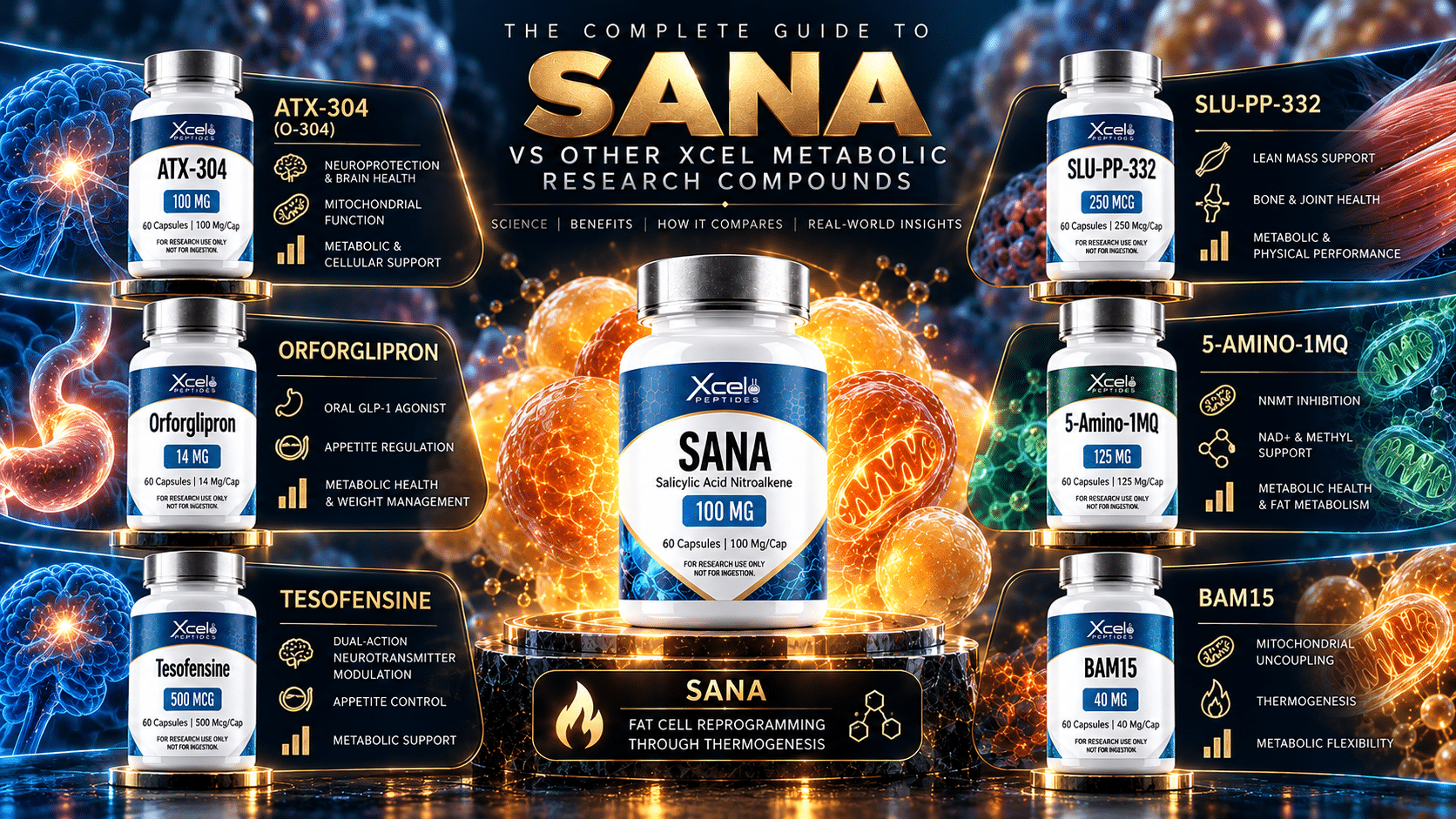
| Compound | Primary pathway studied | Research distinction |
|---|---|---|
| SANA / MVD1 | Creatine-dependent adipose thermogenesis | Preclinical mechanisms plus small phase 1 safety trial; no approved therapy |
| ATX-304 (O-304) | AMPK activation | Cellular energy regulation and liver-lipid pathways; preclinical evidence |
| SLU-PP-332 | ERRα / ERRβ / ERRγ agonism | Exercise-responsive gene programs; predominantly preclinical |
| Orforglipron | GLP-1 receptor agonism | Substantial human clinical evidence; FDA-approved prescription medicine |
| 5-Amino-1MQ | NNMT enzyme inhibition | Nicotinamide and methylation-linked metabolism; mainly preclinical |
| Tesofensine | Serotonin / norepinephrine / dopamine reuptake inhibition | Central monoamine signaling; published human phase 2 obesity data |
| BAM15 | Mitochondrial protonophore uncoupling | Energy-expenditure experiments in cells and animals; distinct from SANA |
ATX-304 (O-304)
Think cellular energy sensing, not appetite suppression. ATX-304 is studied as an AMPK activator. A 2025 JCI Insight paper reported changes in liver metabolic programming, fatty-acid oxidation, and steatosis-related outcomes in mice. Unlike SANA's creatine-related thermogenesis, the central research interest here is AMPK-linked metabolic regulation.
SLU-PP-332
The exercise-mimetic research lane. SLU-PP-332 is a synthetic agonist of the estrogen-related receptors ERRα, ERRβ, and ERRγ. In cell and mouse research, it has influenced oxidative muscle-fiber programming and endurance-associated pathways. That is not the same as directly replicating exercise in humans or demonstrating long-term muscle preservation.
Orforglipron
The important clinical comparator. Orforglipron is an oral, non-peptide GLP-1 receptor agonist. Its regulated pharmaceutical form, Foundayo, received U.S. FDA approval in 2026. That makes the clinical evidence and regulatory status fundamentally different from SANA's early-stage development story.
5-Amino-1MQ
A different metabolic-enzyme question. 5-Amino-1MQ is investigated as an inhibitor of nicotinamide N-methyltransferase (NNMT). Studies in diet-induced obese mice have reported changes in fat mass, glucose-related outcomes, and liver metabolic measures. It does not act through SANA's proposed creatine-dependent thermogenesis mechanism.
Tesofensine
The central-nervous-system pathway. Tesofensine inhibits reuptake of three monoamines: noradrenaline, dopamine, and serotonin. Its published human phase 2 obesity study is a much more direct clinical weight-related dataset than exists for many experimental metabolic probes, but its mechanism and adverse-effect considerations are very different from SANA's.
BAM15
The closest energy-expenditure comparison, but not the same mechanism. BAM15 is studied as a mitochondrial protonophore uncoupler. In animal experiments, investigators have reported changes in energy expenditure and metabolic markers. SANA, by contrast, is linked to a creatine-associated cellular mechanism and should not be described as simply another BAM15.
What Is Still Unknown About SANA?
It's easy to get excited about first-in-class biology. It's harder, and more valuable, to identify what must happen before researchers can draw reliable conclusions. These are the questions that should drive the next studies:
- Clinical duration: Are metabolic effects durable beyond an early, closely monitored 15-day trial?
- Direct human physiology: Can investigators demonstrate changes in human energy expenditure and adipose-tissue thermogenesis with validated measurements?
- Body composition: How do fat mass, lean mass, and weight change in appropriately powered human studies?
- Safety: What happens with longer exposure, broader populations, comorbidities, and other medicines?
- Mechanistic specificity: Which tissues and creatine-related enzymes are essential to the human response?
- Comparative effectiveness: How would SANA perform against existing care in a proper randomized clinical trial?
And no, a Reddit report of a warm sensation or a rapidly changing scale does not answer those questions. Community discussion is useful for discovering what people are curious about. It is not a substitute for validated identity testing, controlled experiments, or clinical evidence.
SANA Frequently Asked Questions
What does SANA stand for?
SANA refers to salicylic acid nitroalkene, a synthetic nitroalkene-containing salicylate derivative. It was called MVD1 during the first-in-human clinical development program discussed in the 2025 paper.
Is SANA a peptide or a GLP-1?
No. SANA is a small-molecule compound, not a peptide, and its investigated mechanism is not GLP-1 receptor agonism. Research primarily concerns adipose-tissue bioenergetics and creatine-dependent thermogenesis.
Does SANA burn fat without reducing appetite?
Mouse experiments reported metabolic and body-composition effects without a comparable reduction in food intake. This does not prove an appetite-independent weight-loss effect in humans, and SANA has not been established as a human fat-loss treatment.
Did SANA work in human trials?
A small phase 1A/B study reported exploratory short-term weight and metabolic signals, while its primary purpose was safety and tolerability. Larger and longer trials are required before reliable therapeutic efficacy or long-term safety conclusions can be drawn.
Is SANA the same as BAM15?
No. BAM15 is studied as a mitochondrial protonophore uncoupler. SANA research instead implicates creatine-related processes and altered adipose-tissue respiration. Related metabolic interests do not make the compounds mechanistically equivalent.
Does SANA require UCP1 or AMPK?
The reported preclinical weight- and glucose-related effects persisted in experimental models designed to test UCP1 and AMPK independence. Creatine-associated machinery was more central to the demonstrated thermogenic response. These are experimental findings, not a fully validated human mechanism.
Can SANA be combined with 5-Amino-1MQ, BAM15, or GLP-1 drugs?
There is no established human safety or efficacy evidence supporting such combinations. Online stacking anecdotes and theoretical pathway diagrams are not clinical interaction studies. This educational article provides no combination or human-use recommendations.
Is SANA FDA-approved, and are research capsules intended for ingestion?
SANA is not FDA-approved for therapeutic use. Laboratory research materials are not medicines, dietary supplements, or substitutes for regulated pharmaceutical products and are not intended for human or animal ingestion.
SANA Research Sources and Community Discussion
For a topic this new, source quality is everything. Below, original studies and regulatory sources are separated from media and community discussion so readers can tell the difference between published data and speculation.
Primary and scientific sources
- Cal K. et al. (2025), Nature Metabolism: SANA, creatine-dependent thermogenesis and weight-related findings. DOI: 10.1038/s42255-025-01311-z.
- Holm E. et al. (2025), JCI Insight: ATX-304 and AMPK-associated metabolic switching.
- SLU-PP-332 and ERR-associated exercise-response research.
- U.S. FDA (April 1, 2026): Foundayo (orforglipron) approval.
- NNMT inhibition and 5A1MQ in diet-induced obese mice.
- Tesofensine: randomized phase 2 obesity study.
- BAM15: mitochondrial uncoupling and obesity-related mouse studies.
Reporting and community discussions (not clinical evidence)
Different pathways. Better research questions.
Explore Xcel's gated catalog of laboratory reference materials and continue comparing the science behind metabolic signaling, mitochondrial biology and cellular energy use.
Research-use-only notice: This article is an educational overview of published science, not medical advice, a product recommendation for human use, or a statement that research chemicals are safe or effective for any condition. Xcel Peptides research materials are for qualified laboratory research only, not for human or veterinary use, ingestion, diagnosis or treatment. The presence of a product in this article does not establish equivalence to any compound studied in a clinical trial or to an FDA-approved drug. Study findings may change as new evidence emerges. Last editorial review: October 21, 2026.