
UBT251 Research Update: Two Phase 2 Papers, 19.7% Weight Loss, and the Compound 3 Question
Two new peer-reviewed papers. Two different study populations. One increasingly important triple-agonist research program. UBT251, also known by Novo Nordisk's development code NN9559, is no longer a compound supported only by conference slides and company announcements. In October 2026, Cell Metabolism published Phase 2 results in adults with overweight or obesity and a separate Phase 2 report in adults with type 2 diabetes.
The headline results are substantial. In the obesity study, the largest reported mean weight reduction was 19.7% at 24 weeks, compared with 2.0% for placebo. In the diabetes study, mean weight reduction reached 9.8%, compared with 4.8% for semaglutide 1 mg and 1.4% for placebo. But the studies answer different questions, and the fine print is where the science gets interesting.
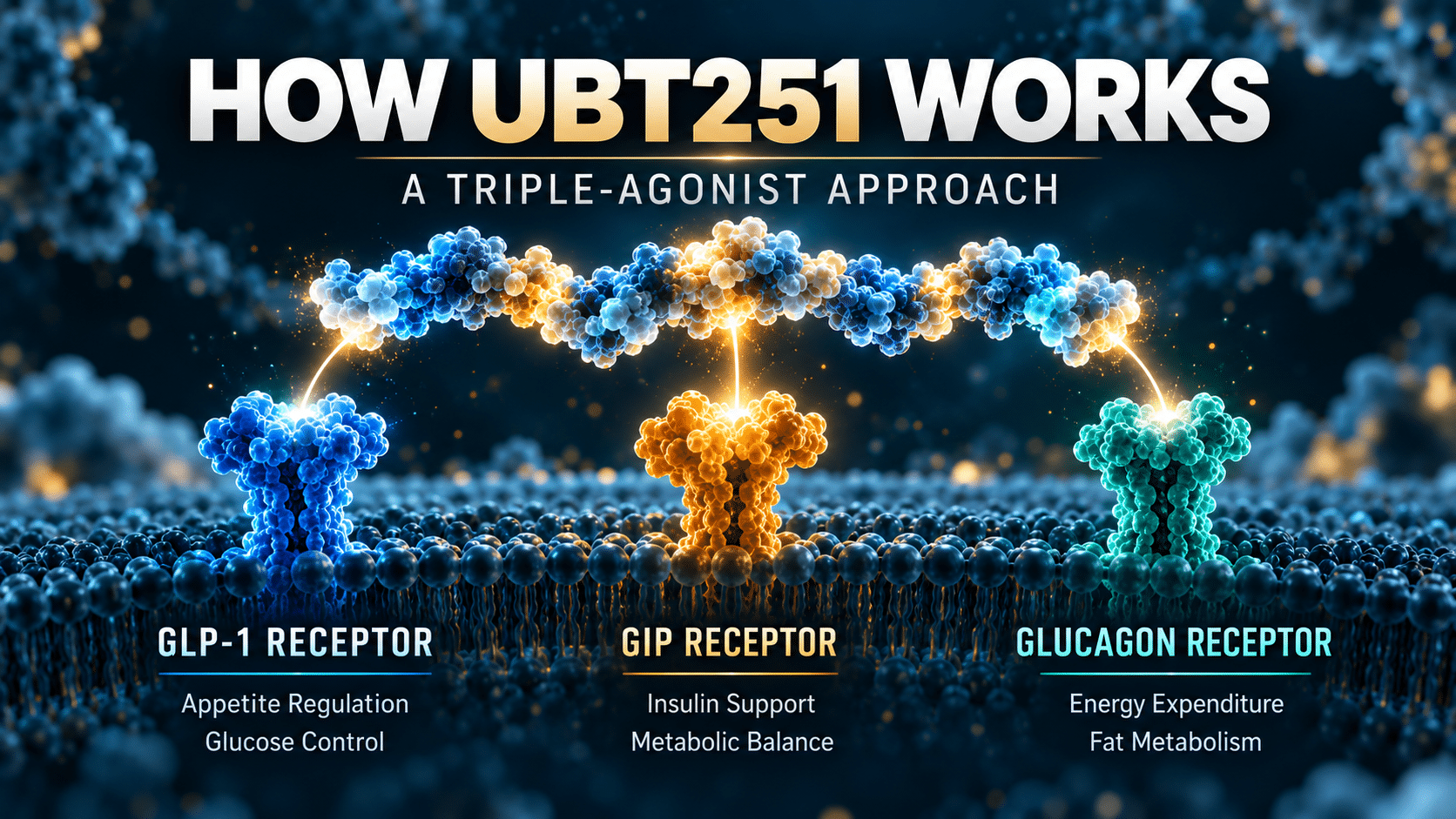
At a glance: UBT251 acts at three receptor targets: GLP-1, GIP and glucagon. The October 8 obesity paper studied 205 adults without type 2 diabetes. The October 26 diabetes paper studied 211 adults with type 2 diabetes. Both lasted 24 weeks. Neither establishes long-term outcomes or direct superiority over retatrutide.
Different study populations. Do not directly compare their percentages.
What is UBT251, and why does the third receptor matter?
UBT251 is an investigational peptide agonist designed to activate the receptors for glucagon-like peptide-1 (GLP-1), glucose-dependent insulinotropic polypeptide (GIP), and glucagon (GCG). It is being developed by United Biotechnology and Novo Nordisk. Novo holds development and commercialization rights outside Greater China, while United Biotechnology retains those rights in Greater China.
GLP-1 and GIP receptor signaling are familiar parts of the modern metabolic-research landscape. Adding glucagon-receptor activity creates a more complicated three-way design: researchers are investigating whether its potential contributions to energy expenditure and metabolism can complement incretin effects while maintaining acceptable glucose control and tolerability. The presence of three receptor targets does not, by itself, establish a superior drug. Receptor balance, exposure, pharmacokinetics, and clinical results matter more than the number three.
Study one: up to 19.7% mean weight loss in the obesity Phase 2 trial
The October 8, 2026 Cell Metabolism paper reported a randomized, double-blind, placebo-controlled Phase 2 study in 205 adults in China with overweight or obesity who did not have type 2 diabetes. Over 24 weeks, the UBT251 groups showed least-squares mean body-weight reductions ranging from 13.6% to 19.7%, versus 2.0% with placebo. The largest placebo-adjusted difference was 17.7 percentage points.
This matters for two reasons. First, the findings were reported in a peer-reviewed journal, with study design and statistical methods available for scrutiny. Second, the range across study groups reinforces the importance of individual dose regimens and trial methods. The 19.7% figure is the largest reported least-squares group mean, not a prediction for every participant or a proven long-term plateau.
Researchers also reported favorable changes in several cardiometabolic measurements. Gastrointestinal symptoms were the most common adverse events, generally described as mild to moderate during the study. A 24-week Phase 2 trial cannot rule out uncommon or longer-term risks.
Read the obesity Phase 2 paper on PubMed.
Study two: the semaglutide comparison is more interesting than the headline
A separate Cell Metabolism paper published October 26, 2026 studied 211 Chinese adults with type 2 diabetes over 24 weeks. Unlike the obesity study, it included an active comparison group receiving semaglutide 1 mg, as well as placebo.
| Outcome at week 24 | UBT251 groups | Semaglutide 1 mg | Placebo |
|---|---|---|---|
| Mean weight change | −7.8% to −9.8% | −4.8% | −1.4% |
| HbA1c change (percentage points) | −1.98 to −2.16 | −1.77 | −0.66 |
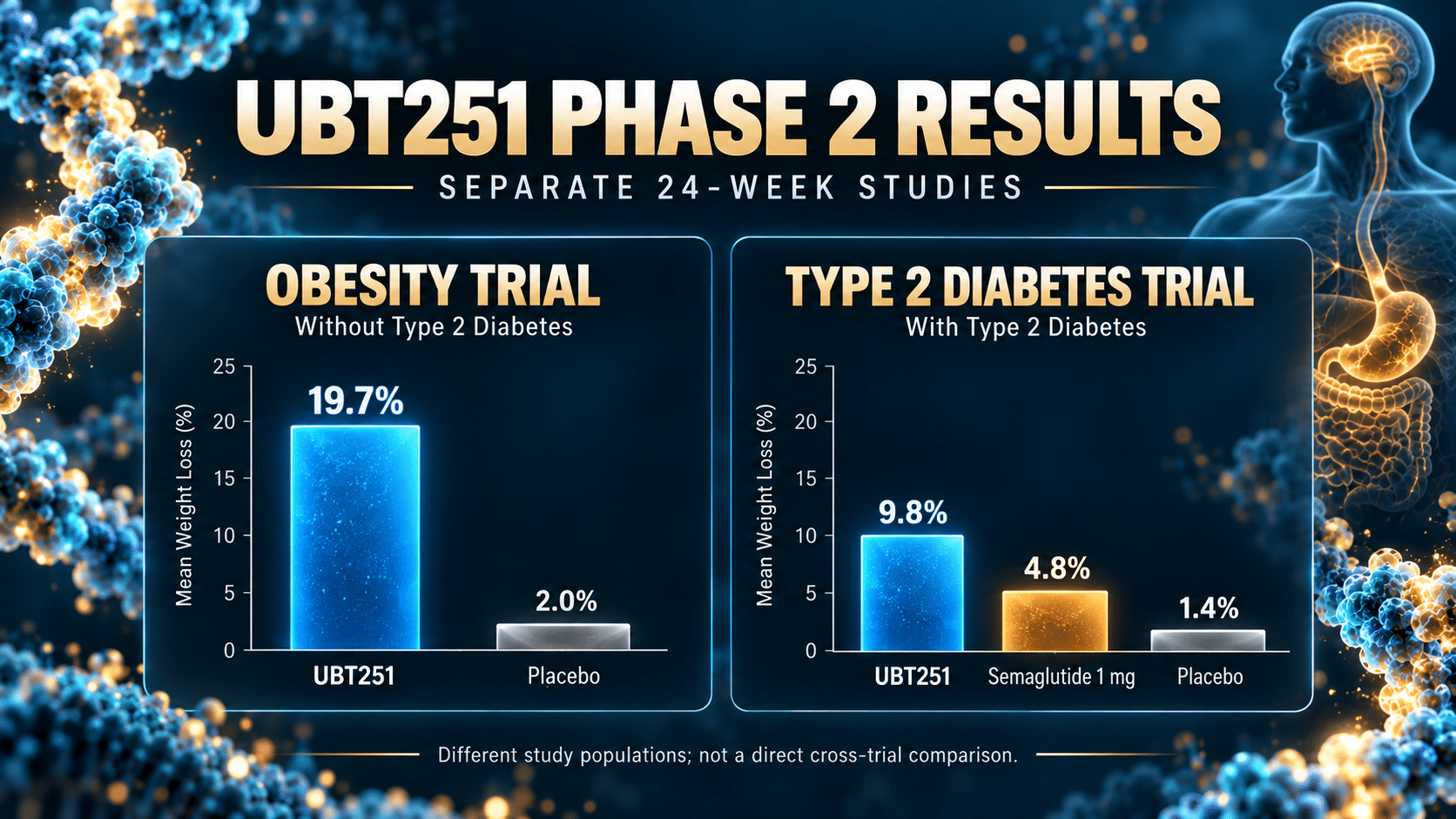
What the comparison supports: The published abstract reports statistically greater weight reduction with UBT251 than semaglutide 1 mg in this trial. For HbA1c, it reports statistically significant differences versus placebo, but does not specify which UBT251 arms differed significantly from semaglutide. Numerically larger changes alone do not establish statistical superiority.
That distinction is essential. Numerically larger is not always statistically established as better, and success on body-weight reduction does not automatically mean superiority on every glycemic endpoint. Also, this study did not compare UBT251 against semaglutide 2.4 mg, tirzepatide, or retatrutide.
Read the diabetes Phase 2 paper, or view its PubMed record and abstract.
UBT251 versus retatrutide: same receptor families, not the same molecule
For background on this comparison, see our earlier UBT251 versus retatrutide triple-agonist research overview. The present article focuses on the newer October 2026 Phase 2 publications.
UBT251 and retatrutide are both investigational triple agonists targeting GLP-1, GIP, and glucagon receptors. That does not make them chemically interchangeable. They have separate clinical development programs. Any precise comparison of their sequences, molecular modifications, receptor activity or exposure requires verified primary evidence.
More importantly, there has been no direct randomized head-to-head UBT251-versus-retatrutide trial establishing which compound performs better. Comparing a 24-week average from one trial with a result from a different population, at a different dose and time point, is a useful hypothesis generator, not a scientific winner's podium.
Another question becoming more important as weight-loss effects increase is body composition. A scale records total mass, not how much loss comes from adipose tissue versus lean tissue. For additional research context, see our GLP-1 muscle-preservation and fat-loss review and the independent PeptideBlog overview of the weight-loss/muscle paradox.
The molecular-identity question: what is Patent Compound 3?
A separate scientific detective story surrounds UBT251's structure. United Biotechnology's published patent application, US20250129135A1, contains a collection of numbered peptide candidates. Compound 3 is especially prominent in the patent's experimental examples and has a reported theoretical molecular weight of approximately 4,986.62 Da.
Laboratory identification is a separate question: A reported theoretical mass can support a structural hypothesis but cannot, by itself, distinguish every modified sequence or confirm that a patent example was used in a clinical program. Analytical identity, material purity and actual peptide content also require different evidence. The research peptide testing guide explains these distinctions. The patent-to-UBT251 mapping should remain provisional until a primary source makes it explicit.
An independent October 2026 analysis has argued that the structural information published with the obesity Phase 2 paper matches Patent Compound 3. That is an important lead. But the clinical papers do not explicitly identify UBT251 using the patent's “Compound 3” label, and we have not independently completed a residue-by-residue check of the original supplementary structure. For that reason, this article treats the mapping as a reported structural match requiring primary-source verification, not as a conclusively authenticated identity.
For analytical chemistry, there is a second distinction that matters just as much: identifying a patented structure is not the same as proving what is inside a particular vial. HPLC purity alone does not establish peptide sequence, modified-residue placement, stereochemistry, or full molecular identity.
Explore the United Biotechnology patent.
Research catalog reference: For Xcel's separate catalog information, see the UBT251 triple-agonist research reference listing. The clinical results summarized here describe the investigational clinical molecule and do not, by themselves, establish the analytical identity or equivalence of any separately supplied reference material.
What happens next in the UBT251 research program?
United Laboratories reported first-participant dosing in its China Phase 3 obesity and type 2 diabetes programs in September 2026. Separately, Novo Nordisk is pursuing a global development program, including a registered Phase 2 dose-finding study in type 2 diabetes under protocol NN9559-8577. In its third-quarter 2026 presentation, Novo said it expects to initiate Phase 3 weight-management research around mid-2027. That is a company projection, not a completed trial or approval. For a separate account of the clinical studies and registry links, see Eloralintide Research’s UBT251 development overview.
The questions future studies need to resolve are straightforward but consequential:
- Durability: What happens beyond 24 weeks, including when weight change begins to plateau?
- Comparative efficacy: How does UBT251 perform in properly controlled comparisons with other advanced incretin programs?
- Safety and tolerability: What do larger and longer exposures reveal about gastrointestinal effects, discontinuation rates and rarer adverse events?
- Body composition: What proportion of the observed weight change is fat mass versus lean mass?
- Molecular identification: Can published primary structural documentation and independent analytical testing conclusively establish identity for research reference materials?
Frequently asked questions
Is UBT251 the same as retatrutide?
No. Both investigate activation of GLP-1, GIP and glucagon receptors, but they are separate investigational molecules. Shared receptor targets do not establish matching structures or interchangeable effects.
Has UBT251 been approved by the FDA?
No. As of November 1, 2026, UBT251 remains investigational. Published clinical findings and trial registrations are not regulatory approval.
Does the 19.7% number mean UBT251 beats semaglutide or retatrutide?
No. The 19.7% result came from the obesity Phase 2 trial versus placebo. The separate diabetes trial did include semaglutide 1 mg and found greater weight reduction with UBT251 in that particular population. Neither trial establishes superiority over retatrutide or all semaglutide regimens.
Bottom line
The most meaningful UBT251 development in October 2026 was not a newly invented molecule or an overnight efficacy breakthrough. It was the arrival of two peer-reviewed Phase 2 reports that allow deeper evaluation of an already promising triple-agonist program. The obesity findings were substantial, the diabetes findings included a meaningful active comparator, and the progression into larger studies creates a path to more reliable answers.
The science is advancing. The evidence still has boundaries. A serious research publication should show both.
Primary research and source documents
- Zhou Z, et al. Obesity Phase 2 trial. Cell Metabolism, published October 8, 2026. PMID 42843337; DOI: 10.1016/j.cmet.2026.09.021.
- Zhou Z, et al. Type 2 diabetes Phase 2 trial. Cell Metabolism, published October 26, 2026. Journal article; DOI: 10.1016/j.cmet.2026.10.010.
- United Laboratories research and development updates, September 2026.
- Novo Nordisk global Phase 2 diabetes study, protocol NN9559-8577.
- US20250129135A1, Multi-Agonist and Use Thereof.