
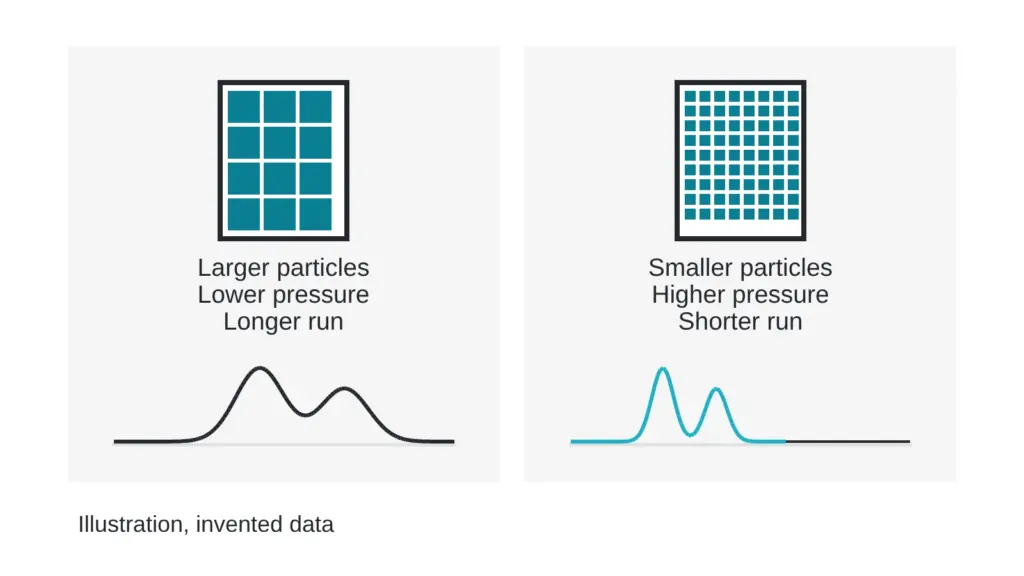
Two laboratories receive portions of the same lot. One runs a 40 minute method on a conventional HPLC system, and the other runs a 15 minute method on a UHPLC system. The first reports an area-percent purity of 92.1 and the second reports 90.4. Both numbers are invented, and both laboratories are doing honest work. The difference comes from what changed between the two instruments, and what did not.
This article covers particle size, pressure, speed and resolution, then explains why two laboratories can still disagree. Terms are defined in the The testing glossary: 14 lab terms in plain English.
What do HPLC and UHPLC share?
Both are forms of liquid chromatography. A pump pushes a liquid, the mobile phase, through a column packed with solid particles. The sample is loaded into that stream, its components stick to the particles to different degrees, and they leave the column at different times. A detector, often ultraviolet absorbance, records each one as a peak.
The separation chemistry is the same in kind. A reversed-phase column holds molecules by their water-repelling surfaces whether the particles are large or small. The detector, the mobile phase ingredients and the way peaks are integrated are also familiar. UHPLC is a refinement of the same technique, with better mechanics.
What changes: particle size, pressure and speed
The technique itself is old. A review aimed at beginners notes that HPLC was introduced in the early 1960s to improve separation efficiency by using small stationary phase particles, and that UHPLC later raised the level again, with significant increases in resolution, speed and sensitivity (Kota and Stolowitz, 2016).
The central change is the particle. Smaller particles shorten the distance a molecule has to travel to reach a binding site and return, which engineers call mass transfer. When mass transfer is fast, peaks stay narrow, and narrow peaks mean the column can separate close neighbors in less time.
The cost is pressure. Packing a column with small particles makes it harder for liquid to pass, so the pump has to push harder.
| Feature | Conventional HPLC | UHPLC |
|---|---|---|
| Typical particle size | Roughly 3 to 5 micrometers | Below 2 micrometers (or core-shell near 2.7) |
| Operating pressure | A few hundred bar | Higher, up to about 1000 bar or more |
| Peak width | Broader | Narrower |
| Typical run time | Longer | Shorter |
| Solvent per run | More | Less |
The ranges in the table are typical values that vary by manufacturer and column.
Published work describes the trade directly. In a study of chiral separations, columns packed with sub-2 micrometer fully porous or 2.7 micrometer superficially porous particles outperformed a 5 micrometer benchmark in speed and efficiency, and the main driver of the gain was a tenfold lower mass transfer resistance (Schmitt et al., 2018).
Smaller particles sharpen the picture. They do not change what is in the vial.
Narrow peaks bring a new sensitivity to plumbing. Tubing, connectors and detector cell volume that barely mattered on a conventional system can blur a UHPLC peak before it is recorded, so the instrument around the column matters more as particles shrink. The theoretical paper cited below names this extra-column dispersion as a limit on narrow columns (Wen et al., 2026).
Resolution, and a caution on pressure
Resolution is how cleanly two neighboring peaks separate. Narrower peaks can pull apart a main component and a close-running impurity that a broader run blends together. A faster run can therefore reveal a shoulder that an older run counted as part of the main peak, and it can lower the reported purity of the same material. That fits the invented example above.
The chiral study also found that 2.7 micrometer superficially porous particles, which have a solid core, gave much lower backpressure, so they can be used without a UHPLC instrument (Schmitt et al., 2018). Smaller is therefore one route to speed, and particle design is another.
Pressure has limits. A theoretical paper on sub-micrometer particles for peptides and proteins describes a ceiling too: lower permeability restricts column length at current pressure limits of 1500 bar, viscous heating calls for narrower columns, and narrower columns are more sensitive to dispersion outside the column itself (Wen et al., 2026).
Why can two laboratories still disagree?
Even two UHPLC laboratories can disagree. The variables that decide an area-percent number are many.
- Column chemistry and batch, since two columns labeled alike can separate differently
- Gradient shape and mobile phase additives
- Detection wavelength
- Integration choices for shoulders and small peaks
- System volume between pump, column and detector, which smears peaks differently on different instruments
- Sample preparation and how long the sample sat
A method moved from a conventional instrument to a faster one has to be adjusted, not copied. Gradient timing, flow and sample volume are scaled with column dimensions, and a validated method should be validated again for the new setting; see Method validation in plain English: a number is only as good as its method. The full set of reasons purity numbers diverge is in Same material, two purity numbers: why labs disagree.
What a sharper chromatogram still cannot say
A narrower peak does not tell you what the peak is. Identity needs mass or another independent measurement, and content needs a measurement of water and counterions. CHNS, liquid chromatography or LC-MS: which test answers which question? sorts those questions, and What a UHPLC purity number actually measures, and what it skips shows what a purity line actually counts.
Quick check you can do today
Look at the method line of a purity report and write down four things: the instrument type, the column particle size, the run time and the detection wavelength. Then compare them with another report on a similar material. If two of the four differ, a difference in purity values between the two reports is not a surprise.
Sources
- Kota U, Stolowitz ML. Advances in Experimental Medicine and Biology, 2016, volume 919, pages 83-143. PubMed ID 27975214. DOI 10.1007/978-3-319-41448-5_5. Descriptor: beginner-oriented review of liquid chromatography modes, including the move to ultra-high-pressure systems.
- Schmitt K, Woiwode U, Kohout M, Zhang T, Lindner W, Lämmerhofer M. Journal of Chromatography A, 2018, volume 1569, pages 149-159. PubMed ID 30041874. DOI 10.1016/j.chroma.2018.07.056. Descriptor: comparison of small fully porous and superficially porous particles in ultra-high-pressure liquid chromatography, with efficiency and speed analysis.
- Wen H, Broeckhoven K, Eeltink S. Journal of Chromatography A, 2026, volume 1785, article 467310. PubMed ID 42541921. DOI 10.1016/j.chroma.2026.467310. Descriptor: theoretical framework on sub-micrometer particle columns for peptides and proteins, covering pressure, permeability and dispersion limits.
Want the catalog? Register free