
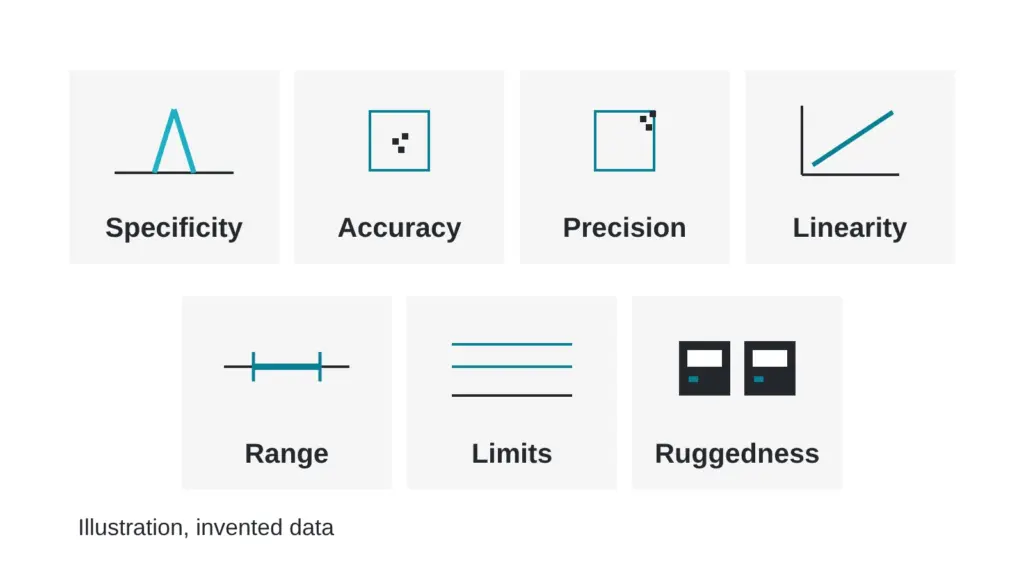
A report says the method was validated. That sentence is true for thousands of methods, and it tells you less than it seems to. Validated for which material? Across which range? Against which impurities? Method validation is a set of specific questions with specific answers, and each answer can be read on the page when the laboratory shows it.
This article walks through seven checks in plain words, with an invented example table so you can see what each one looks like. Terms are defined in the The testing glossary: 14 lab terms in plain English.
What is validation trying to prove?
Validation shows that a method is fit for its stated purpose. The purpose matters because a method built to measure a main component well can be poor at counting trace impurities. A validation belongs to a method, a type of material and a purpose, and moving any of the three weakens it.
Guidance frameworks exist for this, and they keep changing. A case study by regulatory scientists notes that the finalized ICH Q14 guideline on analytical procedure development has pushed laboratories toward enhanced approaches such as analytical quality by design. It then walks through applying those principles to a mass spectrometry procedure, with an analytical target profile, knowledge management and risk assessment, and an evaluation of how the procedure tolerates small changes, following the ICH Q2(R2) validation guideline and Q14 (Zhang et al., 2024). The practical meaning is that the best validations start by writing down what the method must be able to do.
The seven checks, with invented numbers
All values below are invented for teaching.
| Check | The question it answers | Invented example |
|---|---|---|
| Specificity | Does the signal belong to the target and nothing else? | A blank sample shows no peak at the target’s retention time |
| Accuracy | How close is the measured value to the true value? | 40.0 spiked, 39.3 found, a difference of minus 1.8 percent |
| Precision | How tightly do repeat measurements cluster? | Six repeat runs give a relative spread of 1.2 percent |
| Linearity | Does the signal rise in step with the amount? | Five levels from 10 to 80, residuals within plus or minus 2 percent |
| Range | Between which amounts are the above checks all met? | 10 to 80 |
| Limits | What is the smallest amount that can be seen, and counted? | Detection at 0.5, quantitation at 1.5 |
| Ruggedness | Do different analysts, days and instruments agree? | Two analysts on two days differ by 1.8 percent |
The units in the invented table are micrograms per milliliter for the amounts, and every number is made up.
Reading each check
Specificity is the check most often skipped in a casual reading. It asks whether anything else in the sample could produce the same signal. For purity work, the question is whether a chemically similar impurity can hide under the main peak; see CHNS, liquid chromatography or LC-MS: which test answers which question? for why one method rarely answers every question.
Accuracy needs a reference. Laboratories add a known amount and measure how much they find, or they compare against a material of known value. Reference standards exist for exactly this purpose, and a review of peptide reference standards notes that many analytical tests depend on well-characterized standards to determine identity, purity and strength (McCarthy et al., 2023). A method can be tight and wrong at the same time, which is why precision and accuracy are listed separately. Picture darts: a cluster in one corner of the board is precise and inaccurate.
Precision comes in layers. Repeatability means the same analyst, same day and same instrument. Intermediate precision means different days or analysts in one laboratory.
Linearity and range go together. A method can be linear between 10 and 80 and curve off outside that. Reporting an amount outside the validated range means extrapolating beyond what was shown.
Limits matter for impurities. If an impurity sits below the quantitation limit, the method can say it is present, or possibly absent, but it cannot give a trustworthy number.
Ruggedness tests how much the numbers move when conditions shift a little: a different analyst, a different instrument, a different day, or a small change in column temperature or solvent mix. A method that survives these changes is easier to transfer to another laboratory.
Validation in practice
Published validations tend to report these same checks together. A single-laboratory validation of a UHPLC and tandem mass spectrometry method for a group of natural toxins reported specificity, linearity, limits of detection and quantitation, amounts found after spiking known quantities, precision, within-laboratory reproducibility and a formal ruggedness analysis in a single paper (Turner et al., 2018).
A validation covers the measurement and leaves out the steps before it. Sampling, weighing, handling and sample preparation sit outside most validation tables, and they can move a value too. That is one more reason a moisture reading or a weighed portion deserves its own scrutiny; see CHNS, liquid chromatography or LC-MS: which test answers which question?.
Validation also does not end at the first approval. Method conditions, instruments and columns change, which is one reason two laboratories running a validated method can still report different numbers; HPLC vs UHPLC: what actually changes on the bench shows how, and What a UHPLC purity number actually measures, and what it skips explains what the purity line is made of.
Quick check you can do today
Take one report and find the method section. Ask five things:
- Is a validation referred to, and for what type of material?
- What is the validated range, and does the reported value sit inside it?
- What is the quantitation limit, and is it below the impurity level you care about?
- Was ruggedness tested across analysts or instruments?
- Does the laboratory state the guideline it followed?
Any blank belongs on a question list for the laboratory; The questions a good testing lab answers without flinching has more.
Sources
- McCarthy D, Han Y, Carrick K, Schmidt D, Workman W, Matejtschuk P, Duru C, Atouf F. Pharmaceutical Research, 2023, volume 40(6), pages 1317-1328. PubMed ID 36949371. DOI 10.1007/s11095-023-03493-1. Descriptor: peptide reference standards, value assignment by mass balance, vialing and stability studies.
- Zhang J, Raghavachari R, Kirkpatrick DC, Keire DA, Xu X, Faustino PJ. Journal of Pharmaceutical Sciences, 2024, volume 113(10), pages 3028-3033. PubMed ID 39111548. DOI 10.1016/j.xphs.2024.07.022. Descriptor: case study applying ICH Q14 and Q2(R2) principles to a mass spectrometry procedure, with an analytical target profile and risk assessment.
- Turner AD, Waack J, Lewis A, Edwards C, Lawton L. Journal of Chromatography B, 2018, volumes 1074-1075, pages 111-123. PubMed ID 29358154. DOI 10.1016/j.jchromb.2017.12.032. Descriptor: single-laboratory validation of a UHPLC and tandem mass spectrometry method for a group of natural toxins in several sample types.
Want the catalog? Register free