
A retraction notice is a short document, often a single paragraph, and the paragraph tends to follow a pattern. First comes the concern. Then the editors ask the authors for the underlying data. Then comes the sentence that decides everything: the data did not arrive, did not match, or did not explain the concern.
This article reads four such notices published in 2024 and 2025 and sorts what they say by type. Only one names chromatograms directly. The other three concern spectra and raw data, and the same logic carries over. No journals, authors or materials are named. The aim is practical. The same logic applies to anyone who relies on a laboratory report, because a report makes a claim in the same way a paper does. Terms are in the The testing glossary: 14 lab terms in plain English.
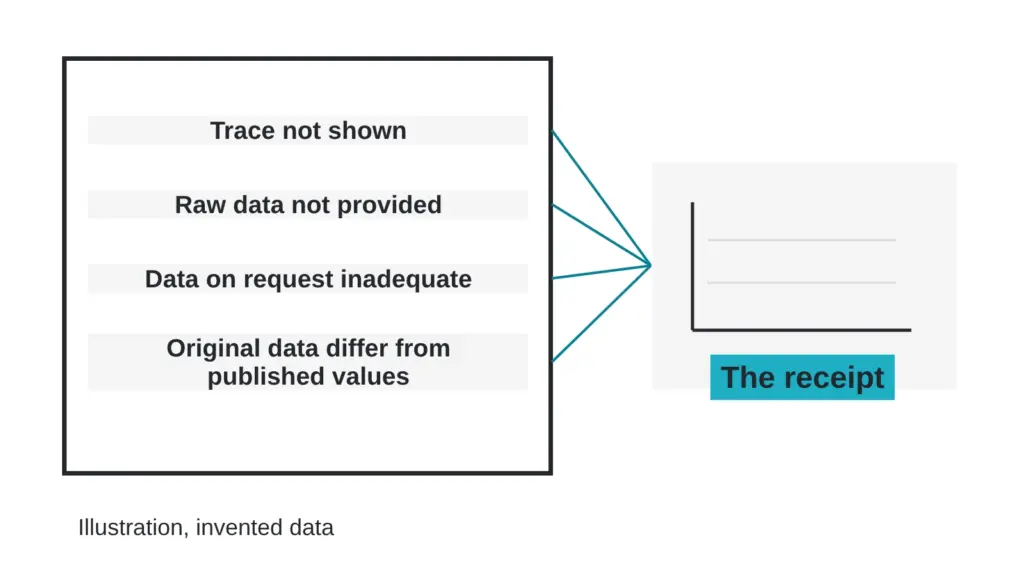
A chromatogram is the receipt for a purity claim.
What the notices say, by type
The method was claimed and the trace was missing. A 2024 notice for a biomedical paper faulted a loading efficiency measured by liquid chromatography. The notice says the figure was not supported by appropriate analytical validation, naming calibration, detection and quantitation limits, and accuracy checks, and that the paper lacked chromatograms to verify identity and purity. The same notice lists other problems, including figures that did not match the paper’s stated topic, so the chromatography was one reason among several (PubMed ID 39278452).
Raw data was requested and the explanation fell short. A 2025 notice for a materials-chemistry paper states that the corresponding author could not give a suitable explanation for concerns about two kinds of spectra. According to the notice, the original data supplied included an image with a spot cropped in from another image, the spectra showed inconsistencies, and raw data for one spectroscopic technique was not provided (PubMed ID 39843278).
Data supplied on request was inadequate. A 2024 notice for a nanoparticle paper reports that third parties flagged irregularities in spectra in two panels, and that the data the corresponding author provided on request was inadequate to address the concerns. The editors judged the conclusions invalid (PubMed ID 39034738).
The original data disagreed with the published values. A 2025 notice for a life-science paper states that, when the publisher asked for original data, it found duplicated data points that were not adequately explained and values that did not match those in the published article. The authors did not supply original images for some experiments for verification. The editors cited the discrepancy between published and original data, together with duplicated images (PubMed ID 40396621).
Several of the notices list other concerns as well. What they share is the moment when a file was requested and the answer failed to settle the question.
What editors reached for
| Claim in a paper | What the editors asked for | What the notice reports |
|---|---|---|
| A method measures a quantity | Calibration, detection and quantitation limits, an accuracy check | Not supported by appropriate validation (39278452) |
| A sample is the right material, at the right purity | The chromatogram itself | Chromatograms lacking (39278452) |
| A spectrum shows what the text says | The raw data files behind the figure | Raw data not provided (39843278) |
| A published value matches its data | Original data from the authors | Inadequate data on request (39034738); original data differed from the published values (40396621) |
Notices are written after trouble starts, so the table shows what editors fall back on when a claim wobbles. Author instructions differ from journal to journal, and this article does not survey them.
Why the trace carries so much weight
Editors cannot rerun an experiment. They can ask for the file. A chromatogram shows the baseline, the shape of every peak, the integration marks and the scale, which makes it the one place where a purity or identity claim can be audited and not merely believed. A summary table of peak areas hides all of that.
With the trace in hand, an editor or reviewer can check in minutes that the main peak sits where the method says it should, that the integration looks sensible, and that the share of area matches the stated figure. Without the trace, none of those checks exists. The claim stands on trust alone, and trust is the thing a retraction notice says has run out.
What this means for a reader of a lab report
A report is a claim. The chromatogram behind it is the evidence. CHNS, liquid chromatography or LC-MS: which test answers which question? explains which kind of test answers which kind of question, and Is that lab report real? Six checks that take minutes and How forged lab reports get caught: the checks a careful reader runs walk through the layers of checking.
The practical rule is the editor’s rule: ask for the trace, the method settings and the native data file. A laboratory that can produce them quickly is behaving the way a careful author does. Nobody will retract a report, so a reader is the only editor that claim will ever have.
A fair word about missing files
A missing file raises a question. It does not answer one. Files get lost, instruments get replaced, and a repeat run is sometimes the honest fix. The notices above describe cases where the explanation was also found wanting, with phrases such as “unable to provide a suitable explanation”, “inadequate” and “not adequately explained”. A prompt, specific answer settles most questions long before anyone writes a notice.
Quick check you can do today
Take one report or paper you rely on and answer four questions with yes or no. Does it show the trace itself, and not only a table? Are the axes labeled and the scale readable? Are the method settings listed? Do you know how to request the native data file? Count the yeses. Anything under four is a question to send, and The questions a good testing lab answers without flinching has the wording.
Sources
- PubMed ID 39278452, 2024. Descriptor: retraction notice for a biomedical journal article, citing mismatched figures and a chromatography-based claim lacking validation and chromatograms.
- PubMed ID 39843278, 2025. Descriptor: retraction notice for a materials-chemistry article, citing spectral inconsistencies and raw data not provided.
- PubMed ID 39034738, 2024. Descriptor: retraction notice for a nanoparticle article, citing irregular spectra and inadequate data supplied on request.
- PubMed ID 40396621, 2025. Descriptor: retraction notice for a life-science article, citing original data that did not match published values, duplicated data points and duplicated images.
Want the catalog? Register free