
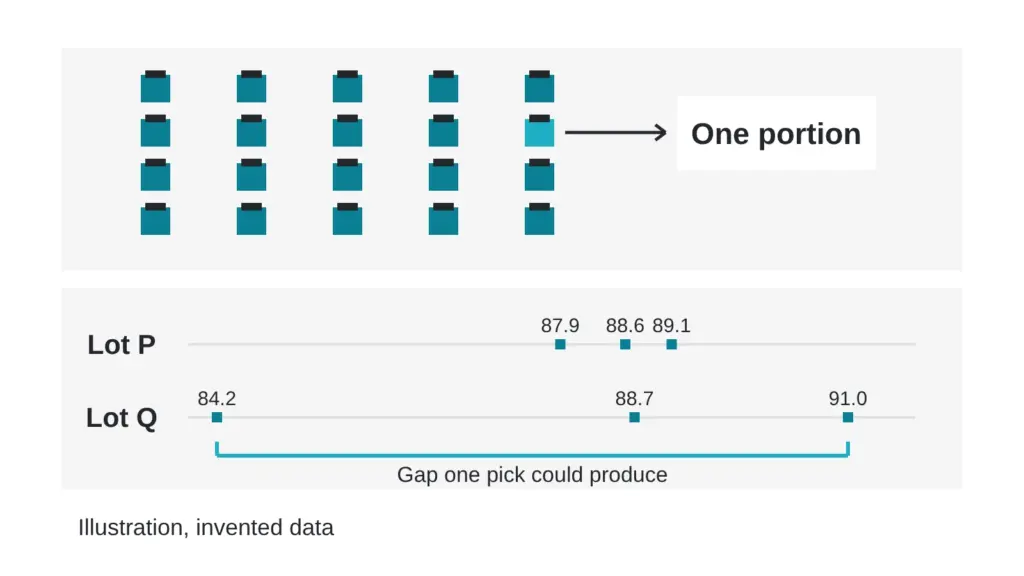
A report arrives for a lot of 200 vials. The lot size is invented, and so is everything else in this scene. The analyst weighed out one portion, ran it, and printed a number. You are holding vial 117. Does the report describe your vial?
It describes the portion that was tested. Whether it also describes vial 117 depends on how the portion was chosen, how uniform the lot is, and whether anyone measured that uniformity. This article covers what a representative sample means, why vials from one lot can differ, and which test designs can support which claims. It uses general chemistry only. Terms are in the The testing glossary: 14 lab terms in plain English.
One test is a photograph. A lot is a film.
What does “representative” have to mean?
A representative sample is drawn so that every part of the lot had a fair chance of being picked, and so that what lands in the analyst’s hands carries the average makeup of the whole. Grabbing the vial nearest the door fails the first half. Taking the top layer of a powder that settled during transport fails the second.
A report can say “tested” with perfect honesty and still leave the reader guessing how the portion was chosen. That choice is part of the method, and it belongs on the page.
Why vials from one lot can differ
Uniform in the plan does not guarantee uniform in the vial. A mapping study of freeze-dried vials, which measured the headspace of every vial in several runs, reported that residual water can be affected by container location, shelf contact, radiative heating and packing density (Cook and Ward, 2011). Vials from one run therefore sit in slightly different conditions while they dry.
People who make reference standards treat that spread as something to measure. A report on peptide reference standards describes testing to confirm consistency of the vialed material and discusses variability and outliers (McCarthy et al., 2023). A food-matrix reference material study reported a relative standard deviation of 1.2 percent among units in its homogeneity study (Lee et al., 2023). A third reference-material paper evaluated the margin contributed by value assignment, by inhomogeneity and by instability as separate pieces (PubMed ID 42421351). Well-made material can be uniform, and the way anyone knows is a homogeneity study, not an assumption.
An invented pair of lots
Test three vials from each of two invented lots.
| Lot | Vial 1 | Vial 2 | Vial 3 | Mean | Spread (highest minus lowest) |
|---|---|---|---|---|---|
| P | 88.6 | 87.9 | 89.1 | 88.5 | 1.2 |
| Q | 91.0 | 84.2 | 88.7 | 88.0 | 6.8 |
The two lots share almost the same mean. A single test of lot P could land anywhere from 87.9 to 89.1 and tell a fair story either way. A single test of lot Q could land on 91.0 or on 84.2, and both are real measurements of real vials. A reader who sees only one of those numbers has no way to learn which lot they are in.
Replicates and vials answer different questions
Many reports print several measurements, which sounds reassuring until you ask what was repeated.
| What was repeated | What it can support | What it cannot support |
|---|---|---|
| Several runs of one prepared solution | Repeatability of the instrument run | Anything about weighing, other portions or other vials |
| Several portions weighed from one vial | Repeatability of the whole method on that vial | Vial-to-vial spread |
| One portion from each of several vials | A first look at spread between vials | A firm estimate when only three or four vials are used |
| One pooled composite from many vials | An average for the lot | Any spread, because pooling averages it away |
Only the third and fourth rows touch the lot at all, and only the third shows spread.
How many vials is enough?
No universal count exists. The honest answer depends on the spread you find. A lot that behaves like P needs fewer vials to describe than a lot that behaves like Q. What a report can do is state its sampling plan: how many vials, how they were drawn, whether they were tested separately, and what spread appeared. A plan that is stated can be judged. A plan that is missing cannot.
Myth versus reality
Myth: one batch, one test, and the number applies to every vial. Reality: one test describes one portion, and it describes the lot only to the extent the sampling and the homogeneity evidence support the jump.
Quick check you can do today
Look at a report you hold and answer five questions. How many vials were tested? How were they chosen? Were the measurements repeats of one vial or separate vials? Is any spread between vials shown? Does the lot identifier match the one on your container? Each blank answer is one question to send to the laboratory: “Please state how many vials were tested, how they were selected, and the spread between them.” For why vials of one lot can look different even when the contents match, see Same batch, different-looking vials: why dry samples vary.
Sources
- Cook IA, Ward KR. PDA Journal of Pharmaceutical Science and Technology, 2011, volume 65(5), pages 457-467. PubMed ID 22293835. DOI 10.5731/pdajpst.2011.00760. Descriptor: moisture-mapping study of freeze-dried vials using headspace measurements.
- McCarthy D, Han Y, Carrick K, Schmidt D, Workman W, Matejtschuk P, Duru C, Atouf F. Pharmaceutical Research, 2023, volume 40(6), pages 1317-1328. PubMed ID 36949371. DOI 10.1007/s11095-023-03493-1. Descriptor: report on producing and characterizing reference standards for synthetic peptides, including content uniformity and consistency of the vialed material.
- Lee S, Baek SY, Han J, Lee J. Analytical and Bioanalytical Chemistry, 2023, volume 415(19), pages 4805-4812. PubMed ID 37269307. DOI 10.1007/s00216-023-04779-4. Descriptor: development of a certified reference material in a food matrix, with a homogeneity study across units.
- PubMed ID 42421351, Se Pu (Chinese Journal of Chromatography), 2026, volume 44(7), pages 785-794. DOI 10.3724/SP.J.1123.2025.10031. Descriptor: value-assignment paper for a purity reference material that evaluated the margin from value assignment, inhomogeneity and instability.
Want the catalog? Register free