

Retzoundi.
Retkouro.
And the Names Nobody’s Talking About.
Nine pharmaceutical trademark applications. One filing date. Multiple names still being protected. The internet thinks it has figured out Eli Lilly’s next big brand identity. The actual records tell a more complicated story.
Original conceptual molecular artwork. Not official Eli Lilly branding or drug packaging.
Somebody spotted two unusual names in Eli Lilly’s trademark records, and the internet immediately connected the dots: Retzoundi and Retkouro must be the future brand names for retatrutide. Maybe. But the deeper you investigate, the more interesting this gets.
Because those two names are not standing alone. Lilly filed a broader collection of prospective pharmaceutical names on April 23, 2024. Among the names appearing in the same group are Senmounto, Emwilzy, Retkaytu, Orfyzent, Valmounry, Zenmounto and Xbountri.
Some of these applications have continued through the trademark process. At least one was abandoned. And several received additional time in October 2026.
So what exactly is Lilly doing? Is this a future retatrutide branding strategy, a collection of backup names for different medicines, or simply routine pharmaceutical trademark housekeeping?
We followed the filings, separated the facts from the theories, and found that the story deserves a much closer look.
Eli Lilly owns the applications for these proposed pharmaceutical names. That is documented. What is not documented is which drug each name is intended for. An application does not establish a commercial product, regulatory approval, or a launch date.
Why Retzoundi and Retkouro Suddenly Have Everyone’s Attention
The theory is easy to understand.
Retatrutide is Eli Lilly’s investigational triple-receptor agonist targeting GIP, GLP-1 and glucagon receptors. It remains in development, and if approved for marketing, the medicine would need an accepted commercial identity.
Meanwhile, the company has trademark applications for two unusual names that begin with “Ret”: Retzoundi and Retkouro.
That resemblance has fueled speculation that Lilly might be preparing two distinct brand identities for retatrutide, perhaps for different therapeutic indications.
The theory also draws on Lilly’s existing commercial approach with tirzepatide, marketed under the names Mounjaro and Zepbound for different approved uses.
Put those pieces together and you’ve got a plausible branding hypothesis.
But plausible is not the same thing as proven.
Neither the Retzoundi nor the Retkouro trademark record names retatrutide. The records also do not assign either proposed brand to a particular indication.
The names may eventually become connected to retatrutide. They may not. And the existence of several other applications makes the simple two-name narrative less certain than it initially appears.
The Bigger Discovery: Nine Lilly Names in the Same Filing Group
Here’s where the investigation gets considerably more interesting.
A wider examination of the April 23, 2024 trademark filings reveals at least nine pharmaceutical names submitted by Eli Lilly in the same filing group.
These are not names invented on social media. They appear in public trademark records with their own application serial numbers.
Nine identified Eli Lilly applications filed April 23, 2024. Click a name to inspect its USPTO record. This is an identified group of filings, not a claim that these were the only applications Lilly submitted that day. Current legal status must be checked individually.
Notice something?
Retkaytu also begins with “Ret.” Senmounto and Zenmounto share another naming pattern, while Xbountri evokes yet another familiar style.
That doesn’t establish any connection to a specific medicine. But it does show why selecting just two applications and declaring the mystery solved is premature.
Lilly appears to have assembled a collection of prospective pharmaceutical names, not simply filed a pair of obvious retatrutide labels.
The applications use broad pharmaceutical descriptions, covering multiple therapeutic categories. These descriptions do not identify an active ingredient, development code or particular product.
And that’s the central limitation of the entire naming theory.
That doesn’t mean it plans to launch nine drugs. Trademark protection is a naming option, not a product announcement.
The October 2026 Trademark Activity: What Actually Changed?
The original filings were submitted in April 2024. That part of the story is more than two years old.
The fresher development is what Lilly has continued doing with certain applications.
Public USPTO records reviewed on October 28, 2026 show that Retzoundi, Retkouro and Senmounto remain live applications. Each received a fourth extension of time to file a Statement of Use during October 2026.
| Name | USPTO Serial | Status as of Oct. 28, 2026 | Relevant Action |
|---|---|---|---|
| RETZOUNDI | 98515533 | LIVE | Fourth extension granted Oct. 13, 2026 |
| RETKOURO | 98515518 | LIVE | Fourth extension granted Oct. 6, 2026 |
| SENMOUNTO | 98515527 | LIVE | Fourth extension granted Oct. 13, 2026 |
| EMWILZY | 98515512 | ABANDONED | Express abandonment filed Oct. 8, 2024 |
This table describes the four applications examined in detail in the original PeptideBlog trademark investigation . It does not classify the current status of all nine identified names.
The broader filing group matters, and there is additional extension activity. For example, public records for Zenmounto also report a fourth extension granted on October 6, 2026.
In other words, the preservation of prospective names extends beyond just the two names generating the most online conversation.
What exactly is a fourth extension?
These applications were filed on an intent-to-use basis.
That process allows a company to seek trademark protection before actually using a proposed name in commerce.
After the USPTO issues a Notice of Allowance, the applicant generally has six months to demonstrate use of the mark or request additional time.
The USPTO permits up to five six-month extension requests, subject to its rules.
A fourth extension keeps additional time available to file the required Statement of Use. An extension alone does not establish whether a Statement of Use has been filed: the USPTO also permits an insurance extension in certain circumstances when a Statement of Use is filed.
It does not mean a medicine has been approved, a commercial launch is scheduled, or the company has identified the drug behind the name.
Read the USPTO’s official intent-to-use explanation for the legal mechanics.
What the Naming Patterns Might Tell Us About Lilly’s Strategy
Pharmaceutical branding isn’t simply a creative department dreaming up something that sounds good on a television commercial.
A potential name must be distinctive, legally protectable and suitable for regulatory review.
The FDA also evaluates proposed proprietary drug names for possible medication errors, including confusion caused by similar spelling or pronunciation.
That creates a practical reason to maintain alternative candidates. Even a name that looks commercially attractive might not ultimately be used.
A company may protect several potential names while it evaluates which ones to pursue commercially.
Distinct brands can sometimes be used for one active ingredient marketed for different approved uses. Lilly has done this with tirzepatide.
Similar-sounding proposed names might relate to entirely separate development programs. A shared filing date cannot resolve that question.
Could Retzoundi be the obesity brand and Retkouro the diabetes brand?
It’s one possibility suggested in online discussions.
The theory imagines a dual-brand approach similar in concept to Lilly’s existing Zepbound and Mounjaro model.
But there is no verified trademark-to-indication assignment.
The USPTO records do not say Retzoundi is for obesity, Retkouro is for diabetes, or that either one is intended for retatrutide.
The additional names are another reason to resist that conclusion.
The most useful way to describe the theory is: possible commercial naming candidates, with no confirmed product assignment.
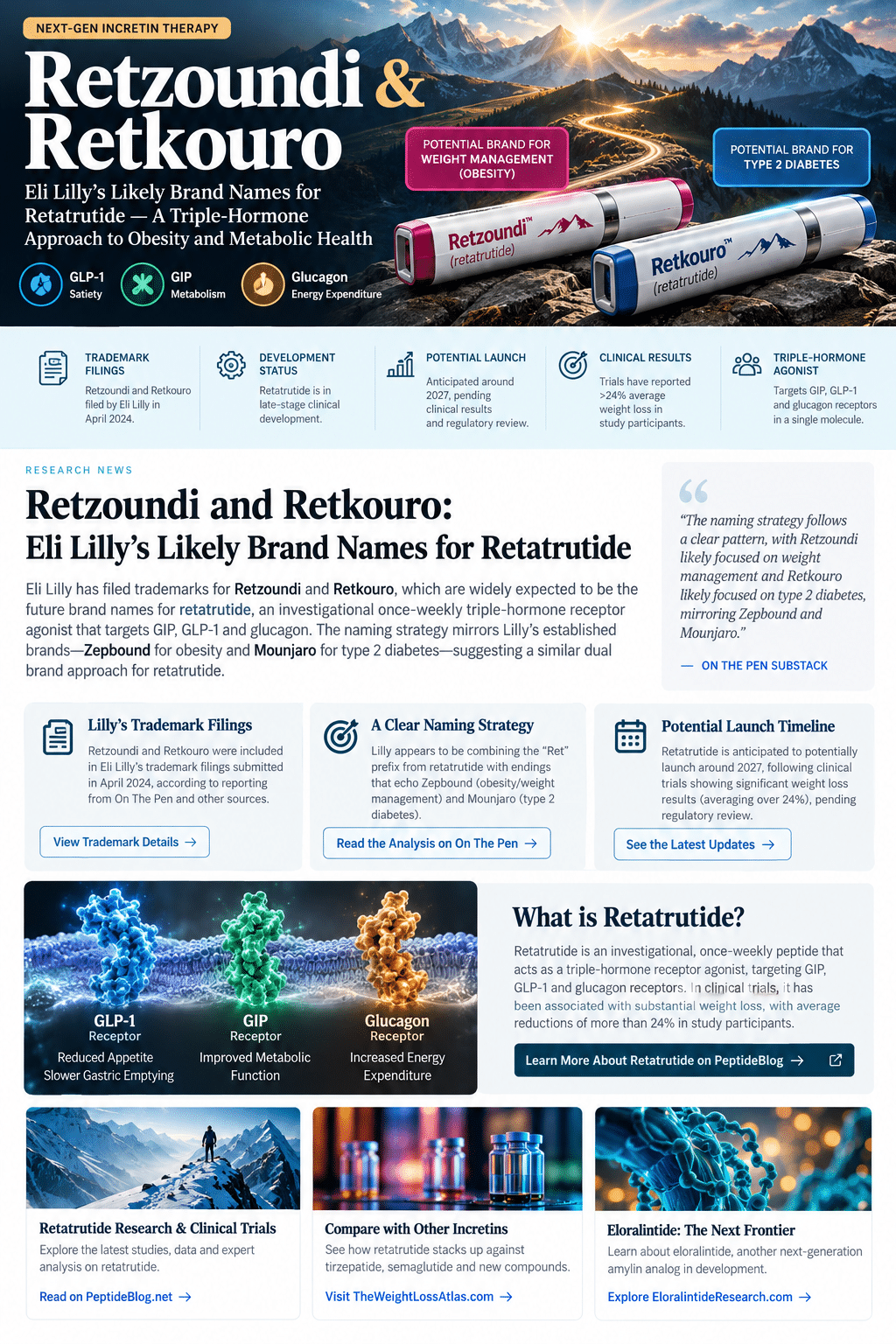
Explore the hypothetical Retzoundi and Retkouro brand concept
Why an Abandoned Name Matters Just as Much as a Live One
Emwilzy provides a useful reality check.
Lilly filed the name on the same day as Retzoundi, Retkouro and Senmounto.
Yet the application was expressly abandoned in October 2024.
The record does not provide a confirmed explanation for the decision.
The point isn’t that Emwilzy was necessarily intended for the same molecule. We don’t know that.
The point is that a trademark filing can disappear from consideration without becoming a commercial product.
A live application means a company is still maintaining a legal path toward a name. It does not mean that the name is the final winner.
This is exactly why trademark speculation must be distinguished from confirmed product information.
Retatrutide: The Scientific Connection in One Minute

Why Retatrutide Enters the Conversation
Retatrutide, also known as LY3437943, is an investigational Lilly compound that acts on GIP, GLP-1 and glucagon receptors.
Its development has generated considerable scientific and commercial interest. That helps explain why observers are searching for possible future brand names.
But there is no established connection between any particular trademark in this investigation and retatrutide.
For the clinical evidence, see the Retatrutide research profile .
The Real Clues to Watch Next
If one of these names eventually
becomes an official commercial
identity, the meaningful evidence
will be more concrete than
a social media theory.
Important distinction for readers: A USPTO extension is a procedural trademark event. It does not identify which compound will carry a name, establish that the name has received FDA proprietary-name review, or indicate that an investigational product has been approved. A defensible identification would connect a company announcement, the relevant trademark record and official product documentation. See the separate retatrutide approval-status explainer before treating a trademark theory as a launch announcement.
Direct confirmation identifying a proprietary name and the medicine it represents.
A filing demonstrating qualifying commercial use of a particular name. It may offer more context but should still be interpreted alongside official product records.
Additional extensions, registration activity or abandonment can show which naming options remain under pursuit.
Official FDA information identifying an approved medicine and its proprietary name would be decisive.
One further detail matters: the FDA reviews proposed proprietary names separately from the trademark-registration process.
A name can therefore appear promising in a trademark database without ever reaching an approved prescription label.
See the FDA’s proprietary drug-naming guidance .
What This Really Tells Us About the Brand-Name Mystery
The search for Retzoundi and Retkouro began as a two-name puzzle.
But the wider record reveals a group of at least nine proposed names sharing a filing date, several applications still being maintained, and others following different paths.
That is more meaningful than treating a single name resemblance as proof of a future product.
The case for a retatrutide connection is plausible. The proof is still missing.
The names have not been assigned to a particular investigational compound in the public evidence discussed here.
Their future use remains an open question.
And until Lilly or an appropriate regulator identifies a specific product, the responsible conclusion is that these are trademark candidates, not confirmed drug brands.
Retzoundi and Retkouro: Frequently Asked Questions
Is Retzoundi the official brand name for retatrutide?
No confirmed connection has been established. Retzoundi is a pharmaceutical trademark application filed by Eli Lilly on April 23, 2024. The application does not identify retatrutide.
What is Retkouro?
Retkouro is another proposed pharmaceutical name filed by Eli Lilly on April 23, 2024. Its USPTO serial number is 98515518. Its intended medicine has not been established in the reviewed public records.
What is Senmounto?
Senmounto is another Lilly pharmaceutical trademark application, serial number 98515527. It remains live as of the October 2026 trademark review and received a fourth extension in October.
What is Retkaytu?
Retkaytu is a separate Lilly pharmaceutical trademark application filed April 23, 2024, under serial number 98515516. Its similar opening syllable does not establish a connection to retatrutide.
Why are there so many Lilly trademark names?
Pharmaceutical companies may file multiple prospective names for commercial planning and legal protection. Some are ultimately used, while others are abandoned or remain unused. These records do not reveal Lilly’s internal naming strategy.
What happened to Emwilzy?
Lilly filed Emwilzy in April 2024 and expressly abandoned the application in October 2024. The public status record does not establish the reason.
Did Lilly extend the Retzoundi and Retkouro trademarks?
Yes. The USPTO records reviewed October 28, 2026 show fourth extensions granted in October 2026. These are extensions of time to demonstrate trademark use, not product approvals or commercial launch dates.
When will Lilly announce a retatrutide brand name?
No confirmed announcement date has been established in the sources reviewed. A pharmaceutical company can consider names long before obtaining approval, and final naming remains subject to applicable review.
Explore the Related Research
For readers who want to go deeper, these independent research resources cover different parts of the story.
Final Analysis: The Name Game Is Far From Over
Retzoundi and Retkouro are real Eli Lilly trademark applications. That much is settled.
What isn’t settled is which medicines they will represent, whether they will ever be marketed, or whether either one has anything to do with retatrutide.
Our broader review identified additional Lilly pharmaceutical names from the same filing date, making the narrative more complex than a two-brand theory.
The filings give researchers a trail to follow, not a product identity to announce.
The next meaningful evidence will come from Lilly’s own communications, new trademark documents, and regulatory records.
Until then, the names are intriguing, the records are public, and the mystery remains unsolved.
Primary Sources and Documents
- RETZOUNDI, USPTO serial 98515533 . U.S. Patent and Trademark Office.
- RETKOURO, USPTO serial 98515518 . U.S. Patent and Trademark Office.
- SENMOUNTO, USPTO serial 98515527 . U.S. Patent and Trademark Office.
- EMWILZY, USPTO serial 98515512 . U.S. Patent and Trademark Office.
- April 23, 2024 trademark filing group, serial numbers 98515500-98515599 . Justia public trademark index; includes the additional Lilly names identified in this investigation.
- ZENMOUNTO, serial 98515531 . Public filing history and October 2026 extension information.
- Trademark applications: intent-to-use basis . U.S. Patent and Trademark Office.
- Best Practices in Developing Proprietary Names for Human Prescription Drug Products . U.S. Food and Drug Administration.
- Retzoundi and Retkouro: What Lilly’s Trademark Filings Show . PeptideBlog, October 28, 2026.