
CBL-514 Research: Can It Reduce Visceral Fat? Clinical Results, Tesamorelin Comparison & Risks
A closer look at the investigational fat-cell apoptosis drug, what human trials actually show, and why localized belly-fat reduction is not the same as proven visceral-fat treatment.
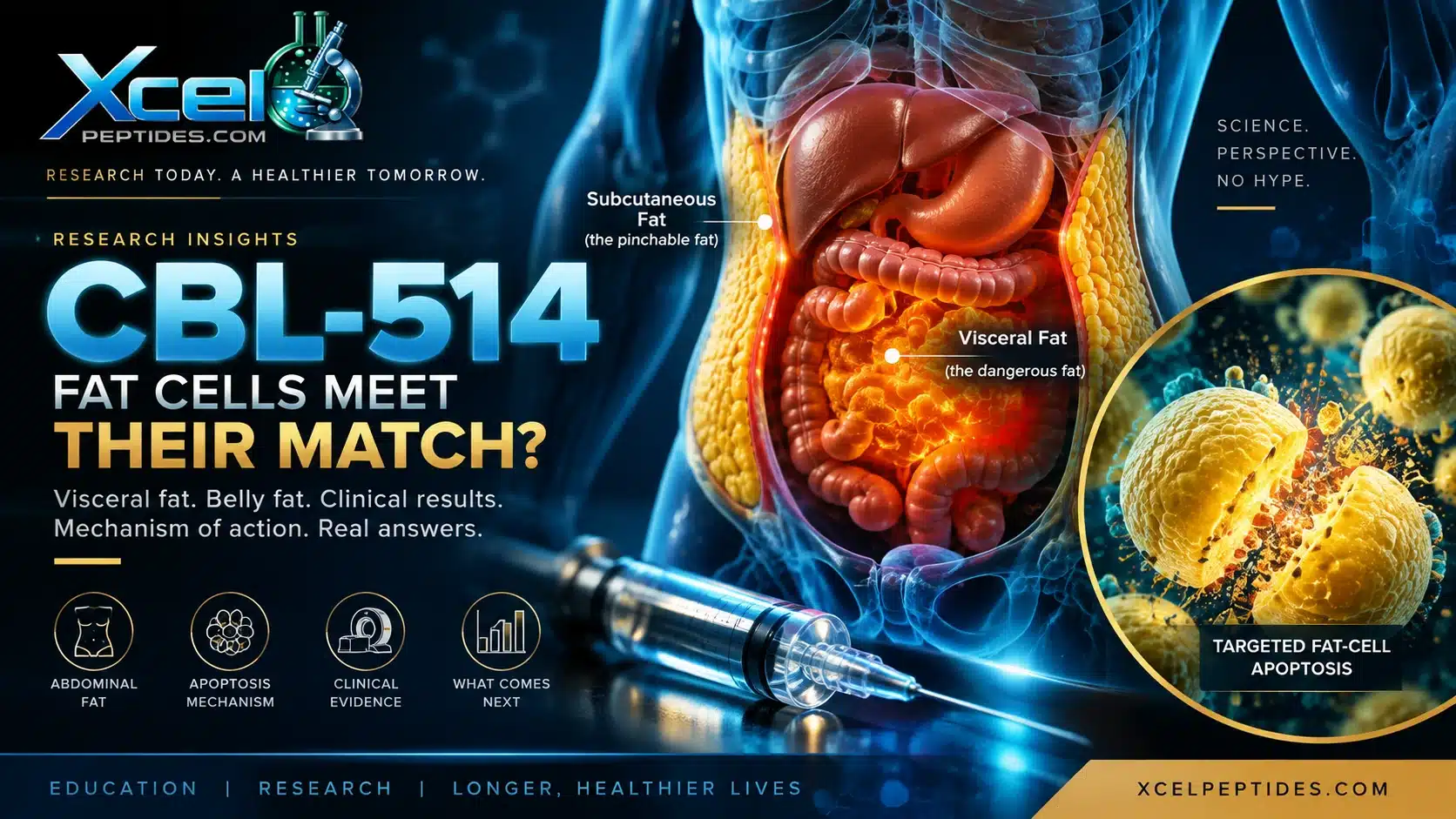
CBL-514 is an investigational injectable small molecule developed by Caliway Biopharmaceuticals to reduce localized subcutaneous fat. Unlike GLP-1 medications, it is designed to induce programmed death of fat cells, called apoptosis. Recent exploratory data also suggest a possible effect on deeper visceral fat, but that finding is not yet established.
What Is CBL-514?
CBL-514 is an experimental small-molecule drug, not a peptide. It is being studied as an injectable treatment for localized fat reduction. Its proposed mechanism differs from appetite-focused obesity medications and from tesamorelin, a growth hormone-releasing hormone analog.
Importantly, the published abdominal studies use multiple injections across a defined treatment area. They do not establish that one ordinary subcutaneous injection delivers the same result.
How Does CBL-514 Work?
CBL-514 is designed to trigger adipocyte apoptosis, a regulated form of cell death. That differs conceptually from treatments that mainly reduce the size of existing fat cells. However, a proposed mechanism does not automatically prove permanent fat removal or explain any observed change in visceral fat.
What Have Human Clinical Trials Found?
A randomized Phase 2 study by Gold and colleagues reported abdominal subcutaneous-fat reduction compared with placebo. A separate Phase 2b study by Lorenc and colleagues randomized 108 adults. In the reported clinician-rating analysis, 23 of 30 participants in the CBL-514 group and 7 of 37 in the placebo group showed at least a one-grade improvement. Those denominators describe the analyzed outcome, not all 108 randomized participants. The authors also reported MRI-measured subcutaneous-fat changes. Most treatment-emergent adverse events were mild or moderate, but severe events were reported in 5 of 52 treated participants (9.6%) and 2 of 55 placebo participants (3.6%). Four CBL-514 participants stopped because of adverse events. Across both groups, 42 of 108 randomized participants discontinued the study early for several reasons, including unstable weight, withdrawal and loss to follow-up. These are study-level findings, not predictions for an individual. These findings do not establish effects on visceral fat. Study endpoints, populations, and assessment times differ, so the percentages should not be treated as interchangeable.
| Research finding | What it means | Evidence level |
|---|---|---|
| Abdominal subcutaneous-fat reduction | Supported by randomized human studies using localized injection protocols. | Moderate, developing |
| Visceral-fat reduction | Reported in a small exploratory MRI analysis, requiring independent confirmation. | Preliminary |
| Permanent results | Long-term durability is not yet established. | Insufficient |
| Single systemic injection | Not demonstrated as equivalent to studied multi-injection protocols. | Insufficient |
Does CBL-514 Reduce Visceral Fat?
Possibly, but this is the question requiring the most caution. Subcutaneous fat is the layer beneath the skin. Visceral fat is located deeper inside the abdominal cavity around organs and is associated with cardiometabolic risk.
Distinguishing tissue compartments: A subcutaneous measurement does not directly establish a change in visceral tissue. An improvement in a treated subcutaneous area does not, by itself, demonstrate a reduction in visceral fat. Evaluating a visceral-fat claim requires its own imaging endpoint, defined sample, controls and follow-up, ideally in a replicated trial. This distinction also applies when comparing localized endpoints with systemic research approaches in the broader obesity research pipeline.
In an exploratory MRI analysis presented at EASD 2026, investigators described changes in visceral-fat volume following CBL-514 treatment. The conference press release, also republished by the developer, reports 40 participants with available 8-to-12-week follow-up data, including 23 in the CBL-514 group and 17 in the placebo group. It describes an exploratory MRI analysis, not a completed Phase 3 trial or a full peer-reviewed report of the visceral-fat findings. This small analysis does not establish whether the observed change resulted from direct drug exposure, indirect physiological effects, or another mechanism.
CBL-514 vs. Tesamorelin: Which Has Better Visceral-Fat Evidence?
Tesamorelin acts through the growth hormone/IGF-1 axis and has clinical trial evidence for reducing excess visceral abdominal fat in adults with HIV-associated lipodystrophy, its approved indication. CBL-514 is principally being studied for localized subcutaneous-fat reduction, with preliminary visceral-fat findings.
| Category | CBL-514 | Tesamorelin |
|---|---|---|
| Drug type | Investigational small molecule | GHRH analog peptide |
| Primary studied target | Localized subcutaneous fat | Excess visceral abdominal fat in HIV-associated lipodystrophy |
| Proposed action | Adipocyte apoptosis | GH/IGF-1-mediated effects |
| Administration studied | Multiple localized injections per session | Subcutaneous administration under prescribed regimen |
| Visceral-fat evidence | Exploratory | Established in indicated population |
| FDA status | Investigational | Approved for a specific HIV-associated indication |
There is no head-to-head clinical trial demonstrating that either drug is superior to the other. Tesamorelin also has meaningful safety considerations, including effects on glucose regulation and IGF-1, so it is not a general-purpose cosmetic fat-loss drug.
Why So Many Injections? Could Fat Loss Become Uneven?
Published CBL-514 studies have used numerous injections distributed over the target abdominal area, rather than one systemic injection. Localized administration raises reasonable questions about uniform drug distribution, injection-site reactions, and cosmetic contour irregularities.
Potential concerns include asymmetry, depressions, or inconsistent fat reduction if treatment effects vary across the area. These are plausible considerations, not evidence that such outcomes are common. Larger trials and longer follow-up should clarify how often clinically important contour changes occur.
Is CBL-514 Permanent?
Not proven. Although apoptosis is intended to eliminate targeted cells, that does not guarantee permanent changes in appearance or body composition. Weight changes, remaining fat cells, and biological adaptation can all influence long-term outcomes.
Is CBL-514 FDA-Approved or Available for General Use?
No. As of October 2026, CBL-514 was investigational. Products marketed online under the same name should not be assumed to match the identity, formulation, purity, or clinical performance of material used in regulated trials. This article is not an invitation to purchase or self-administer the compound.
Frequently Asked Questions
Is CBL-514 a peptide?
No. It is an investigational small-molecule compound.
Does CBL-514 destroy visceral fat?
Direct visceral adipocyte destruction has not been established. A small exploratory analysis reported reduced visceral-fat volume, but the mechanism and reproducibility remain uncertain.
Does CBL-514 require multiple injections?
Published localized-fat studies have used multiple injections across the treatment area. A single systemic injection has not been shown to be equivalent.
Can CBL-514 cause dents or uneven belly fat?
Uneven contour is a reasonable theoretical concern for localized fat reduction, but available data do not establish that it is a common outcome. Longer-term safety and cosmetic follow-up are important.
Is CBL-514 better than tesamorelin?
There is no direct comparison. Tesamorelin has stronger evidence for visceral-fat reduction in its approved HIV-associated indication; CBL-514 has more direct research on localized subcutaneous-fat reduction.
Is CBL-514 FDA-approved?
No. It remains an investigational drug as of the publication date.
Research Sources & Further Reading
- Gold M. et al. Efficacy and Safety of CBL-514 Injection in Reducing Abdominal Subcutaneous Fat, published clinical study.
- Published CBL-514 Phase 2b research, PubMed record.
- Caliway Biopharmaceuticals, developer announcements and trial updates.
- ClinicalTrials.gov, registered CBL-514 studies.
- FDA Drugs@FDA, regulatory drug information.
Originally published October 12, 2026; selected research updates November 5, 2026. Research and regulatory status can change. This article distinguishes published clinical findings from exploratory or sponsor-reported results.