
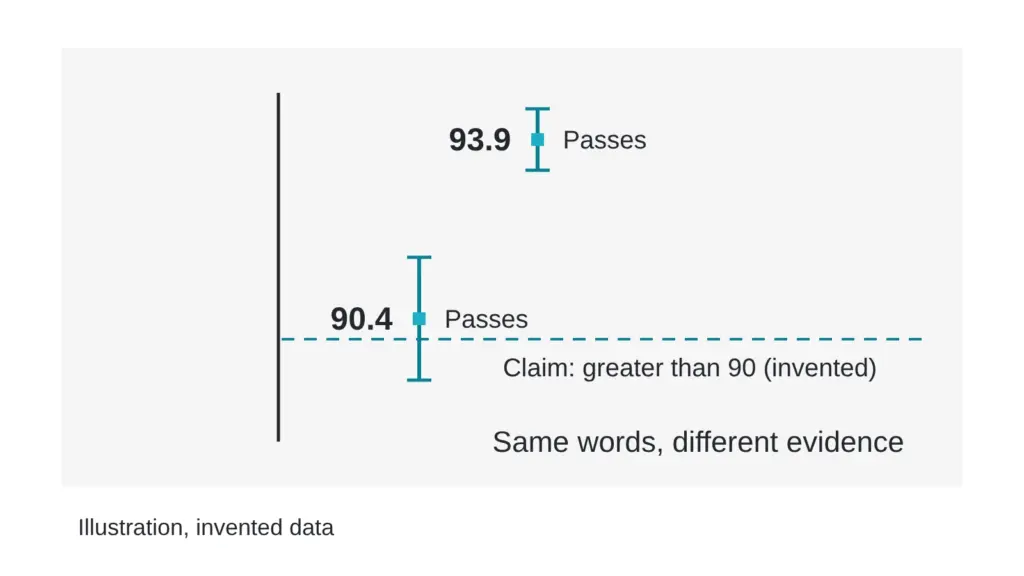
A specification line reads “Purity: greater than 90 percent.” Two vials both pass it. One was measured at 90.4 percent and the other at 93.9 percent. Both figures are invented for this article. The words on the page are identical for both vials, and the material behind the words is not.
That gap is what a “greater than” statement hides. This article covers what such a claim can support, why the edge of a threshold is the dangerous place, how reporting limits shape the little numbers on a report, and what to ask for in place of a floor. Terms are in the The testing glossary: 14 lab terms in plain English.
A floor tells you nothing about how high the ceiling is.
What a threshold statement can and cannot say
A statement of the form “greater than X” reports that a measured value cleared a line. The measured value itself stays out of sight. Anything from just above the line to far above it produces the same sentence.
| Statement | What it supports | What it leaves out |
|---|---|---|
| “Greater than 90 percent” | The value cleared one line | The value itself, anywhere above the line |
| “90.4 percent by area, margin 1.2” (invented) | A measured value and how far to trust it | The settings behind it, unless they are listed too |
| “No single impurity above 0.5 percent” (invented) | Each seen impurity sat under a cap | How many impurities appeared, how close any came to the cap |
| “Not detected” | Nothing rose above the detection limit | Whether that limit was low enough to matter |
Every row leaves out something. The first row leaves out the most.
Floors also move between documents. One lot may be labeled “greater than 85” and another “greater than 90”. A reader who sees two passes learns nothing about the distance between them, and the distance is the information a purchasing or planning decision usually needs.
The edge problem
Return to the invented 90.4. Suppose its margin is plus or minus 1.2 points. The range runs from 89.2 to 91.6, and the line at 90 sits inside it. A pass declared on that value rests on a measurement that cannot tell whether it is above or below the line. The 93.9 vial, with the same margin, sits well clear.
Both vials receive the same word, “greater”. Only the measured value and its margin separate a clear pass from a coin flip, and the claim provides neither.
Where the small numbers come from
The same logic applies at the other end of the scale, where reports say “less than 0.5” or “not detected”.
A reporting threshold is a line below which impurities are not reported. A method can only back a “less than” statement if it can actually quantify below that line. One validation paper on a mass spectrometry method for peptide-related impurities reported lower limits of quantification of 0.02 and 0.03 percent of the main peptide, below the regulatory reporting threshold of 0.10 percent (Weisz et al., 2024). The ordering matters. If the limit of quantification sat above the threshold, a “less than” claim would describe the method’s blind spot and say nothing about the sample.
Counting rules also shape what appears. A validation study of a peak-detection feature found the intensity threshold to be the most critical setting, since a low threshold can produce false positives and a high threshold can obscure true peaks (Oyugi et al., 2023). Two reports with the same impurity cap can therefore sit on very different detection settings.
Area-based claims inherit every weakness underneath
A “greater than” claim built on area percent inherits the response-factor question. A 2022 method paper on impurity profiling notes that liquid chromatography usually yields the area percent of the target peak, while reporting by weight requires relative response factors, which are not always available (Thakkar et al., 2022). The floor sits on top of whatever the area calculation assumed, and a floor cannot repair a shaky foundation.
Why floors are popular
A threshold is convenient for everyone involved. The laboratory avoids defending decimals, the reader gets a simple pass, and nobody has to explain a margin. The price is information, and the reader pays it.
What to ask for instead
- The measured value, with the basis stated (area or weight).
- The margin attached to that value.
- The method settings: wavelength, gradient and counting threshold.
- For any “less than” or “not detected” line, the limit of quantification or detection that backs it.
- The date and lot identifier, so the value belongs to something you can place.
Myth versus reality
Myth: a “greater than” claim is a stricter, more confident statement than a number. Reality: it is a looser one, because it names a boundary and withholds the position. A measured value with a margin says more with fewer words.
Quick check you can do today
Find any “greater than”, “less than” or “not detected” statement on a report you hold. Write down the line it refers to, then request the measured value and its margin. Subtract the line from the value. If the gap is smaller than the margin, the claim sits on the edge and deserves a second look. For “less than” lines, ask for the limit of quantification and compare it with the line. If the limit is higher than the line, the statement speaks for the method and says nothing about the sample. More on reading a trailing digit is in Three decimals, no extra truth: how to read the last digit on a lab report.
Sources
- Weisz DA, Rogstad SM, Zeng K, Pang E, Geerlof-Vidavsky I. Journal of Pharmaceutical and Biomedical Analysis, 2024, volume 255, article 116654. PubMed ID 39778260. DOI 10.1016/j.jpba.2024.116654. Descriptor: validation of a liquid chromatography-high-resolution mass spectrometry method that quantifies peptide-related impurities.
- Oyugi M, Wang X, Yang X, Wu D, Rogstad S. Journal of Pharmaceutical and Biomedical Analysis, 2023, volume 234, article 115564. PubMed ID 37451094. DOI 10.1016/j.jpba.2023.115564. Descriptor: validation paper on a liquid chromatography-mass spectrometry peptide-mapping approach, including spike-in tests of a new-peak detection feature.
- Thakkar H, Jain S, Kumar S, Bhalekar VS, Gangakhedkar S, Shah RP. Journal of Chromatography A, 2022, volume 1689, article 463725. PubMed ID 36586282. DOI 10.1016/j.chroma.2022.463725. Descriptor: method-development paper on hyphenated liquid chromatography with diode array, charged aerosol and mass spectrometry detection for impurity profiling and relative response factors.
Want the catalog? Register free