
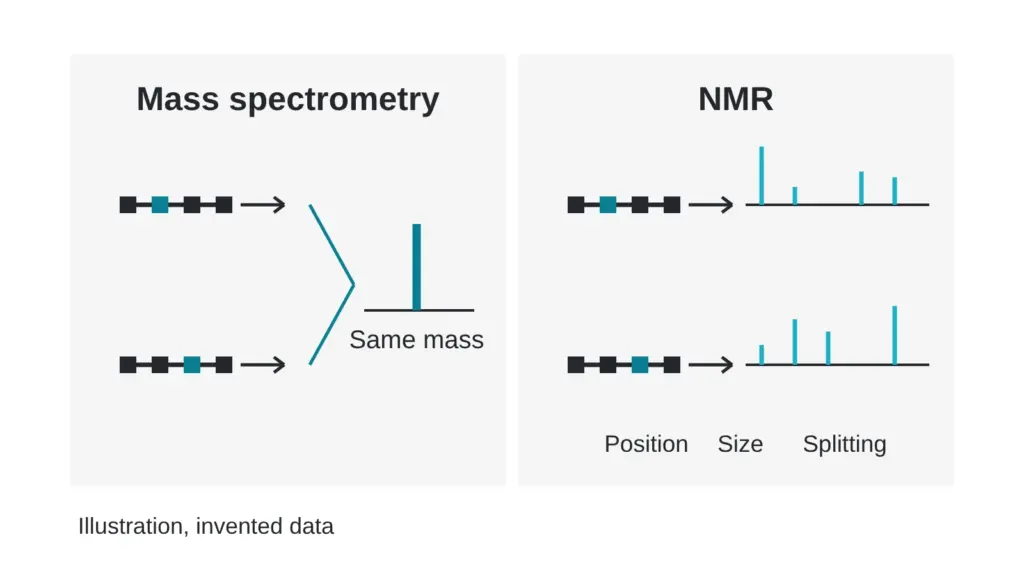
A report arrives with a clean chromatogram and a mass spectrum, and the line under them says the measured mass matches. Then someone asks whether there is an NMR spectrum too, and the lab answers that it is a separate test on a separate instrument. Is it worth the extra step?
This article explains what an NMR spectrum records, three things it can show that a mass spectrum cannot, and where it falls short. Terms are in the The testing glossary: 14 lab terms in plain English, and the mass side of the story is in Mass spectrometry for beginners: read a spectrum without a chemistry degree.
What does each instrument actually measure?
Mass spectrometry weighs molecules, and fragments of molecules, as charged particles. NMR, short for nuclear magnetic resonance, puts a sample in a strong magnetic field and listens to the atomic nuclei inside it, most often hydrogen, as they answer a pulse of radio waves. Each nucleus answers a little differently depending on what sits next to it.
A mass spectrum is a weigh-in. An NMR spectrum is a floor plan.
Three features of an NMR spectrum do the work:
- Position: where a signal sits tells you what kind of chemical neighborhood the nucleus lives in.
- Size: the area under a signal tracks how many nuclei produced it.
- Splitting: a signal that breaks into a small cluster tells you about the neighbors next door.
Same mass, different molecule
Two molecules can contain exactly the same atoms joined in a different arrangement. Chemists call these isomers, and an intact-mass measurement cannot tell them apart, because their masses are equal.
A published study of a metal-bound peptide used liquid chromatography with tandem mass spectrometry and NMR side by side. The authors concluded that isoforms and isomers usually go undetected by mass spectrometry, and that complementary methods are needed to characterize a reference material fully (Abbas et al., 2018). A review from a pharmacopeial group lists NMR, mass spectrometry and chromatography together as the identity tools used for peptide reference standards (McCarthy et al., 2023).
A matching mass confirms the formula. It cannot confirm the arrangement. The article on How labs confirm what a molecule is: mass, fragments and structure shows how fragmentation narrows the gap, and NMR closes more of it.
What can NMR see that a chromatograph misses?
A liquid chromatography detector set to ultraviolet light only notices molecules that absorb it. Anything transparent at that wavelength passes by without a trace on the chromatogram.
One published case shows the consequence. The authors point out that routine liquid chromatography quality control depends on its detection mode and can be blind to some impurities. Using quantitative proton NMR, they found a substantial amount of an undeclared, highly polar, UV-transparent constituent in two custom synthetic peptides, and they saw it even on a benchtop instrument at 60 MHz (Choules et al., 2019). Their conclusion: experimental verification outranks trust, in research-grade material as much as in pharmaceutical work.
That finding concerns two samples in one paper. It does not say how common the problem is. It does show what a purity chromatogram can leave out.
Can NMR count as well as identify?
Yes, with a trick. The area under a signal is proportional to the number of nuclei behind it. Add a known mass of a reference compound, called an internal standard, to the sample, and compare the two signal areas. The ratio gives the mass of the sample’s molecule directly. That is quantitative NMR, or qNMR.
A multi-laboratory study organized by a pharmacopeial group compared three ways to quantify one small peptide: a liquid chromatography assay, qNMR and amino acid analysis. The liquid chromatography assay, run against the same bulk material as its standard, showed the lowest variability between laboratories. The authors described proton qNMR as a direct measurement against an internal standard that is not difficult under common laboratory conditions, and said it deserves further exploration as a primary method for assigning reference values (Li et al., 2018).
Which question goes to which instrument?
| Question | Mass spectrometry | NMR |
|---|---|---|
| Does the intact mass match the expected formula? | Direct answer | Not its job |
| Are two same-mass isomers the same molecule? | Limited, needs fragmentation | Spectra usually differ |
| Is a UV-invisible constituent present? | Depends on how it ionizes | Visible if it has signals |
| Is a trace species present at very low levels? | Strong | Weaker, needs more sample |
| How much molecule per mass of powder? | Needs an external standard | Direct, against an internal standard |
Where does NMR fall short?
It needs more material than a mass spectrometer does. In larger molecules the signals crowd and overlap, and assigning each one takes a trained analyst. A clean spectrum for a small molecule can become a hard puzzle for a long chain. NMR is a complement to mass spectrometry and chromatography, never a replacement for them.
Quick check you can do today
Look at the identity section of any report you hold. Write down which instrument produced each statement. If every line traces to a mass spectrometer, you have confirmed the weight and the fragments. Ask whether an NMR spectrum exists and what it was used for: identity only, or quantity against an internal standard as well. Then see CHNS, liquid chromatography or LC-MS: which test answers which question? and The question every buyer should ask: purity or content? for the next question on the list.
Sources
- Abbas IM, Vranic M, Hoffmann H, El-Khatib AH, Montes-Bayon M, Moller HM, Weller MG. International Journal of Molecular Sciences, 2018, volume 19(8), article 2271. PubMed ID 30072660. DOI 10.3390/ijms19082271. Descriptor: study of a metal-bound peptide by liquid chromatography with tandem mass spectrometry, high-resolution mass spectrometry and NMR, concluding that complementary methods are needed for reference materials.
- Choules MP, Bisson J, Simmler C, McAlpine JB, Giancaspro G, Bzhelyansky A, Niemitz M, Pauli GF. Journal of Pharmaceutical and Biomedical Analysis, 2019, volume 178, article 112915. PubMed ID 31671336. DOI 10.1016/j.jpba.2019.112915. Descriptor: report of quantitative proton NMR detecting an undeclared constituent in custom synthetic peptides, including on a benchtop instrument.
- Li C, Bhavaraju S, Thibeault MP, Melanson J, Blomgren A, Rundlof T, Kilpatrick E, Swann CJ, Rudd T, Aubin Y, Grant K, Butt M, Shum W, Kerim T, Sherwin W, Nakagawa Y, Pavon S, Arrastia S, Weel T, Pola A, Chalasani D, Walfish S, Atouf F. Journal of Pharmaceutical and Biomedical Analysis, 2018, volume 166, pages 105-112. PubMed ID 30640042. DOI 10.1016/j.jpba.2018.12.028. Descriptor: multi-laboratory comparison of three quantification methods for one small peptide, including qNMR.
- McCarthy D, Han Y, Carrick K, Schmidt D, Workman W, Matejtschuk P, Duru C, Atouf F. Pharmaceutical Research, 2023, volume 40(6), pages 1317-1328. PubMed ID 36949371. DOI 10.1007/s11095-023-03493-1. Descriptor: review of how reference standards for synthetic peptides are produced and characterized, including NMR, mass spectrometry and chromatography for identity.
Want the catalog? Register free