
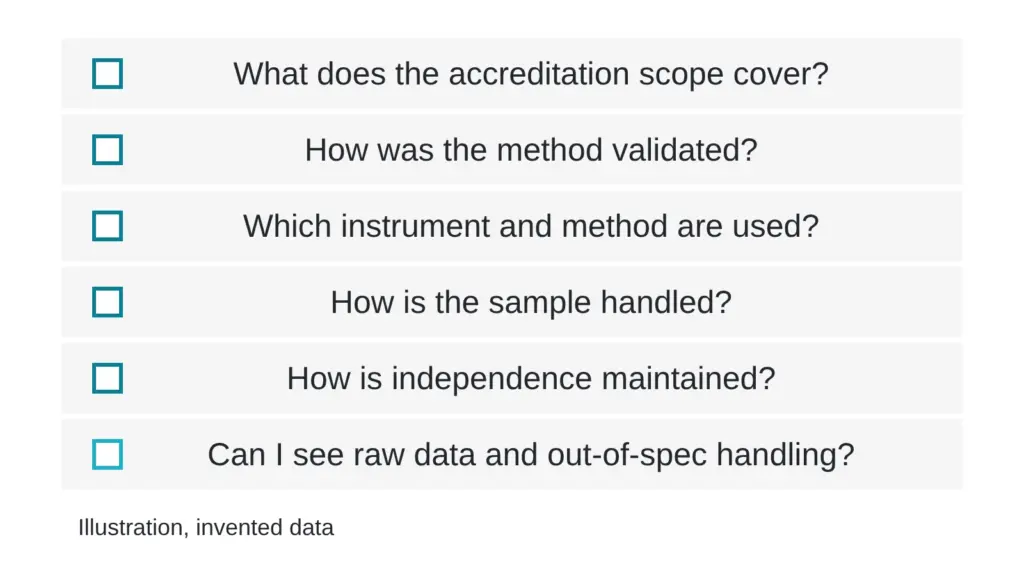
A laboratory report is only as sound as the laboratory behind it. This article gives you a short list of questions to ask any testing lab, about accreditation, method validation, instruments, sample handling, independence, raw data and how unexpected readings are handled. The questions apply to any analytical laboratory. Technical terms are defined in the The testing glossary: 14 lab terms in plain English.
Accreditation and its scope
ISO/IEC 17025 is the international standard for the competence of testing and calibration laboratories. An accreditation body assesses a laboratory against it and grants accreditation for a defined scope. The scope matters as much as the badge.
Ask these:
- Is accreditation held for the specific test on my report, or only for other methods?
- Which accreditation body issued it, and can I see the current scope document?
- Is the laboratory’s name on the scope the same as the name on my report?
Accreditation does not apply to every test, and an unaccredited laboratory can still do careful work. It does mean that an outside assessor has checked the quality system. Method papers often show the usual order of events: validate a method first, then add it to the accreditation scope. One published example describes a single-laboratory validation of a metals screening method that was afterward added to the laboratory’s ISO/IEC 17025:2017 accreditation (Baidas et al., 2026).
Method validation
A validated method has documented evidence that it works for its intended use. Typical characteristics include specificity, accuracy, precision, working range, and limits of detection and quantitation. The international ICH guidance on validation of analytical procedures sets out these ideas. A 2025 study of counterion analysis, for example, reported that its detection methods were validated according to ICH guidelines (Erckes et al., 2025).
Ask whether the method on your report was validated for this type of sample, who validated it, and whether the validation report is available on request.
Instrument and method details
You need enough detail to judge a number and to compare it with another laboratory’s number. Ask for:
- the instrument make and model, and the detector type
- the column, mobile phase, gradient and wavelength
- how the instrument was checked before the run, and which reference standard was used to calibrate
- how the laboratory handles co-elution, for example with mass spectrometry or a second method
If a laboratory cannot name its column and wavelength, you cannot compare its numbers with anyone else’s. Same material, two purity numbers: why labs disagree shows why each of these details can move a purity number.
Sample handling and chain of custody
A reading describes the sample the laboratory tested, so the history of that sample matters. Chain of custody is the written record of who held the sample, when, and under what conditions.
Ask how the laboratory logs a sample on arrival, how it assigns a unique identifier, what condition the container was in when it arrived, and where and how the sample is stored before testing. Ask whether any deviation, such as a damaged closure or a delay, would be written on the report. Ask also whether the laboratory weighs the sample itself and records the balance used, because every mass-based number depends on that weighing. A good report names the sample as received and states its condition on arrival.
Independence from the party that supplied the sample
ISO/IEC 17025 includes a requirement for impartiality. In practice, ask who pays for the test and whether the laboratory has any financial or ownership link to the party that supplied the sample. Ask whether the laboratory receives the sample directly from you or through that party, and whether it can see anything about the sample’s origin before it reports.
A laboratory that is open about these points is easier to trust. One that avoids the questions has told you something too.
Raw data and out-of-specification handling
A summary page is a summary. Ask whether the laboratory will share the raw data behind it: chromatogram files, integration settings, the instrument identifier, the analyst and the run date. Check that the numbers on the report match the raw data.
Then ask what happens when a reading falls outside the expected range. A sound laboratory has a written procedure. It investigates the cause before it retests, keeps the original data, and states in the report what was done. A laboratory that quietly repeats a run until the number looks right is a poor sign. The 2023 paper on reference standards describes the care that goes into addressing variability and identifying outliers when several laboratories contribute data (McCarthy et al., 2023).
Related reading: How a reference standard gets its number, and who checks the math and CHNS, liquid chromatography or LC-MS: which test answers which question?.
Sources
- Baidas H, Begzad M, Muneem S, Urban S. Food Chemistry, 2026, volume 528, article 151037. PubMed ID 42731167. DOI 10.1016/j.foodchem.2026.151037. Descriptor: single-laboratory validation of a metals screening method, reporting that the method was then added to the laboratory’s ISO/IEC 17025:2017 accreditation.
- Erckes V, Streuli A, Chamera Rendueles L, Kramer SD, Steuer C. Pharmaceuticals, 2025, volume 18(8), article 1163. PubMed ID 40872554. DOI 10.3390/ph18081163. Descriptor: study of counterion analysis and exchange in synthetic peptides, reporting validation of its detection methods under ICH guidelines.
- McCarthy D, Han Y, Carrick K, Schmidt D, Workman W, Matejtschuk P, Duru C, Atouf F. Pharmaceutical Research, 2023, volume 40(6), pages 1317-1328. PubMed ID 36949371. DOI 10.1007/s11095-023-03493-1. Descriptor: review with case studies on preparing, testing and assigning values to reference standards for synthetic peptides, including handling of variability and outliers.
- Standards named in the text, not indexed in PubMed: ISO/IEC 17025:2017 (general requirements for the competence of testing and calibration laboratories) and the ICH guidance on validation of analytical procedures.
Want the catalog? Register free