
A reference standard is only as useful as its assigned value. This article explains mass balance, one common way to assign that value. It draws on a 2023 paper from a pharmacopeial group and on two supporting papers, and it describes only what those records support. Technical terms are defined in the The testing glossary: 14 lab terms in plain English.
Why a reference standard needs an assigned value
Many analytical tests of peptide quality depend on well-characterized reference standards to determine identity, purity and strength, according to the 2023 paper by McCarthy and colleagues. A standard with the wrong value passes its error to every measurement calibrated against it. The value therefore needs to be established with care, and ideally by more than one route.
The two-step process in the 2023 paper
The authors describe how a final lyophilized vial of a reference standard gets its value. Findings from multiple laboratories are integrated. The process has two steps.
In step one, a mass balance approach assigns a quantitative value to a bulk peptide material. In step two, that bulk material serves as a standard to assign a final value to the vialed material.
The paper also covers testing to confirm identity and to check that vials are consistent with each other. It describes nuclear magnetic resonance, mass spectrometry and chromatography for identity, and liquid chromatography and gas chromatography methods for peptide content and impurities. It addresses variability, outliers and stability studies. It notes that some peptide features, such as chiral or isobaric amino acids, may need additional techniques for full characterization (McCarthy et al., 2023).
What mass balance means
Mass balance accounts for every part of the material. The logic runs in three moves:
- Start with the full mass of the material.
- Subtract each non-peptide part that was measured on its own.
- Multiply what remains by the chromatographic purity.
The abstract of the 2023 paper does not list the individual deductions. A separate certified reference material study shows what such an accounting can include. Its authors measured related impurities, aggregation, moisture, volatile organic compounds, anions and ignition residues (Wang et al., 2022). In general practice the usual deductions are water, residual solvents, counterions and inorganic residue, each measured by its own method.
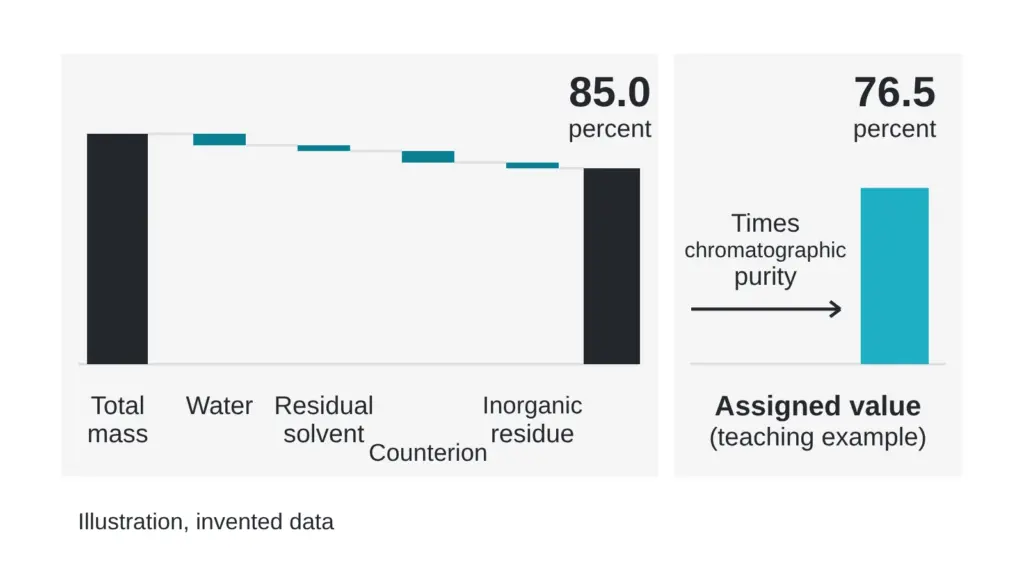
These numbers are invented. A bulk material contains 4.0 percent water, 0.5 percent residual solvent, 10.0 percent counterion and 0.5 percent inorganic residue by mass. Those four items total 15.0 percent, so 85.0 percent of the mass is peptide-related material.
Chromatography shows that 90.0 percent of the peptide-related material is the intended molecule. The assigned value is 85.0 multiplied by 0.900, which is 76.5 percent by mass.
Notice that this value is a content-type number. It answers how much of the powder is the intended molecule. It differs from a raw area-percent purity, which could read 90.0 for the same material. See Same material, two purity numbers: why labs disagree.
Why impurity quantification matters
The chromatographic step is only as good as the impurity data behind it. Li and colleagues note that approaches such as mass balance, amino acid analysis, quantitative nuclear magnetic resonance and nitrogen determination can all be used to assign purity. They add that every one of them needs a correction for structurally related peptide impurities to avoid bias, and that liquid chromatography with high-resolution mass spectrometry has become the key technique for identifying and quantifying those impurities (Li et al., 2018).
Cross-checks and limits
The certified reference material study used two routes to its value. Mass balance was one. Amino acid analysis with isotope dilution mass spectrometry was the other. The authors then checked the value with liquid chromatography with circular dichroism and with quantitative nuclear magnetic resonance, and reported good agreement. The value was stated with a margin of error, as grams per gram of material (Wang et al., 2022).
Agreement between independent methods builds trust in an assigned value. A single method gives a number. Several methods that land in the same place give evidence.
The approach assumes that every component has been measured once and only once. Water measured by titration should not also be counted inside the chromatographic step, and a counterion should not be deducted twice. It also assumes the impurity data are complete. An impurity that co-elutes with the main peak, or a component that no method looked for, stays inside the peptide fraction and inflates the value.
Every measurement also has its own spread, and those spreads add up in the final figure. That is why a well-made reference value is stated together with a margin of error, and why labs compare more than one route.
Related reading: The salt nobody lists: how a counterion changes what a vial really holds and CHNS, liquid chromatography or LC-MS: which test answers which question?.
Sources
- McCarthy D, Han Y, Carrick K, Schmidt D, Workman W, Matejtschuk P, Duru C, Atouf F. Pharmaceutical Research, 2023, volume 40(6), pages 1317-1328. PubMed ID 36949371. DOI 10.1007/s11095-023-03493-1. Descriptor: review with case studies on preparing, testing and assigning values to reference standards for synthetic peptides, including a two-step mass balance approach.
- Wang X, Wu L, Huang Y, Su P, Yang Y, Yang B, Zhang N. Analytical and Bioanalytical Chemistry, 2022, volume 414(11), pages 3443-3457. PubMed ID 35201368. DOI 10.1007/s00216-022-03965-0. Descriptor: development of a certified reference material for a small protein using mass balance and amino acid analysis with isotope dilution mass spectrometry.
- Li M, Josephs RD, Daireaux A, Choteau T, Westwood S, Wielgosz RI, Li H. Analytical and Bioanalytical Chemistry, 2018, volume 410(20), pages 5059-5070. PubMed ID 29862433. DOI 10.1007/s00216-018-1155-y. Descriptor: liquid chromatography with high-resolution mass spectrometry for structurally related impurities in a synthetic peptide calibrator, noting the purity assignment approaches in use.
Want the catalog? Register free