
A vial of dry peptide powder holds more than peptide. This article explains what a counterion is, why peptide samples carry one, why routine purity methods miss it, and how laboratories measure content so they can say how much peptide a vial actually holds. Technical terms are defined in the The testing glossary: 14 lab terms in plain English.
What a counterion is
A charged molecule needs an opposite charge nearby to keep the solid neutral overall. Peptides carry positive charges at basic sites, such as the amino terminus and some amino acid side chains. Negatively charged ions sit alongside them in the solid. Each of those ions is a counterion, and the peptide plus its counterions forms a salt.
Common counterions include trifluoroacetate, acetate and chloride. The number per peptide molecule depends on how many charged sites the sequence has, so it varies from one sequence to the next.
Why peptide samples carry them
Solid-phase synthesis relies on trifluoroacetic acid to cleave the finished chain from its support, and purification by liquid chromatography uses the same acid as an ion-pairing reagent. Peptides are therefore commonly obtained as trifluoroacetate salts (Erckes et al., 2025).
A laboratory can swap this counterion for another. In the same study, the authors replaced trifluoroacetate with chloride by freeze-drying the peptide from hydrochloric acid solutions of different strengths. They quantified the leftover trifluoroacetate with infrared spectroscopy, fluorine-19 nuclear magnetic resonance and liquid chromatography with an evaporative light-scattering detector.
The counterion fraction can also change during drying. A separate study found that volatile counterions were partly lost during freeze-drying, and that the loss depended on the formulation and on process settings (Sahakijpijarn et al., 2019). Two preparations of the same sequence can therefore carry different amounts of counterion.
Why routine methods miss them
Purity by liquid chromatography with ultraviolet detection reports on species that absorb light and separate on the column. Small ions such as chloride and acetate absorb little at the wavelengths chosen for peptides, and they travel with the solvent front, well ahead of the peptide peaks.
Mass spectrometry does not fill the gap. In solution the salt separates into the peptide ion and its counterion, and a typical scan range is set for the peptide’s mass, not the counterion’s. The spectrum shows the peptide.
So a chromatogram can show a clean main peak while a large share of the powder’s mass is counterion and water. Purity and content answer different questions.
How content is measured
Content is the mass of peptide per mass of material, for example grams of peptide per gram of powder. Laboratories use several methods, often together:
- Amino acid analysis breaks the peptide into its amino acids and measures each one against standards. It reports peptide amount without counting counterions or water. One certified reference material study paired it with mass balance and expressed the final value as grams per gram of material (Wang et al., 2022).
- Elemental analysis measures nitrogen, carbon and hydrogen. Nitrogen determination is one of the approaches used to assign peptide purity (Li et al., 2018). Because peptides are rich in nitrogen, it can estimate peptide mass, but nitrogen from other sources distorts the estimate.
- Ion analysis measures the counterion directly. Ion chromatography is the usual technique for anions such as chloride and acetate, and the study cited above used infrared and fluorine-19 nuclear magnetic resonance methods for trifluoroacetate.
- Karl Fischer titration measures water, which belongs in the same accounting.
Why a vial holds less peptide than its fill weight
Fill weight is the mass of powder in the vial. Content tells you how much of that mass is peptide.
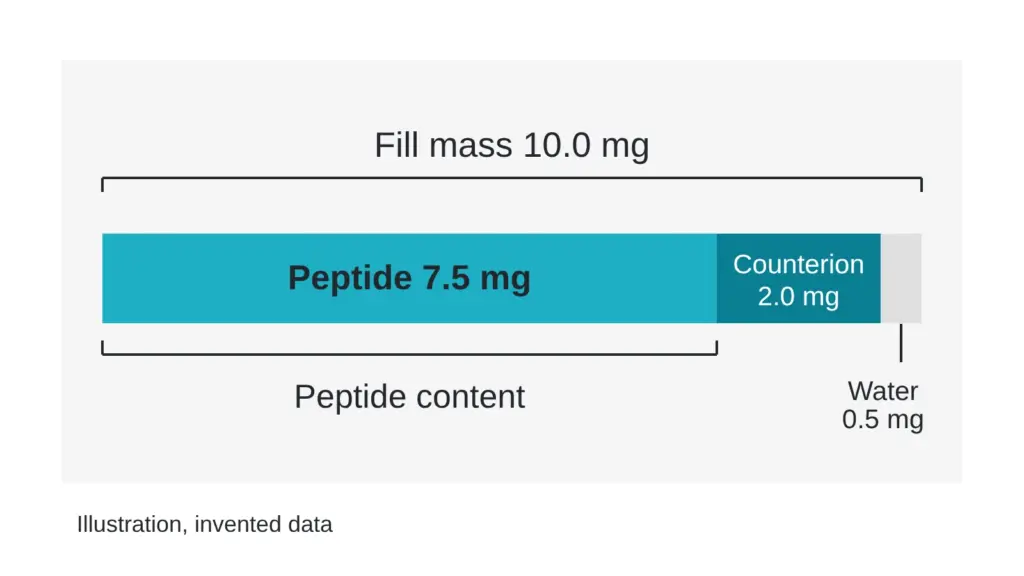
Here is a teaching example with invented numbers. A vial holds 10.0 mg of powder. Analysis shows 7.5 mg of peptide, 2.0 mg of counterion and 0.5 mg of water. The content is 75.0 percent. A laboratory that treats the full 10.0 mg as peptide would overstate the peptide mass by one third. Any molar calculation built on that mass would be off by the same factor. This is also why a report that lists purity alone cannot tell you how much peptide a vial holds. A content figure, with the method behind it, fills that gap.
Erckes and colleagues made the same point from the other side. Their study stresses the need to quantify and specify the counterion, because it changes what the sample is.
Related reading: How a reference standard gets its number, and who checks the math and Inside a freeze-dried cake: what lyophilization leaves behind.
Sources
- Erckes V, Streuli A, Chamera Rendueles L, Kramer SD, Steuer C. Pharmaceuticals, 2025, volume 18(8), article 1163. PubMed ID 40872554. DOI 10.3390/ph18081163. Descriptor: study of counterion analysis and exchange in synthetic peptides, including detection of residual trifluoroacetate by three methods.
- Sahakijpijarn S, Moon C, Koleng JJ, Williams RO. Pharmaceutics, 2019, volume 11(10), article 498. PubMed ID 31569515. DOI 10.3390/pharmaceutics11100498. Descriptor: study of how formulation and freeze-drying process settings affect preservation of volatile counterions in a peptide sample.
- Wang X, Wu L, Huang Y, Su P, Yang Y, Yang B, Zhang N. Analytical and Bioanalytical Chemistry, 2022, volume 414(11), pages 3443-3457. PubMed ID 35201368. DOI 10.1007/s00216-022-03965-0. Descriptor: development of a certified reference material for a small protein using mass balance and amino acid analysis with isotope dilution mass spectrometry.
- Li M, Josephs RD, Daireaux A, Choteau T, Westwood S, Wielgosz RI, Li H. Analytical and Bioanalytical Chemistry, 2018, volume 410(20), pages 5059-5070. PubMed ID 29862433. DOI 10.1007/s00216-018-1155-y. Descriptor: liquid chromatography with high-resolution mass spectrometry for structurally related impurities in a synthetic peptide calibrator, noting the purity assignment approaches in use.
Want the catalog? Register free