
Lyophilization, also called freeze-drying, removes water from a sample without heating it to boiling. This article covers the basic chemistry, why laboratories use the method for fragile molecules in general, and what the dry solid left behind contains. It is general chemistry only. Technical terms are defined in the The testing glossary: 14 lab terms in plain English.
What freeze-drying does
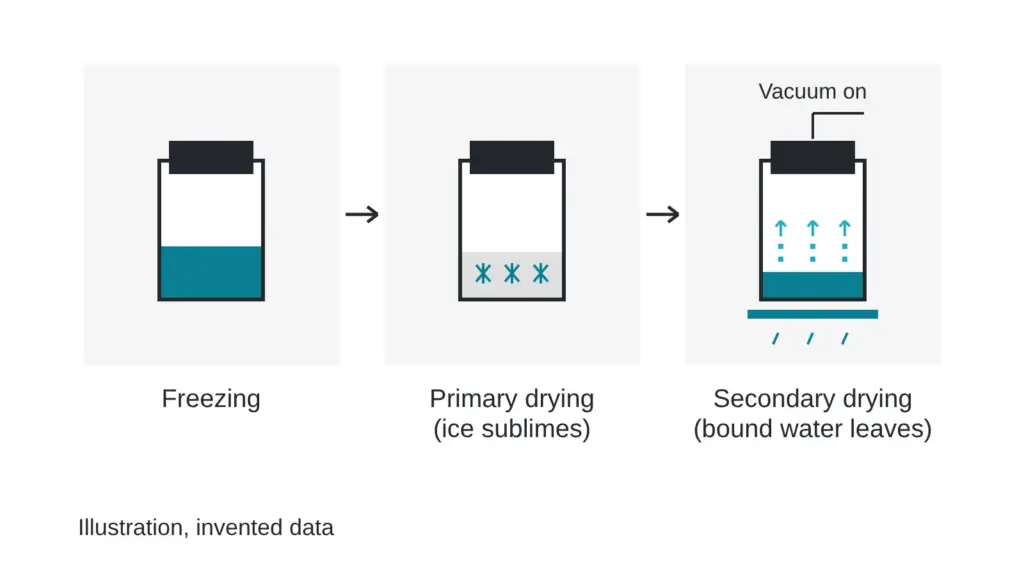
A freeze-drying run has three stages: freezing, primary drying and secondary drying (Butreddy et al., 2020).
First, the solution is frozen, so the water becomes ice and the dissolved solids are locked into the frozen mass.
Next comes primary drying. The pressure around the sample is lowered and a little warmth is supplied. Under these conditions ice sublimes, which means it goes straight from solid to vapor without passing through liquid water. Water’s triple point is near 0.01 degrees Celsius and 611 pascals, so drying has to happen at pressures below that. A very cold surface in the chamber, called a condenser, collects the vapor.
Last is secondary drying. Some water is not ice but is bound to the solid. The temperature is raised somewhat to drive that water off.
Why fragile molecules are freeze-dried
Water takes part in many degradation reactions. It breaks some chemical bonds directly, and it lets molecules move, meet and react. In a dry solid, molecular motion is much lower and many of those reactions slow down.
Freeze-drying removes water at low temperature, which avoids the heat that boiling or oven drying would apply. One industry review describes lyophilization as a way to obtain a stable dry material from a sample that is unstable as a ready-to-use liquid (Butreddy et al., 2020).
The method has costs. Freezing and drying put their own stresses on a molecule, and the process takes long runs under vacuum. That is why formulations often include added solids chosen to protect the molecule during drying.
What a lyophilized cake is
The solid left in the container is called a cake. It is a porous plug that keeps the shape of the frozen mass, with small voids where the ice used to be. It is often white and light. Its pore size depends partly on how fast the solution froze: fast freezing makes many small ice crystals and small pores, while slow freezing makes fewer, larger crystals and larger pores.
A cake holds everything in the original solution that did not leave as vapor:
- the molecule of interest
- buffer salts and other non-volatile solids
- counterions that do not sublime
- bulking agents, which are added to support the cake structure
- a small amount of residual water
The review cited above lists cake appearance and evenness of moisture content among the quality attributes of the process (Butreddy et al., 2020). A shrunken, cracked or collapsed cake tells an analyst that the drying conditions or the formulation behaved differently than planned.
What freeze-drying does not do
Sublimation removes only components that are volatile under the drying conditions, mainly water and any volatile solvents or acids. It does not separate the molecule of interest from non-volatile impurities. Impurities present in the solution before drying are still in the cake afterward, so a chromatogram of the dissolved cake mostly mirrors the starting solution, apart from any change that happened during drying itself.
Why the dry solid is not all analyte
Because the cake holds salts, additives and residual water, its mass is larger than the mass of the molecule of interest. Some components can also leave during drying. A study of a peptide sample found that volatile counterions were partly lost during freeze-drying, and that the loss depended on formulation and process settings (Sahakijpijarn et al., 2019).
Residual moisture is usually measured by Karl Fischer titration, a chemical titration specific to water. This is one reason a laboratory measures content separately from purity. See The salt nobody lists: how a counterion changes what a vial really holds.
Moisture, temperature, light and container closure
A dry cake is often hygroscopic, which means it takes up water vapor from the air. Absorbed water brings back some of the molecular motion that drying removed, and a cake that takes up enough of it can soften and collapse. The Butreddy review names the container and its closure among the factors that determine whether freeze-drying succeeds.
Temperature and light also matter in general chemistry. Warmth speeds most degradation reactions, and light can drive photochemical changes in some molecules. For these reasons, stability studies track temperature, humidity, light exposure and the quality of the closure, and analysts note them when they judge a sample.
Related reading: The salt nobody lists: how a counterion changes what a vial really holds and CHNS, liquid chromatography or LC-MS: which test answers which question?.
Sources
- Butreddy A, Dudhipala N, Janga KY, Gaddam RP. AAPS PharmSciTech, 2020, volume 21(7), article 252. PubMed ID 32885357. DOI 10.1208/s12249-020-01787-w. Descriptor: industry review of the freeze-drying process stages, formulation additives, container closure and quality attributes.
- Sahakijpijarn S, Moon C, Koleng JJ, Williams RO. Pharmaceutics, 2019, volume 11(10), article 498. PubMed ID 31569515. DOI 10.3390/pharmaceutics11100498. Descriptor: study of how formulation and freeze-drying process settings affect preservation of volatile counterions in a peptide sample.
Want the catalog? Register free