
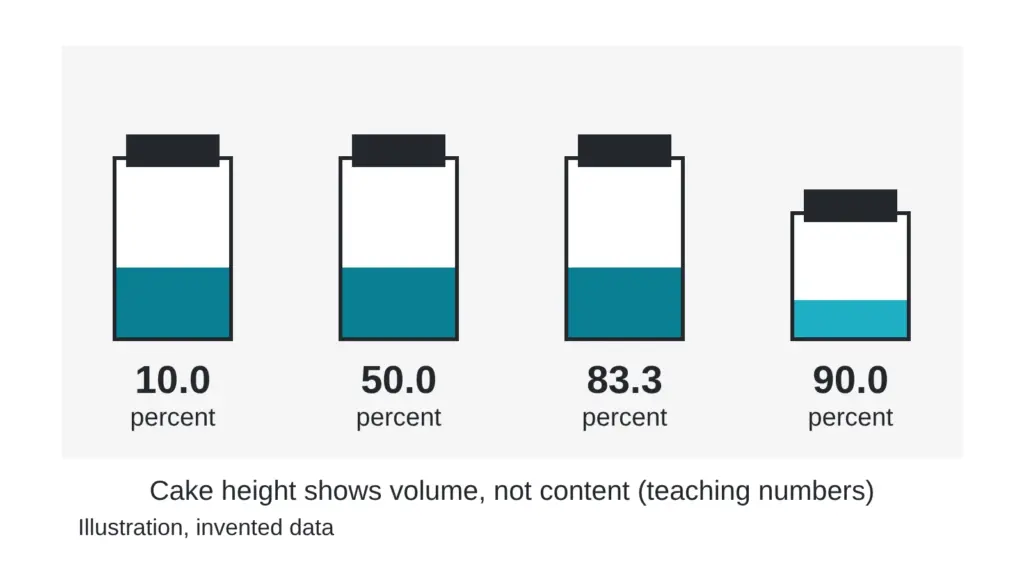
Two vials labeled with different masses can look identical. Two vials labeled with the same mass can look different. Appearance can feel like a measurement. This article explains what shapes the solid in a vial and what actually establishes how much is inside. Terms are defined in the The testing glossary: 14 lab terms in plain English.
Mass is not volume
Milligrams measure mass, while the eye judges volume. A freeze-dried solid is a porous cake that is mostly empty space, as described in Inside a freeze-dried cake: what lyophilization leaves behind. Compare a sponge with a brick: two objects of equal mass can differ a great deal in height, and two of different mass can match in height if one is more tightly packed.
What shapes a cake
An industry review of lyophilization lists the factors that decide how a cake turns out: the properties of the active ingredient, the excipients, the solvent system and the container closure, together with the settings of freezing, primary drying and secondary drying. Those process settings affect cake appearance and the evenness of moisture content. Excipients such as stabilizers, buffers and bulking agents are added in part to support the cake structure (Butreddy et al., 2020).
Two more factors are worth knowing. How fast the solution freezes changes the size of the ice crystals and so the size of the pores. The fill height and the vial geometry set the starting volume that the cake inherits.
The consequence is simple: cake height reflects total solid mass and structure, and the molecule of interest may be only a fraction of the total.
Worked example with invented numbers
Three fills of the same process, all invented for teaching:
| Fill | Analyte | Bulking agent | Total solid | Analyte share |
|---|---|---|---|---|
| A | 5.0 mg | 45.0 mg | 50.0 mg | 10.0 percent |
| B | 25.0 mg | 25.0 mg | 50.0 mg | 50.0 percent |
| C | 25.0 mg | 5.0 mg | 30.0 mg | 83.3 percent |
Fills A and B contain the same total solid, so their cakes can look alike even though B holds five times as much analyte. Fill C holds as much analyte as B but has the smallest cake, because there is less bulking agent. Reading the vials by eye would rank C below A. The analyte share is 5.0 divided by 50.0 for A, 25.0 divided by 50.0 for B and 25.0 divided by 30.0 for C.
When appearance does carry information
Appearance is a prompt to investigate. A cake that has shrunk, cracked or collapsed, changed color or become slow to dissolve points to a difference in drying conditions, formulation or storage.
Timing of collapse matters. In a study of a freeze-dried antibody, cakes that collapsed during freeze-drying were compared with cakes that were intact at first and collapsed later during storage at 40 and 50 degrees Celsius for up to three months. The protein was significantly better stabilized in the cakes that collapsed during drying (Schersch et al., 2013).
A study of a lyophilized peptide hormone found that the excipient mannitol changed form and crystallinity rose over the storage period, while at 25 degrees with 60 percent relative humidity particles grew and the time to dissolve lengthened (Srinivasan et al., 2015). An appearance change can therefore signal a physical change in the solid. It still does not say how much of the target molecule is present.
What establishes content
Content comes from two kinds of evidence. The first is manufacturing records of the weight placed in each container. The second is an analytical content assay on the finished solid, such as elemental analysis, amino acid analysis or a calibrated chromatographic assay, plus a water measurement by Karl Fischer titration. Counterions add mass without adding target molecule, which is why The salt nobody lists: how a counterion changes what a vial really holds matters for content. How the main methods differ is laid out in CHNS, liquid chromatography or LC-MS: which test answers which question?.
How to read a vial
- Treat cake height and shape as information about the solid, not about content.
- Compare vials with the same labeled fill and process, and note any outlier in color, shrinkage or cracking.
- Ask for the content assay and the fill record, not for a photograph.
- Ask whether cake appearance is part of the specification, since the industry review discusses it among the quality attributes of a freeze-dried product (Butreddy et al., 2020).
Sources
- Butreddy A, Dudhipala N, Janga KY, Gaddam RP. AAPS PharmSciTech, 2020, volume 21(7), article 252. PubMed ID 32885357. DOI 10.1208/s12249-020-01787-w. Descriptor: industry review of lyophilization formulation, process steps, container closure and quality attributes including cake appearance.
- Srinivasan C, Siddiqui A, Korang-Yeboah M, Khan MA. International Journal of Pharmaceutics, 2015, volume 481(1-2), pages 104-113. PubMed ID 25636302. DOI 10.1016/j.ijpharm.2015.01.044. Descriptor: stability and particulate study of a lyophilized peptide hormone formulation, mannitol polymorphic changes.
- Schersch K, Betz O, Garidel P, Muehlau S, Bassarab S, Winter G. European Journal of Pharmaceutics and Biopharmaceutics, 2013, volume 85(2), pages 240-252. PubMed ID 23727369. DOI 10.1016/j.ejpb.2013.05.009. Descriptor: effect of cake collapse during drying versus during storage at 40 and 50 degrees Celsius.
Want the catalog? Register free