
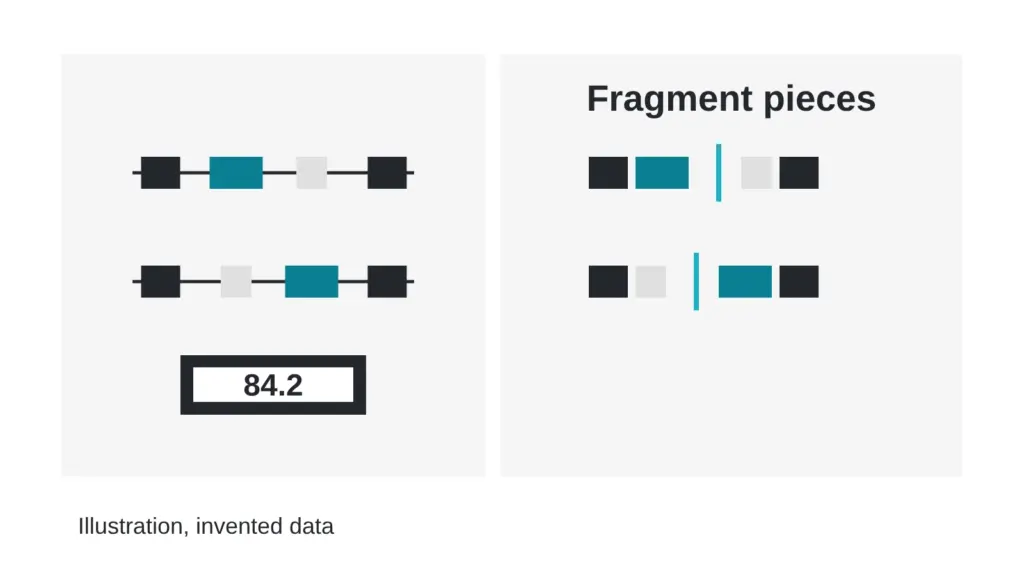
A report lists an expected mass of 842.4 and a measured mass of 842.4. Both numbers are invented for teaching. They agree to the last digit, and the line beneath them says “identity confirmed.” Does a match like that prove the sample is the intended molecule?
It proves less than most readers assume. This article shows where the gap sits, names four ways a wrong molecule can pass a mass check, and explains what closes the gap. Terms are defined in the The testing glossary: 14 lab terms in plain English.
What a mass measurement sees
A mass spectrometer weighs the whole molecule. That weight is the sum of its parts. A matching mass confirms that the parts add up. It cannot confirm the order in which they are joined.
Mass tells you which letters are in the word. It cannot tell you the spelling. “Listen” and “silent” weigh the same on a scale of letters.
Four ways to match the mass and still be a different molecule
| Case | What differs | Does the intact mass catch it? |
|---|---|---|
| Swapped neighbors | Two adjacent units exchange places | No. Same parts, same total. |
| Same-mass building blocks | One unit is replaced by a different unit that happens to have identical mass | No. The total does not move. |
| Mirror-image form | One unit is the mirror-image version of the intended one | No. Same formula, same mass. |
| Deletion with an offsetting change | A missing unit is balanced by a change elsewhere | It can land on the target mass, especially on a low-resolution instrument. |
A plain deletion shifts the mass by a known step and is usually visible. The trouble starts when changes offset each other, or when the allowed tolerance is wide enough to swallow a small gap.
These are not exotic. A review of reference standards for synthetic peptides, written by a pharmacopeial group, notes that features such as chiral or isobaric building blocks may call for additional techniques to characterize a material fully (McCarthy et al., 2023). A strategy paper on quality control lists substitutions, chain cleavages and mirror-image isomers among the look-alike impurities that can co-elute with the target in reversed-phase liquid chromatography (Stoll et al., 2023).
A worked example with invented units
Give five units invented colors and invented masses: red 10, blue 20, green 30, yellow 40 and white 50 mass units. The intended molecule is red, blue, green, yellow, white. A look-alike has blue and green swapped: red, green, blue, yellow, white. Both total 150, so an intact mass check passes both.
Now break each one from the left and weigh the pieces. The intended molecule gives pieces of 10, 30, 60 and 100. The look-alike gives 10, 40, 60 and 100. The second piece differs, 30 against 40, and that single mismatch exposes the swap.
What fragmentation adds
Tandem mass spectrometry selects the intact ion, breaks it apart and weighs the pieces. The pattern of pieces reads like a ladder, and the ladder follows the order of the units. Swapped neighbors change the piece sizes at the swap point, so the ladder can expose a mistake that the total hides.
Why the tolerance matters
Every mass check has a tolerance, often written in parts per million. An invented example: a tolerance of 5 parts per million on a mass of 842.4 allows about 0.004 mass units of wiggle room. Two molecules whose masses differ by less than that cannot be separated by the total alone, however good the instrument. A report that states the tolerance lets you judge how much a match really rules out. A report that omits it asks you to trust the word “match.”
Where fragmentation runs out
Ordinary fragmentation has blind spots. In a study of two isomeric peptides, the common standard fragmentation approach gave the same fragment masses for the two isomeric units, so the protonated forms could not be told apart. A different way of generating the ions produced characteristic side-chain losses that did separate them (Wee et al., 2002).
The lesson is practical. A laboratory has to pick an experiment aimed at the specific doubt. A fragment ladder that cannot distinguish the suspect units still shows a perfect-looking pattern for the wrong molecule.
What else closes the gap
Several kinds of evidence add up, and none is enough alone:
- Retention time against a reference run on the same system. Isomers sometimes separate, though look-alikes can also co-elute: a proteomics study found three related forms of one peptide co-eluted in reversed-phase chromatography and needed a second separation dimension to resolve them (Hao et al., 2012).
- Nuclear magnetic resonance, which maps how atoms connect.
- Composition analysis, which counts the units without reading their order.
- Chiral methods, aimed at the mirror-image question.
Identity is a body of evidence, not a single digit. The longer walk-through is in How labs confirm what a molecule is: mass, fragments and structure, and the question of which test answers which doubt is in CHNS, liquid chromatography or LC-MS: which test answers which question?.
Myth versus reality
A clean chromatogram plus a matching mass equals identity. Reality: that pair shows the sample is mostly one thing and that the thing has the right total weight. A same-mass look-alike that happens to elute close to the target passes both checks.
Quick check you can do today
Open an identity section and count the evidence types. Expected mass, observed mass and the allowed tolerance make one type. Fragment data is a second. A side-by-side run with a reference is a third. If the section holds only one pair of numbers, you have a consistent weight and no evidence about order. A fair question to send: what supports the order of the units, and not only their total? More wording is in The questions a good testing lab answers without flinching.
Sources
- McCarthy D, Han Y, Carrick K, Schmidt D, Workman W, Matejtschuk P, Duru C, Atouf F. Pharmaceutical Research, 2023, volume 40(6), pages 1317-1328. PubMed ID 36949371. DOI 10.1007/s11095-023-03493-1. Descriptor: review of how reference standards for synthetic peptides are characterized, noting that chiral or isobaric building blocks may need additional techniques.
- Stoll DR, Sylvester M, Euerby MR, Buckenmaier SMC, Petersson P. Journal of Chromatography A, 2023, volume 1693, article 463873. PubMed ID 36871316. DOI 10.1016/j.chroma.2023.463873. Descriptor: method-development paper on two-dimensional liquid chromatography for checking whether similar impurities co-elute with a target peptide.
- Wee S, O’Hair RAJ, McFadyen WD. Rapid Communications in Mass Spectrometry, 2002, volume 16(9), pages 884-890. PubMed ID 11948821. DOI 10.1002/rcm.658. Descriptor: tandem mass spectrometry study of two isomeric peptides, comparing standard fragmentation with a radical-cation approach.
- Hao P, Qian J, Dutta B, Cheow ESH, Sim KH, Meng W, Adav SS, Alpert A, Sze SK. Journal of Proteome Research, 2012, volume 11(3), pages 1804-1811. PubMed ID 22239700. DOI 10.1021/pr201048c. Descriptor: proteomics method paper on separating isomeric forms of the same peptide that co-elute in reversed-phase liquid chromatography.
Want the catalog? Register free