
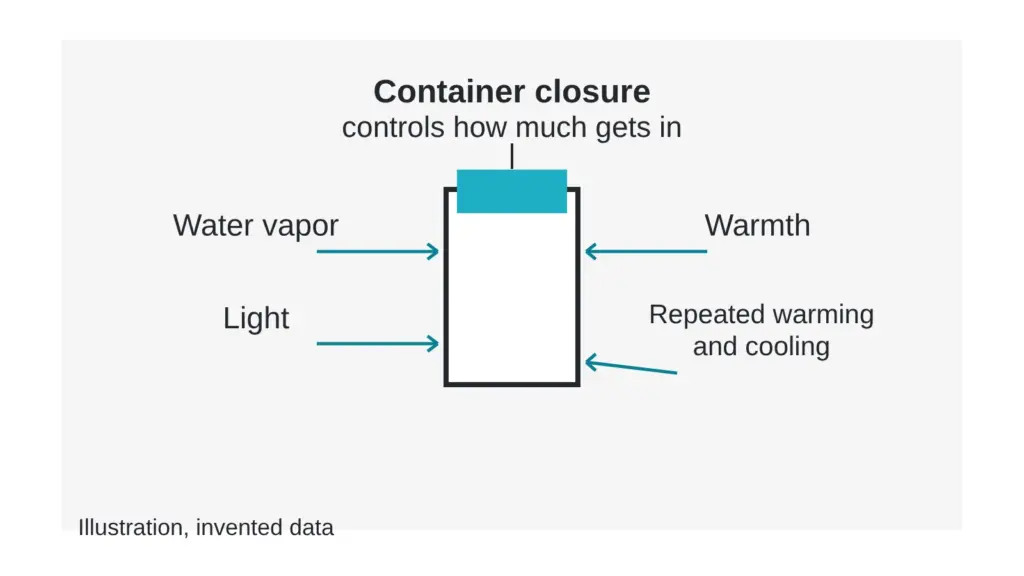
Storing a dry research material comes down to four factors: moisture, temperature, light and the container. This article explains why each one matters in general terms. It does not set a shelf life for any specific material, because a shelf life is a claim that needs stability data for that material, that container and that condition. Terms are defined in the The testing glossary: 14 lab terms in plain English.
Moisture comes first
Drying works because water is removed, as described in Inside a freeze-dried cake: what lyophilization leaves behind. Water is also the thing that comes back. When a dry solid takes up moisture, molecules regain mobility and the reactions that drying had slowed can resume.
Published work backs this up. A lyophilized protein exposed to elevated temperature and moisture formed both covalent and noncovalent aggregates, and the amount of aggregation correlated with how much water the powder had taken up (Costantino et al., 1994). In a freeze-dried antibody formulation, the glass transition temperature fell from 80 degrees Celsius at 1 percent residual moisture to 25 degrees at 8 percent. Samples with more moisture aggregated faster above that transition, and higher moisture reduced chemical stability whether the solid was glassy or rubbery (Breen et al., 2001).
Worked example with invented numbers
A dry solid weighs 50.0 mg and contains 0.5 mg of water, which is 1.0 percent. Suppose it then takes up 1.0 mg more water from humid air.
- Water is now 0.5 + 1.0 = 1.5 mg.
- Total mass is 50.0 + 1.0 = 51.0 mg.
- Water content is 1.5 divided by 51.0, about 2.9 percent.
A gain of 1.0 mg on a 50 mg solid almost tripled the water percentage. Small absolute gains matter a lot to a low-moisture solid, and a weighing at the start and end of a storage period can reveal them. The numbers are invented.
Temperature
Chemical and physical degradation both speed up as temperature rises. A review of protein instability describes the chemical routes, including proteolysis, deamidation, oxidation, racemization and beta-elimination, and the physical routes, including aggregation, precipitation, denaturation and adsorption to surfaces (Manning et al., 1989). A later review adds a discussion of stabilization in the dried state and of how chemical and physical instability relate to each other (Manning et al., 2010).
In the antibody study above, all formulations were stable at 5 degrees Celsius over 6 or 12 months. Both chemical and physical degradation followed Arrhenius kinetics in the glassy state, so rates climbed predictably with temperature (Breen et al., 2001). Colder storage slows these processes. It also creates a handling risk: a cold container opened in humid air collects condensation, which adds water to a dry solid.
Reading a storage statement
A storage statement on a label or report is shorthand for a set of conditions. Ask what each term assumes. Does “cool” mean a refrigerator range or a room range? Does “dry” mean a sealed container, a desiccant, or both? Does the statement apply to the sealed container only, or also after it has been opened? A statement that cannot answer those questions is a hint, not a specification. Comparing it against the transit and stability literature in A hot truck and a dry sample: what heat in transit can and cannot change helps judge how much weight it deserves.
Light and oxygen
Some amino acid residues are sensitive to light and to oxygen, which is why amber glass, opaque secondary containers and tight closures are common for research materials. The extent of sensitivity depends on the sequence and the formulation.
The container closure
The closure and container decide how much water vapor and oxygen reach the solid over time. A well-sealed container slows moisture uptake, and a poorly seated closure defeats months of careful drying. Repeated warming and cooling can pump moist air in and out, so fewer temperature swings are better than many.
Records
A storage record needs only a few entries: the lot identifier, the date received, the storage condition, the dates the container was opened, and a temperature record if one is available. With those entries, a later question about a sample, such as whether a transit event could matter (see A hot truck and a dry sample: what heat in transit can and cannot change), can be answered from evidence. Dates on a laboratory report are discussed in Five dates on a COA and what each one really means.
Why durations are not given here
Claims such as a year or two at a given temperature belong to a specific material with data behind it. Without that data, a figure is a guess. The sensible habit is to ask for the stability data that supports any stated period.
Sources
- Costantino HR, Langer R, Klibanov AM. Pharmaceutical Research, 1994, volume 11(1), pages 21-29. PubMed ID 8140052. DOI 10.1023/a:1018981208076. Descriptor: moisture and temperature induced aggregation of a lyophilized protein, correlated with water uptake.
- Breen ED, Curley JG, Overcashier DE, Hsu CC, Shire SJ. Pharmaceutical Research, 2001, volume 18(9), pages 1345-1353. PubMed ID 11683251. DOI 10.1023/a:1013054431517. Descriptor: effect of residual moisture and glass transition temperature on a freeze-dried antibody formulation.
- Manning MC, Patel K, Borchardt RT. Pharmaceutical Research, 1989, volume 6(11), pages 903-918. PubMed ID 2687836. DOI 10.1023/a:1015929109894. Descriptor: review of chemical and physical decomposition pathways for protein pharmaceuticals.
- Manning MC, Chou DK, Murphy BM, Payne RW, Katayama DS. Pharmaceutical Research, 2010, volume 27(4), pages 544-575. PubMed ID 20143256. DOI 10.1007/s11095-009-0045-6. Descriptor: update review covering chemical and physical instability and stabilization in the dried state.
Want the catalog? Register free