
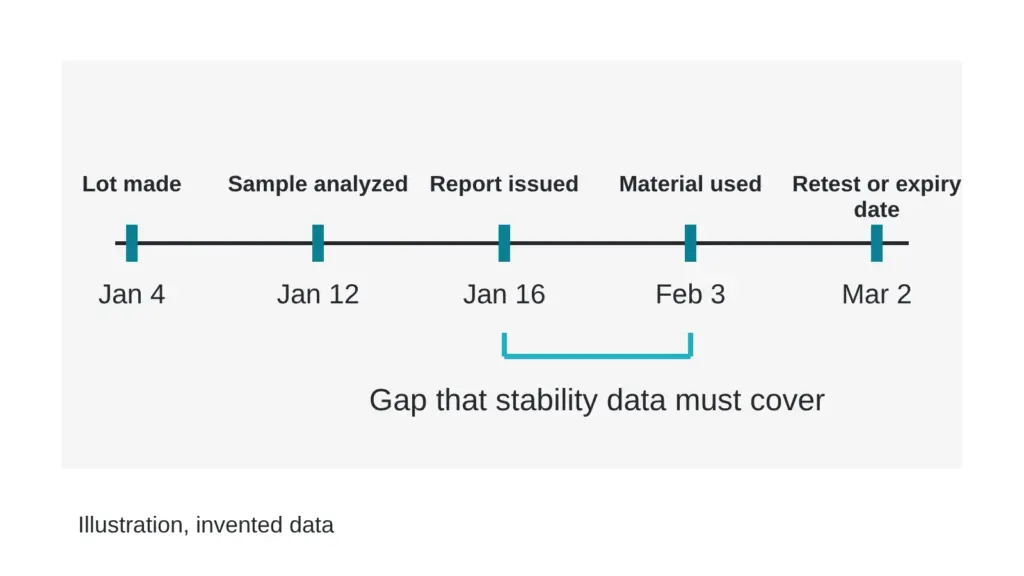
A certificate of analysis can carry several dates, and readers often mix them up. A report that looks old raises the question whether the material is old. A report that looks new raises the opposite assumption. Neither follows from the date alone. This article sorts out what each date records and what it cannot show. Terms are defined in the The testing glossary: 14 lab terms in plain English.
The dates that can appear
| Date | What it records | What it does not tell you |
|---|---|---|
| Lot or manufacture date | When the lot was produced | When it was tested or how it has been kept |
| Sample or receipt date | When the laboratory took in the sample | Whether the sample represents the whole lot |
| Analysis date | When the instrument runs happened | How the material has aged since |
| Report issue date | When the document was signed off | When the analysis was done, which may be earlier |
| Retest or expiry date | The date by which material should be re-examined, or after which it is no longer supported | Anything, unless stability data stands behind it |
Not every report shows all five. A report that shows one date without saying which kind it is leaves the reader guessing.
A report date describes an event
The analysis date says when a sample from the lot was measured. The material may then wait before it is used. A new report on an older lot is not an error, and an older report is not by itself a warning. What matters is whether the evidence covers the span between the measurement and the day of use.
Neither a recent date nor an old one measures freshness. A recent date shows that testing was recent. It does not show that the method was good, and it says nothing about storage between the test and the day of use.
How a date is earned: stability data
A retest or expiry date is a claim about the future, and it is supported by stability studies. Programs that certify reference materials show the pattern. For candidate milk powder reference materials, one program tested homogeneity, short-term stability at 4, 18 and 40 degrees Celsius with measurements at 0, 1, 2 and 4 weeks, and long-term stability at minus 20 and 4 degrees with measurements at 0, 6, 12 and 18 months. It found no significant trends and calculated stability error margins of 7.4 and 6.3 percent for a shelf life of 6 years at minus 20 degrees (Josephs et al., 2005).
For synthetic peptides, a review from the United States Pharmacopeial Convention describes reference-standard programs that combine value assignment by mass balance with stability studies on the vialed material (McCarthy et al., 2023).
Monitoring has to continue. A multi-supplier comparison of liquid reference standards recommended continuous long-term monitoring of stability, noting that otherwise a product may show a target value of only 80 percent, as seen in one instance (Steiner et al., 2024). That study concerns a different class of material, but the lesson carries: a date on paper is only as good as the monitoring that backs it.
Worked example with invented dates
All dates below are invented for teaching.
| Event | Date |
|---|---|
| Lot made | 3 March |
| Sample analyzed | 10 March |
| Report issued | 14 March |
| Material used | 14 October |
The gap between report issue and use is 7 months. Now compare two cases.
- Case one: a stability program supports 24 months at the stated storage condition. The 7 month gap sits well inside that window, so the analysis date and the use date are connected by data.
- Case two: the stability program only supports 3 months. The 7 month gap runs past it. That does not mean the material changed. It means nothing on the page connects the test to the use, and a retest would be the way to close the gap.
What the dates cannot show
Dates do not show the storage conditions between the test and the day the material arrived. They do not show whether the sample tested came from the same lot as the container in hand, which is why the lot identifier on the report and on the label has to match. They also do not show whether the sample was representative of the whole lot.
A checklist for reading the dates
- Does the lot identifier on the report match the one on the label?
- Is the analysis date given separately from the issue date?
- Is there a retest or expiry date, and which stability data supports it?
- Which storage condition does that date assume? Storage principles are in Storage mistakes that quietly add water to a dry sample.
- Has the lot been tested again since, and was the same method used?
For other questions to put to a laboratory, see The questions a good testing lab answers without flinching. The difference between content, purity and identity values on the same report is covered in CHNS, liquid chromatography or LC-MS: which test answers which question?.
Sources
- McCarthy D, Han Y, Carrick K, Schmidt D, Workman W, Matejtschuk P, Duru C, Atouf F. Pharmaceutical Research, 2023, volume 40(6), pages 1317-1328. PubMed ID 36949371. DOI 10.1007/s11095-023-03493-1. Descriptor: peptide reference standards, value assignment by mass balance and stability studies.
- Steiner D, Bartok T, Sulyok M, Szekeres A, Varga M, Horvath L, Rost H. Toxins, 2024, volume 16(9), article 397. PubMed ID 39330855. DOI 10.3390/toxins16090397. Descriptor: multi-supplier comparison of liquid reference standards, with a recommendation for continuous stability monitoring.
- Josephs RD, Ulberth F, Van Egmond HP, Emons H. Food Additives and Contaminants, 2005, volume 22(9), pages 864-874. PubMed ID 16192073. DOI 10.1080/02652030500166537. Descriptor: homogeneity and short- and long-term stability testing of candidate certified reference materials.
Want the catalog? Register free