
On a laboratory report, the line for counterion content is often the shortest and the most skipped. It can also be the line that moves the content value the most. A 2012 methods paper asks a plain question about that line: which instrument can actually count these ions?
This is a journal club piece, built from the published abstract and PubMed record (PubMed ID 22252914). It describes the paper by type, as a comparison of analytical techniques for counter-ions in synthetic peptides, and follows five questions: what it set out to do, how it did it, what it found, what that means for reading a report, and what it cannot tell you. Terms are defined in the The testing glossary: 14 lab terms in plain English.
What did the paper set out to do?
Synthetic peptides are usually delivered as salts, so each molecule travels with counter-ions such as acetate, trifluoroacetate or chloride. Those ions have mass, and a weighed sample contains them. The authors set out to test how well three different analytical techniques could determine them: ion chromatography, capillary electrophoresis and capillary isotachophoresis. The background on why these ions are present is in The salt nobody lists: how a counterion changes what a vial really holds.
How did it go about it?
The abstract says the authors analyzed three ions, acetates, trifluoroacetates and chlorides, with each of the three techniques and compared how they performed. They judged the techniques on points that include the limit of detection and the limit of quantification, which are the smallest amounts a method can reliably see and reliably measure.
All three techniques separate and count ions, but they do it differently. Ion chromatography sends the sample through a column that holds ions with different strength. Capillary electrophoresis separates ions by how fast they move in an electric field inside a thin tube. Isotachophoresis sorts them into consecutive zones as they migrate. Different physics means different weak spots, which is why a comparison like this is useful.
The paper also tested several sample-solvent procedures followed by freeze-drying, as a way to lower trifluoroacetate content. That part is outside the scope of this article.
What did it find?
The abstract reports four findings.
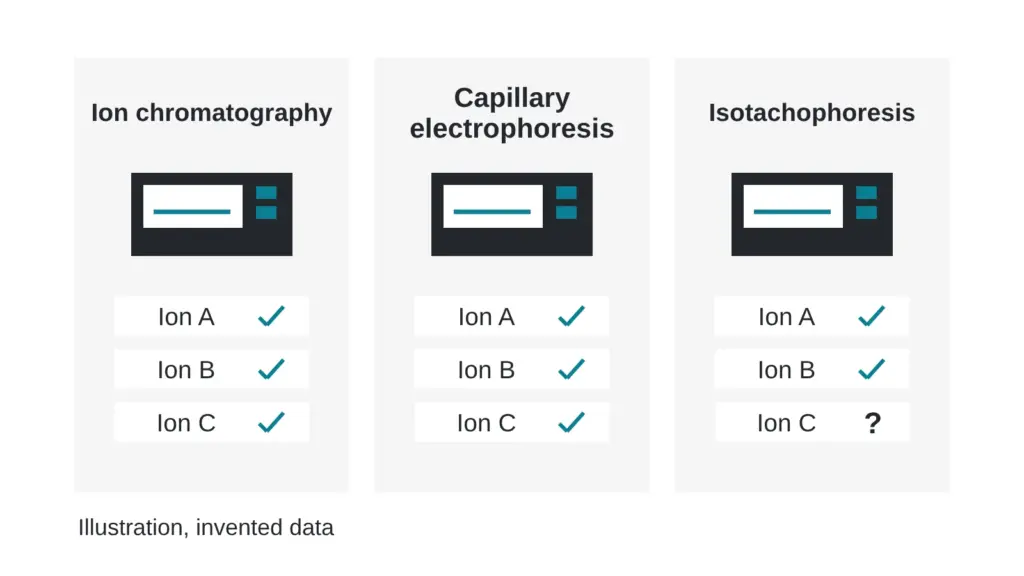
- Ion chromatography ranked first of the three techniques.
- Capillary electrophoresis was comparable to it in most respects, with the exception of limit of detection and limit of quantification.
- Isotachophoresis was ranked least useful, because chloride was difficult to determine with it.
- All three techniques could analyze trifluoroacetate and acetate ions satisfactorily, as the authors judged it.
Notice what the ranking says. Among these three techniques, ion chromatography handled all three ions best. It does not say ion chromatography beats every possible method.
A newer methods paper adds a second view. A 2025 study of synthetic peptides quantified trifluoroacetate with three different approaches: infrared spectroscopy, fluorine nuclear magnetic resonance and liquid chromatography with an evaporative light-scattering detector. The authors reported that all three detection methods were validated according to ICH guidelines, and they concluded that their work stresses that counterion content should be quantified and specified (Erckes et al., 2025).
What does it mean for reading a laboratory report?
A counterion line should name its method, because the methods differ in what they can see. Liquid chromatography with ultraviolet detection, the workhorse behind most purity percentages, tracks the peptide. It is the wrong instrument for counting the ions riding along with it, which is why content and purity are separate questions; see The question every buyer should ask: purity or content?.
The ions can be a large share of the weighed mass. In a purity assignment study of a candidate peptide reference material, trifluoroacetic acid measured by a fluorine nuclear magnetic resonance method made up nearly 25 percent by mass and was treated as an impurity (PubMed ID 30143839, 2018). The next table uses invented numbers to show how that plays out. All values are invented for teaching.
| Quantity (invented) | Value |
|---|---|
| Weighed sample | 10.0 mg |
| Water at 5.0 percent | 0.5 mg |
| Counterion at 20.0 percent | 2.0 mg |
| Left for the peptide itself | 7.5 mg |
A report that skipped the counterion line would credit the peptide with 9.5 mg, an overstatement of about 27 percent over the true 7.5 mg. A full worked example is in Why a 10 mg label can hold only 6.9 mg of the molecule: a worked example.
A counterion line you cannot audit is a guess with a decimal point.
Here is what to look for on a report:
| Detail | Why it matters |
|---|---|
| Ion named (trifluoroacetate, acetate, chloride) | Different ions, different masses |
| Method named | The paper shows that techniques differ at the low end and for chloride |
| Value given as a percent of the weighed mass | It must be on the same basis as the water and content lines |
| Same lot as the other lines | Lots can differ in counterion content |
What can the paper not tell you?
- It cannot say how much counterion a typical sample holds. The abstract gives no content figures.
- It cannot rank methods outside the three it tested. Nuclear magnetic resonance and other techniques appear in later papers, not in this comparison.
- It cannot vouch for any one sample. A method that works satisfactorily in the authors’ hands still needs to be validated in the laboratory that reports your number.
- It cannot replace the full text. The abstract gives no detection limits, so this summary leaves them out.
Quick check you can do today
Pick one report and find the counterion line. Check four things: the ion is named, the method is named, the value sits on the same weighed-mass basis as the water line, and the lot matches. If the line is absent, ask where the counterion was accounted for. The related question of which test answers which question is covered in CHNS, liquid chromatography or LC-MS: which test answers which question?.
Sources
- Mrozik W, Markowska A, Guzik L, Kraska B, Kamysz W. Journal of Peptide Science, 2012, volume 18(3), pages 192-198. PubMed ID 22252914. DOI 10.1002/psc.1436. Descriptor: methods comparison of ion chromatography, capillary electrophoresis and capillary isotachophoresis for counter-ions in synthetic peptides.
- Erckes V, Streuli A, Chamera Rendueles L, Kramer SD, Steuer C. Pharmaceuticals (Basel), 2025, volume 18(8). PubMed ID 40872554. DOI 10.3390/ph18081163. Descriptor: study of counterion analysis in synthetic peptides using three validated detection methods.
- PubMed ID 30143839, 2018. Descriptor: purity assignment for a candidate peptide reference material that combines quantitative nuclear magnetic resonance and amino acid analysis with a mass balance prior.
Want the catalog? Register free