
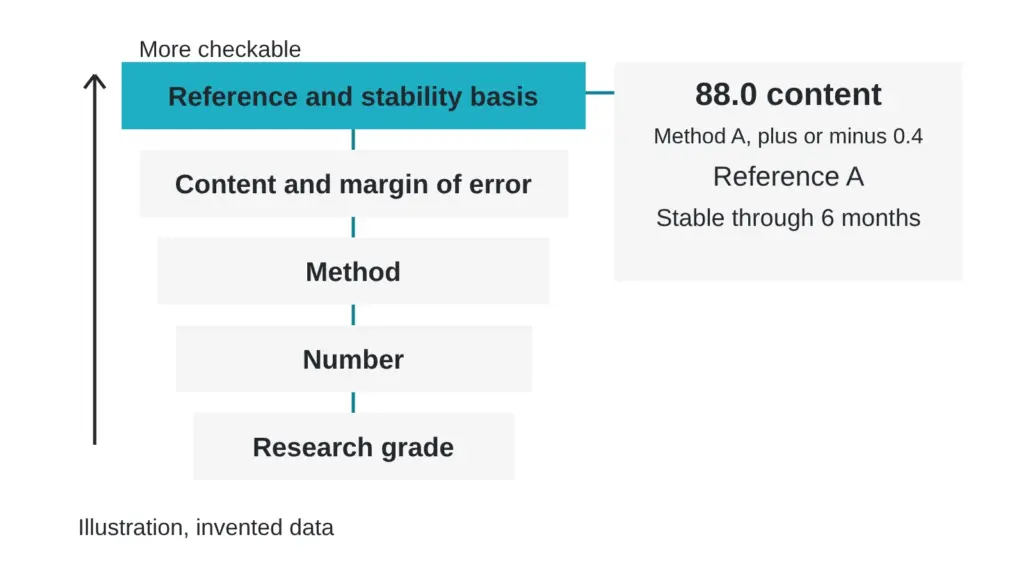
Three pages describe their material in three words: “research grade”. A reader asks the obvious question. Grade according to whom, measured how, against what?
The phrase sounds like a standard and reads like a label. This article does three things. It shows how grade systems work where they are written down, it states what the phrase “research grade” leaves unspecified, and it gives a template for a grade statement that a reader can check. Terms are in the The testing glossary: 14 lab terms in plain English.
A grade is a promise with a specification attached. Without the specification it is decoration.
Where grades are written down
In reagent chemistry, a grade name has long pointed to a written specification: a list of attributes, a limit for each and a method for measuring it. The same logic runs through reference materials. General terms, from the top of the ladder down:
- A primary reference material anchors a measurement scale, and other materials get their values by comparison with it.
- A certified reference material carries a value, a stated margin of error and a documented path to that value.
- A working or secondary standard is valued against a higher-level material and used in routine work.
Published work shows what sits behind the top rungs. One revision of a measurement scale rests on a defined calibration hierarchy, values assigned in a mutually consistent way, and margins that include assessments of inhomogeneity and stability (Assonov et al., 2021). A matrix reference material built under the international reference-material production standard assessed between-unit heterogeneity, stability during dispatch and best storage conditions, took its reference values from an interlaboratory study of laboratories of demonstrated competence, and calculated expanded margins of 4 to 19 percent (PubMed ID 35238378, 2022). For peptides, a pharmacopeial report describes vialing, lyophilization, analytical testing and stability studies, with a two-step value assignment that starts with the bulk material and ends with the vial (McCarthy et al., 2023).
Notice what these have in common: each grade is a set of documented tests plus a number with a margin.
What “research grade” leaves unspecified
We have found no published specification that defines the phrase. What a reader can say with confidence is narrower: the phrase on its own states no attribute, no limit and no method. Two sellers can use it for materials that differ widely, and neither would be wrong by any written rule the reader can look up.
That is a problem of information, and it has a fix. Ask the seller to replace the label with the statement it stands for.
The phrase persists because it is cheap and sounds careful. It costs a seller nothing to print and commits the seller to nothing. A grade statement costs real analytical work, which is exactly why it carries information.
What a useful grade statement contains
A usable statement answers seven questions in plain text.
- Identity: confirmed by which method, against what expected value?
- Purity: measured by which method and conditions, and what does the figure count?
- Content: reported by a separate method, including water and counterion?
- Margin: what range of error comes with each value?
- Reference: what material were the values compared with, and who valued it?
- Lot and dates: which lot, analyzed when, issued when?
- Stability basis: what data supports the retest date?
The way margins accumulate is worth remembering. A traceability review notes that each step in a calibration chain carries a margin and that the combined margin grows with every step (Miller, 2024). A grade statement that names the reference lets a reader count the steps.
An invented grade statement
All values here are invented for teaching.
“Identity: intact mass within 5 ppm of the expected value, plus fragment confirmation. Purity: liquid chromatography at the stated wavelength and gradient, main peak at least 90.0 percent of detected area, with the peak checked for a hidden partner by mass scans across its width. Content: 78.0 percent by weight with a margin of 2.0 percent, by a separate method, with water and counterion measured. Reference: in-house working standard valued against a higher-level material, valuation record attached. Lot 000-X, analyzed on the stated date, issued on the stated date. Retest date supported by stability data at the stated storage condition.”
A reader can argue with every clause. That is the point.
The ladder
| Level | What the page offers | What a reader can check |
|---|---|---|
| 0 | The label alone | Nothing |
| 1 | A single figure | Nothing about its meaning |
| 2 | Figure plus method | Whether the method fits the question |
| 3 | Plus content and a margin | Whether two reports agree within their margins |
| 4 | Plus reference, lot, dates and stability basis | The whole path from sample to statement |
Myth versus reality
Myth: a grade label means somebody set a bar. Reality: a bar exists only where it is written down in a place you can read.
Quick check you can do today
Look at any page that uses a grade word. Write down which of the seven items from the grade statement list it supplies. A page that supplies none sits at level 0 on the ladder. Send the seller one sentence: “Please send the specification behind this grade, with the method, the limit and the reference for each attribute.” The answer shows where the page really sits. How reference standards earn their values is covered in Reference standards: the quiet argument behind every purity number.
Sources
- Assonov S, Fajgelj A, Allison C, Groening M. Rapid Communications in Mass Spectrometry, 2021, volume 35(8), article e9018. PubMed ID 33615572. DOI 10.1002/rcm.9018. Descriptor: paper on the calibration hierarchy and value assignment of isotope reference materials, with margins including inhomogeneity and stability.
- Journal of AOAC International, 2022, volume 105(4), pages 1051-1059. PubMed ID 35238378. DOI 10.1093/jaoacint/qsac034. Descriptor: development of a matrix reference material under the international reference-material production standard, with an interlaboratory study for reference values.
- McCarthy D, Han Y, Carrick K, Schmidt D, Workman W, Matejtschuk P, Duru C, Atouf F. Pharmaceutical Research, 2023, volume 40(6), pages 1317-1328. PubMed ID 36949371. DOI 10.1007/s11095-023-03493-1. Descriptor: report on producing and characterizing reference standards for synthetic peptides.
- Miller WG. Clin Chem Lab Med, 2024, volume 62(8), pages 1462-1469. PubMed ID 38579121. DOI 10.1515/cclm-2023-1201. Descriptor: review of metrological traceability and the growth of combined margins along a calibration chain.
Want the catalog? Register free