
A report says the sample was “quantified against an in-house reference standard.” Another lab’s report on the same powder says “against a certified reference material.” The two numbers do not match. Who is right?
Often the answer sits in the ruler. This article explains what a reference standard is, how primary and secondary standards differ, what an assigned value really states, and where traceability can break. Terms are in the The testing glossary: 14 lab terms in plain English.
A reference standard is a ruler, and every ruler was measured against an older ruler.
What is a reference standard?
It is a material with a documented value for a property, kept so that other measurements have something to be compared with. Many quality tests rely on well-characterized reference standards to judge identity, purity and strength (McCarthy et al., 2023).
A lab that wants to know how much target molecule is in a powder cannot read the number off the powder. It measures the instrument response of the powder, measures the response of the standard, and scales by the standard’s known value. If the standard’s value is off, every sample measured against it is off by the same proportion.
Primary versus secondary: what is the difference?
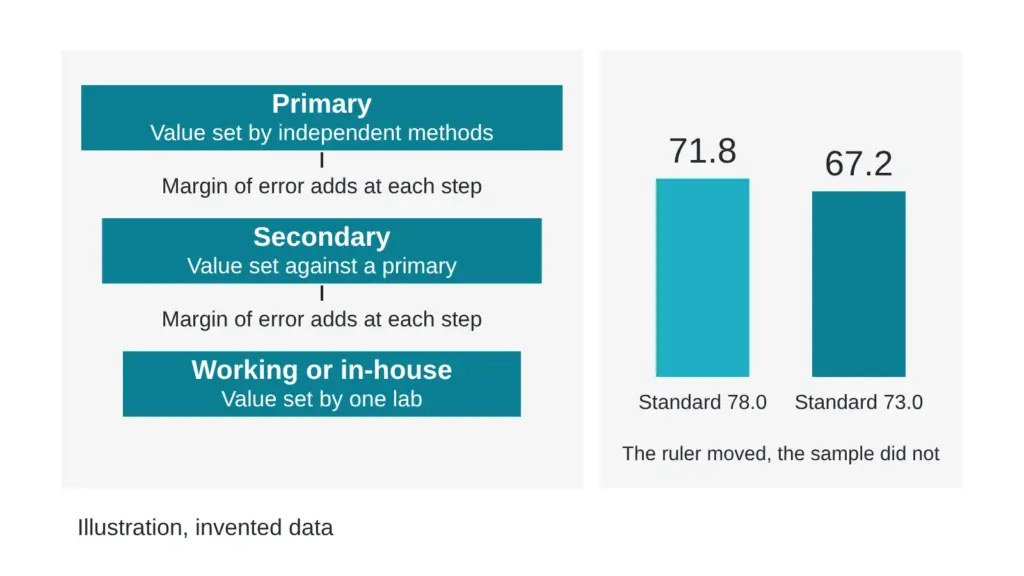
| Level | How its value is set | What to ask |
|---|---|---|
| Primary | Assigned by methods that do not depend on another standard of the same molecule, such as mass balance, quantitative NMR or amino acid analysis | Which methods, and how well do they agree? |
| Secondary | Assigned by comparing the material with a primary standard | Which primary standard, and when? |
| Working or in-house | Assigned by a lab, often against a secondary standard or by its own methods | Who assigned it, and is the paperwork available? |
The middle and bottom rows rest on the top row. One case study from a pharmacopeial group describes a two-step process: a mass balance approach assigns a quantitative value to a bulk material, then the bulk material serves as the standard to assign a final value to the vialed material (McCarthy et al., 2023). A reference-method paper describes a similar split. A characterized recombinant protein served as the primary calibrator, with traceability to SI units established by high-resolution mass spectrometry and amino acid analysis, and the method was designed to assign target values to secondary certified reference materials (Huynh et al., 2022).
What is an assigned value?
An assigned value is the number a standard comes with, such as a content figure in milligrams of target per gram of material. It is built from measurements. The build is a mass balance (see How a reference standard gets its number, and who checks the math) or a direct measurement, and often both.
A good assigned value comes with a margin of error. A mass balance study of a synthetic peptide reported its assigned value together with a stated measurement margin, and verified the method through an international comparison between metrology institutes (Wang et al., 2021). Another group assigned a peptide reference value by combining three orthogonal methods, quantitative NMR, amino acid analysis and mass balance, and found good agreement, with the counterion counted as an impurity because it made up a large share of the mass (Melanson et al., 2018). Agreement between independent methods is what earns confidence. A value with no margin attached is a number without a promise.
A worked example with invented numbers
Suppose a standard carries an invented assigned content of 78.0 percent. A lab measures a sample and finds its response is 0.92 times that of the standard at equal weight. The sample content is 0.92 times 78.0, which is 71.8 percent.
Now suppose a better assignment later shows the standard was really 73.0 percent. The same measurement gives 0.92 times 73.0, which is 67.2 percent. The instrument, the analyst and the sample did not change. The ruler did. That is why a report should name its standard and the date its value was assigned.
Why does everyone argue?
Five fault lines show up again and again. None of them requires anyone to be careless, because each one quietly changes the ruler:
- Different definitions: one lab means purity by area, another means content by mass balance. See The question every buyer should ask: purity or content?.
- Different inclusions: a value that subtracts water and counterions differs from one that does not.
- Different chains: a standard assigned by a national institute and one assigned by a single lab sit at different distances from the top.
- Different ages: standards change over time, so reference programs include stability studies and checks for variability and outliers (McCarthy et al., 2023).
- Different documents: some labs share the standard’s certificate and some only name it.
What does traceability mean?
Traceability is a documented chain of comparisons from your number up to a stated reference, ideally the SI units. Each link has its own margin of error, and the margins add up. The chain in the mass balance study above ended at SI units through named methods and an international comparison (Wang et al., 2021).
Traceable means the chain is documented. Exactness is a separate matter, set by the margin of error at each link. A long, well-documented chain can produce a wider margin than a short one. Accreditation helps, because a lab working to a recognized quality standard must show its calibration chain. See ISO 17025: what the accreditation covers and what it leaves out.
Myth versus reality
“Quantified against a reference standard” means the number is accurate. Reality: the number is as accurate as the standard’s assigned value and as well documented as its chain.
Quick check you can do today
Find the line in a report that names the standard, and write down five things: its name or ID, who assigned the value, by what methods, on what date, and what margin of error came with it. Any blank is a question. Then ask whether the standard’s own certificate can be shared. For a method that counts units directly, see How labs count what is in a vial: amino acid analysis explained.
Sources
- McCarthy D, Han Y, Carrick K, Schmidt D, Workman W, Matejtschuk P, Duru C, Atouf F. Pharmaceutical Research, 2023, volume 40(6), pages 1317-1328. PubMed ID 36949371. DOI 10.1007/s11095-023-03493-1. Descriptor: review of how reference standards for synthetic peptides are produced, value-assigned and monitored for stability.
- Huynh HH, Delatour V, Derbez-Morin M, Liu Q, Boeuf A, Vinh J. Analytical Chemistry, 2022, volume 94(10), pages 4146-4154. PubMed ID 35235744. DOI 10.1021/acs.analchem.1c03061. Descriptor: candidate reference measurement procedure paper describing a characterized primary calibrator and the assignment of values to secondary reference materials.
- Wang S, Wu P, Li M, Huang T, Shi N, Feng L, Li H. Journal of Pharmaceutical and Biomedical Analysis, 2021, volume 207, article 114401. PubMed ID 34656934. DOI 10.1016/j.jpba.2021.114401. Descriptor: mass balance purity assignment for a synthetic peptide with SI-traceable value and an international comparison.
- Melanson JE, Thibeault MP, Stocks BB, Leek DM, McRae G, Meija J. Analytical and Bioanalytical Chemistry, 2018, volume 410(26), pages 6719-6731. PubMed ID 30143839. DOI 10.1007/s00216-018-1272-7. Descriptor: purity assignment for a peptide certified reference material by combining quantitative NMR, amino acid analysis and mass balance.
Want the catalog? Register free