
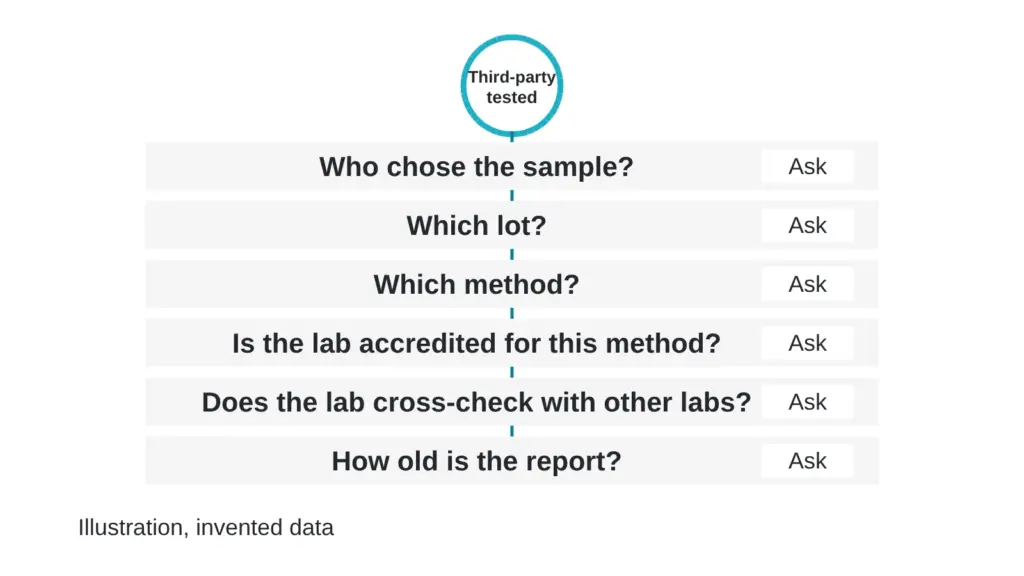
A green badge sits in the corner of a page: “third-party tested”. It looks like an answer. Look closer and it is a heading with no paragraph under it. Tested for what, on which sample, by which method, in a laboratory approved for that method or not?
This article lists the six questions that sit behind the badge and gives you a way to ask each one in a single line. The goal is a reader who can tell a badge with evidence behind it from a badge with a logo behind it. Terms are in the The testing glossary: 14 lab terms in plain English.
A badge names who held the instrument. The report says what the instrument was asked.
What the badge does establish
It establishes one thing: someone other than the seller operated the measurement. That has real value, because it removes the most obvious conflict of interest. The background is covered in Independent testing: what independence proves and what it does not.
Everything else a reader cares about sits outside the badge. The six questions below are where the evidence lives.
Question one: who chose the sample?
An outside laboratory measures whatever it is handed. If the seller picked, prepared and shipped the sample, the laboratory’s independence covers the instrument and not the selection. A report should say who collected the sample, when, and from which lot. When it says nothing, the independence stops at the lab door.
Question two: which lot was it?
The lot identifier connects a page to a physical container. A badge that sits on a whole product line, with no lot on the report behind it, certifies a category. Ask for the lot identifier on the report and compare it with the one on your container.
Question three: which method, with which settings?
“Tested” covers anything from a quick identity check to a full content assay. The method decides what the test could possibly have found. Identity, purity and content are different questions, and each one needs its own method.
Question four: is the laboratory accredited for that method?
Accreditation to the international laboratory competence standard is described as objective evidence of the technical competence of testing and calibration laboratories (Franic et al., 2020). It comes attached to a scope, and the scope is the fine print: a published account from public health laboratories notes that a requested test method may fall outside the scope of a laboratory’s accreditation (Wangsness et al., 2017). The same account also covers laboratories for whom accreditation is not feasible and lists quality-system practices they can follow, which means the absence of accreditation tells you to ask for more evidence, and its presence tells you to check the scope. What the standard covers is explained in ISO 17025: what the accreditation covers and what it leaves out.
Question five: does the laboratory check itself against other laboratories?
Competent laboratories still disagree with one another. A five-laboratory comparison of mass spectrometry methods found good or acceptable agreement overall, yet it also uncovered operator errors, bias at some sites, and a bias that earlier proficiency testing had not identified (Braun et al., 2023). Regular cross-checking is how a laboratory finds its own blind spots. Labs grading labs: how proficiency testing keeps numbers honest shows how the schemes work.
Question six: how old is the report?
A report describes the day of the analysis. It says little about material handled since. Ask for the analysis date, the issue date and the date range that stability data support.
What a badge with evidence behind it looks like
A useful badge works as a doorway. It links to a report that names the lot, the method and the analysis date, and it says who collected the sample. Here is an invented caption of that kind: “Sample drawn from lot 000-X by the testing laboratory on the stated date. Method named on the report. Analysis date and issue date shown. Full report on request.”
The caption makes claims a reader can check against the page behind it. A caption that reads only “third-party tested” makes a claim a reader can only admire. The first earns trust with details, and the second asks for trust in advance.
The badge decoder
| Badge claim | What it establishes | What stays open | One-line question |
|---|---|---|---|
| Third-party tested | An outside operator ran the instrument | Sample choice, lot, method | “Who collected the sample, and from which lot?” |
| Tested by an accredited laboratory | Competence evidence for some scope | Whether your method sits inside the scope | “Is this method listed in the accreditation scope?” |
| Independent verification | An outside party looked | What the party looked at | “Can I see the raw data file for this run?” |
| Recent test | Analysis was timely | Handling since the test | “What is the date of analysis, and what storage followed?” |
Myth versus reality
Myth: a badge means the product passed. Reality: a badge says a test took place. Passing needs a specification, and a specification needs a number and a method written down in advance.
Quick check you can do today
Pick one badge you have trusted. Write down the lot identifier on the matching report, the method named on it, and the date of analysis. If any of the three is missing, send the laboratory or the seller this single line: “Please send the lot, method and analysis date for this report, and say whether the method is in the laboratory’s accreditation scope.” The reply, or the silence, is your answer. More questions to put to a laboratory are in The questions a good testing lab answers without flinching.
Sources
- Franic Z, Bituh T, Godec R, Cackovic M, Mestrovic T, Sisko J. Archives of Industrial Hygiene and Toxicology, 2020, volume 71(4), pages 312-319. PubMed ID 33410772. DOI 10.2478/aiht-2020-71-3449. Descriptor: review of one institute’s experience with laboratory accreditation, including its description of accreditation as evidence of technical competence for stated scopes.
- Wangsness K, Salfinger Y, Randolph R, Shea S, Larson K. Journal of AOAC International, 2017, volume 100(4), pages 1123-1125. PubMed ID 28720178. DOI 10.5740/jaoacint.16-0427. Descriptor: white-paper summary on quality practices for laboratories where accreditation is not feasible or a method is outside the accreditation scope.
- Braun V, Ceglarek U, Gaudl A, Gawinecka J, Muller D, Rauh M, Weber M, Seger C. Clin Chem Lab Med, 2023, volume 62(5), pages 900-910. PubMed ID 38038605. DOI 10.1515/cclm-2023-0847. Descriptor: five-laboratory interlaboratory comparison of mass spectrometry methods.
Want the catalog? Register free