
A report arrives from a laboratory with no stake in the sale. Is the number on it right? The independence is real, and it still does not settle the question.
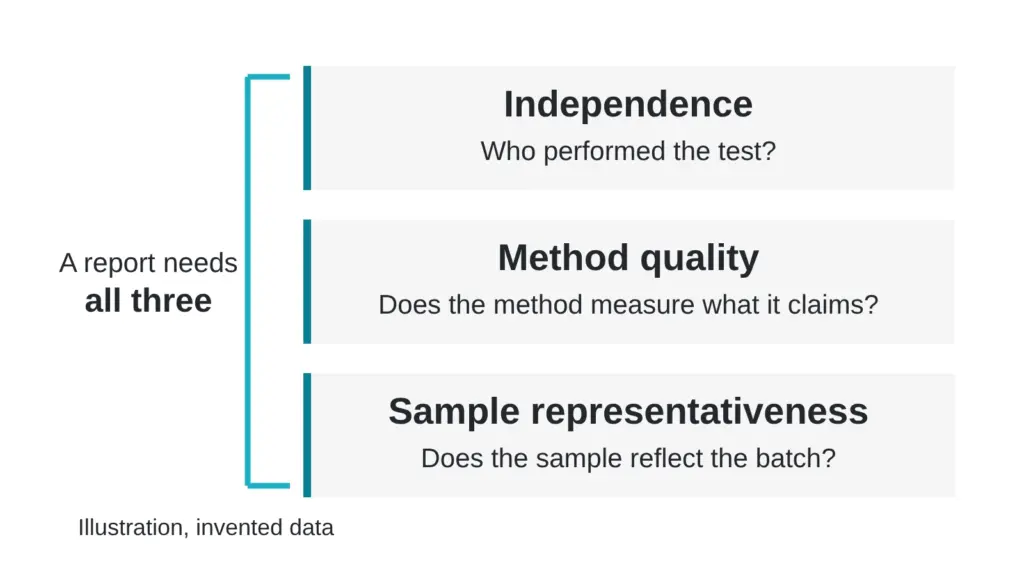
Independence answers one thing: who had a reason to shade the finding. Whether the finding is correct depends on two other things that independence cannot supply, which are the quality of the method and the sample that was tested. This article separates the three and ends with questions that cover the gaps. Terms are in the The testing glossary: 14 lab terms in plain English.
Independence removes a motive. It does not add a method.
A third-party laboratory is paid to measure, not to sell. That matters, because a seller who tests its own material has an obvious incentive to favor a good outcome, even without bad intent. An outside tester removes that pressure.
A tester can be perfectly honest and still produce a poor number, if the method is unsuited to the question or badly run. Honesty and accuracy are separate qualities.
Three questions, three different answers
| Question | What helps answer it | Does independence help? |
|---|---|---|
| Who could have shaded the finding? | The tester’s ownership, funding and relationship to the seller | Yes |
| Was the method fit for the question and well run? | Method validation, accreditation scope, proficiency testing, method details on the report | No |
| Did the tested sample represent the lot? | Sampling plan, number of units, who chose them, chain of custody | Only partly |
A report needs a yes in every row. Independence covers the first.
Method quality varies between independent laboratories
Two independent laboratories can disagree on the same material. In a comparison of several assay types for one dry material, liquid chromatography readings depended on the laboratory that ran them, and amino acid analysis was highly variable in one laboratory and quite precise in another (Vemuri, 2005). Neither laboratory had a reason to cheat. Their methods and their execution differed.
That is why accreditation and proficiency testing exist. A survey of laboratories against the criteria of a laboratory competence standard counted proficiency testing through accredited providers among eight areas, and found it among the weakest in compliance (Bezerra et al., 2025). Read ISO 17025: what the accreditation covers and what it leaves out for how scope fits in.
Sampling is its own source of doubt
A laboratory reports on what it received. If the units sent for testing were chosen by the seller, the tester’s independence covers the measurement and not the choice.
Variation inside a batch makes this real. A paper on freeze-dried products notes that batch freeze-drying has high intra-batch variability, so a high number of samples needs to be tested to get a representative measurement (Bobba et al., 2021). One vial speaks for one vial. Several vials chosen by the tester or a neutral party speak for more of the lot.
What a report covers
A report covers the sample received, on the dates stated, by the methods stated, for the attributes listed. It does not cover storage after the test, attributes that were not tested, or later lots. The dates question has its own walk-through in Five dates on a COA and what each one really means.
Blinding strengthens independence
One design feature worth knowing is blinding. A multi-laboratory reproducibility study of a cell-based assay set up the system independently in three laboratories and used anonymized test materials, so the participants did not know what they were measuring. The study then assessed outliers and agreement between sites (Herwig et al., 2015). The idea carries over to chemistry: a laboratory that does not know which sample is the reference and which is the unknown has fewer ways to be nudged.
How strong is the claim?
Wording tells you how much an independent report can carry. Compare three sentences.
- “An independent laboratory tested this.” Weak. It names no method, sample or date.
- “An independent laboratory tested units drawn by the buyer, using a stated method, on a stated date.” Stronger. Independence, sampling and method all appear.
- The same sentence, plus the scope row, the unit count and the attributes left untested. Strongest. A reader can check every part.
The more of the three rows a sentence names, the less the reader has to take on trust.
Questions to ask
Use these to close the gaps:
- Who owns or funds the testing laboratory, and does it have any relationship with the seller?
- Who chose the sample, how many units were tested, and how did they reach the laboratory?
- Which methods were used, and are they inside the laboratory’s accredited scope?
- Does the laboratory take part in proficiency testing for this kind of measurement?
- Was the sample coded so the laboratory did not know its source?
- Which dates and which attributes does the report cover, and which does it leave out?
The longer list is in The questions a good testing lab answers without flinching. For the reasons that numbers drift between sites, see Same material, two purity numbers: why labs disagree.
Quick check you can do today
Take a report and mark which of the three rows it covers. Independence: do you know who the laboratory is and who pays it? Method: can you find the method details and a scope or validation statement? Sample: can you say who chose the units, and how many? Any row you cannot fill in is a question to send before you rely on the number.
Sources
- Vemuri S. Journal of Peptide Research, 2005, volume 65(4), pages 433-439. PubMed ID 15813890. Descriptor: comparison of four assay types for peptide content in a freeze-dried material, covering precision and laboratory dependence.
- Bezerra LSA, Souza-Neto AC, Chaves PB, Poltronieri CF. Forensic Science International, 2025, volume 371, article 112489. PubMed ID 40318431. DOI 10.1016/j.forsciint.2025.112489. Descriptor: survey of laboratories against eight criteria drawn from a laboratory competence standard, including proficiency testing.
- Bobba S, Zinfollino N, Fissore D. Journal of Pharmaceutical Sciences, 2021, volume 111(5), pages 1437-1450. PubMed ID 34678272. DOI 10.1016/j.xphs.2021.10.015. Descriptor: study of a near-infrared method for residual moisture in freeze-dried products, noting high intra-batch variability.
- Herwig R, Gmuender H, Corvi R, and 21 coauthors. Archives of Toxicology, 2015, volume 90(9), pages 2215-2229. PubMed ID 26525393. DOI 10.1007/s00204-015-1617-3. Descriptor: multi-laboratory reproducibility study of a cell-based assay using anonymized test materials and outlier assessment.
Want the catalog? Register free