


The Internet Says MOTS-C Goes Bad Fast. Our 21-Day Laboratory Study Tells a Different Story.
Few peptides generate more debate regarding stability than MOTS-C.
Search online forums, Reddit discussions, peptide groups, and research communities, and you’ll quickly find a recurring claim:
“MOTS-C degrades almost immediately after reconstitution.”
Some researchers suggest using it within days. Others claim it becomes unstable shortly after mixing. In many discussions, these statements are repeated as accepted fact despite little analytical data being presented.
That raised an important question:
Does reconstituted MOTS-C actually degrade as quickly as many people claim?
At Xcel Peptides, we wanted a data-driven answer.
Instead of relying on anecdotes or assumptions, we commissioned a 21-day stability study utilizing independent third-party laboratory testing from Janoshik Analytical Laboratories.
The results may surprise many researchers.
Why We Conducted This Study
MOTS-C has become one of the most widely discussed mitochondrial peptides in research.
Despite its popularity, there remains significant uncertainty regarding:
-
- MOTS-C stability
-
- Reconstituted MOTS-C shelf life
-
- MOTS-C degradation after mixing
-
- MOTS-C storage conditions
-
- How long MOTS-C lasts in refrigeration
-
- MOTS-C purity over time
Most discussions ultimately rely on speculation.
Very few rely on analytical testing.
As a result, researchers are often forced to navigate conflicting opinions with little actual data available.
This study was designed to provide something the discussion frequently lacks:
Independent laboratory evidence.
Study Design
Three separate MOTS-C vials were tested over a 21-day period following reconstitution.
Testing Schedule
| Timepoint | Date |
|---|---|
| Day 0 – Vials A, B, C (click to view results) | April 23, 2026 |
| Day 7 | April 30, 2026 |
| Day 14 | May 7, 2026 |
| Day 21 – Vials A, B, C (click to view results) | May 14, 2026 |
Study Conditions
-
- All vials were reconstituted prior to testing
-
- Samples remained refrigerated throughout the entire study
-
- Independent testing was performed by Janoshik Analytical Laboratories
-
- Both content (mg) and purity (%) were evaluated at each interval
The objective was simple:
Determine whether refrigerated reconstituted MOTS-C demonstrates significant degradation over a three-week period.
Complete 21-Day MOTS-C Stability Results
The following infographic summarizes all laboratory results obtained during the study.
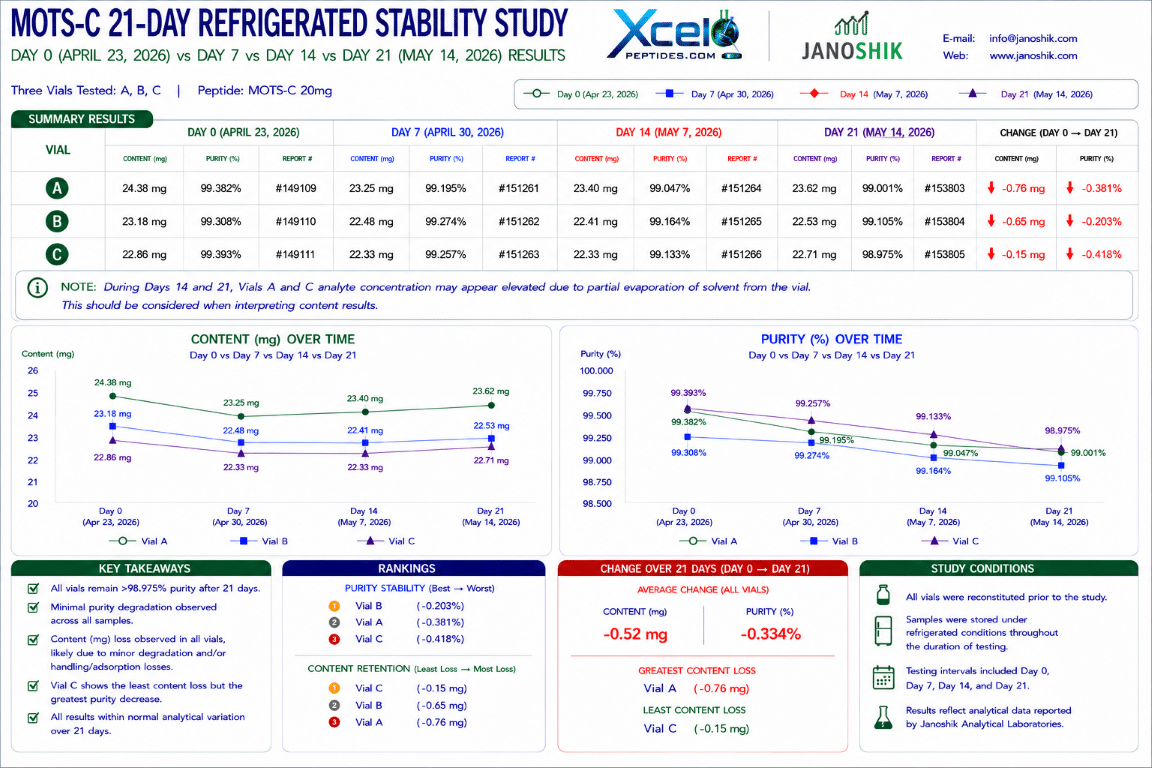
Figure 1. Twenty-one day MOTS-C stability study demonstrating content (mg) and purity (%) measurements across three independently tested reconstituted vials stored under refrigerated conditions.
What the Data Shows
The most important observation is remarkably straightforward:
All three MOTS-C samples remained approximately 99% pure after 21 days of refrigerated storage.
If MOTS-C were degrading rapidly following reconstitution, substantial losses in purity would be expected.
That did not occur.
Day 21 Purity Results
Even after three weeks of storage, purity remained exceptionally high across all tested samples.
Understanding Content Changes vs. Degradation
One of the most common mistakes made when evaluating peptide stability is confusing concentration changes with molecular degradation.
Throughout Days 14 and 21, Janoshik included an important observation regarding certain samples.
Laboratory Note
During Days 14 and 21, Vials A and C analyte concentration may appear elevated due to partial evaporation of solvent from the vial. This should be considered when interpreting content results.
This distinction is important.
When solvent evaporates, concentration measurements may shift despite minimal change to peptide integrity itself.
For this reason, purity measurements frequently provide a more direct indication of peptide stability than content values alone.
Stability Rankings
Purity Stability (Best to Worst)
 Vial B
Purity Change: -0.203%
 Vial A
Purity Change: -0.381%
 Vial C
Purity Change: -0.418%
Content Retention (Best to Worst)
Vial C
Content Change: -0.15 mg
Vial B
Content Change: -0.65 mg
Vial A
Content Change: -0.76 mg
Despite minor variation between samples, all three maintained high purity throughout the study.
Addressing the MOTS-C Degradation Myth
A review of peptide forums and community discussions reveals a recurring narrative:
“MOTS-C degrades extremely fast after mixing.”
The problem is that these statements are often presented without analytical evidence.
This study does not claim MOTS-C is immune to degradation.
All peptides degrade under certain conditions.
However, the data collected during this 21-day evaluation does not support the idea that refrigerated reconstituted MOTS-C rapidly breaks down within days.
If substantial degradation were occurring, researchers would expect to observe:
-
- Significant purity reductions
-
- Pronounced degradation products
-
- Consistent losses across all samples
-
- Rapid analytical decline over time
Those outcomes were not observed.
Instead, all samples remained near 99% purity after three weeks of refrigerated storage.
Why Proper Refrigerated Storage Matters
Storage conditions play a critical role in peptide stability.
Variables that can impact peptide integrity include:
-
- Heat exposure
-
- Temperature fluctuations
-
- Repeated freeze-thaw cycles
-
- Light exposure
-
- Improper handling
-
- Microbial contamination
The results presented in this study apply specifically to reconstituted MOTS-C stored under refrigerated conditions throughout the testing period.
Researchers should avoid extrapolating these findings to improperly stored samples.
What Researchers Can Take Away From This Study
This study provides a practical real-world look at how reconstituted MOTS-C behaved under controlled refrigerated storage conditions.
The data suggests:
✓ Refrigerated reconstituted MOTS-C remained highly pure through Day 21
✓ Rapid degradation was not observed
✓ Three independent samples produced similar stability profiles
✓ Purity remained approximately 99% across the study
✓ Analytical testing provided a clearer picture than anecdotal reports alone
Final Thoughts
The peptide industry is filled with assumptions.
Reliable analytical data is far less common.
After 21 days of refrigerated storage, three independently tested MOTS-C samples maintained approximately 99% purity with relatively minor analytical variation.
While additional studies over longer periods would be valuable, the results of this evaluation challenge one of the most commonly repeated claims surrounding MOTS-C:
That reconstituted MOTS-C rapidly degrades shortly after mixing.
Based on the laboratory findings presented here, that assumption deserves closer examination.
When evaluating peptide stability, analytical data should always carry more weight than internet myths.