
Xcel Peptides | Research briefing | October 2026
Petrelintide Research Update (2026): What the ZUPREME Trials Found
Petrelintide (ZP8396) is a long-acting amylin analog being investigated in obesity research; its Phase 3 program is underway, but the compound remains unapproved by regulatory authorities.
Another peptide headline, another alphabet soup of trial names. But the science gives us something worth unpacking: Phase 1 pharmacology, peer-reviewed ZUPREME-1 findings, and ZUPREME-2 topline results. The trick is separating published evidence from sponsor claims.
What Is Petrelintide, Exactly?
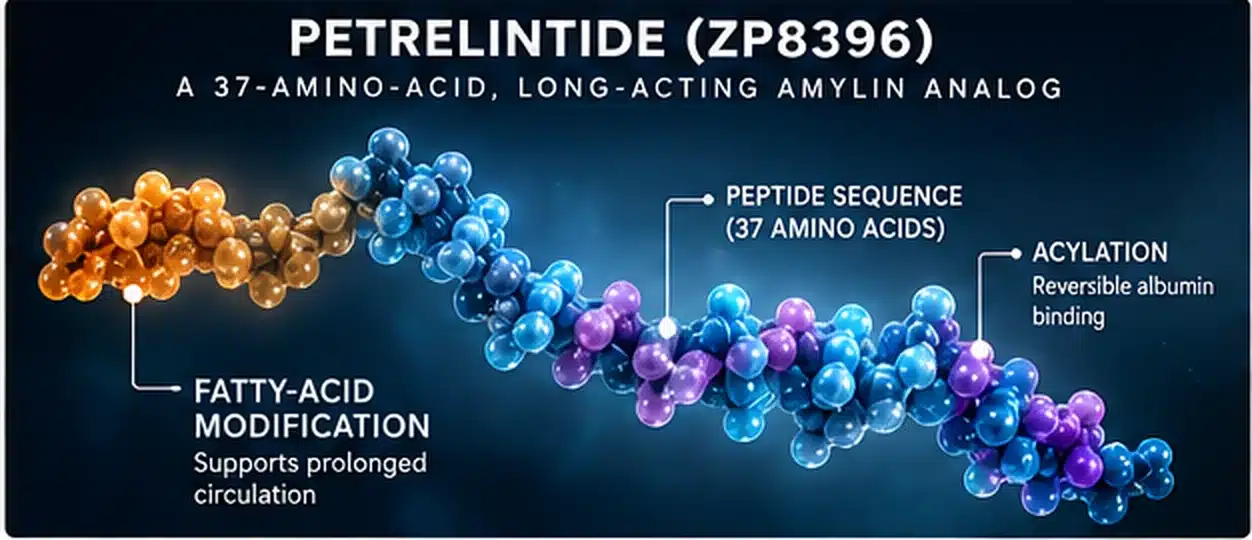
Petrelintide, previously identified as ZP8396, was developed by Zealand Pharma and is being advanced with Roche. It is a chemically modified version of amylin, a peptide hormone released from pancreatic beta cells alongside insulin. An attached fatty-acid group supports reversible albumin binding, which helps explain its prolonged circulation in pharmacokinetic research.
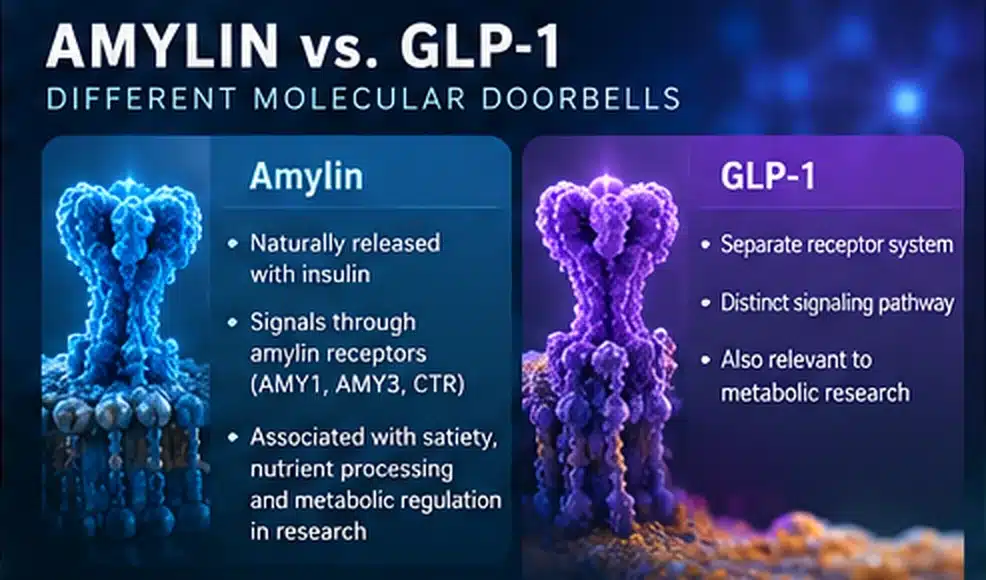
In receptor-characterization studies, petrelintide has shown agonist activity at AMY1 and AMY3 amylin receptors and the calcitonin receptor (CTR). Those research findings do not establish the properties of an independently manufactured laboratory vial.
Amylin vs. GLP-1: Different Molecular Doorbells
Amylin is associated with nutrient-responsive satiety signaling, whereas GLP-1 signals through a separate receptor family. Both pathways feature in metabolic research, but an amylin receptor and a GLP-1 receptor are not interchangeable. Same broad biological neighborhood, entirely different doorbells. That distinction is why researchers study the pathways separately.
Phase 1: Why the Pharmacology Matters
A 2026 Diabetes, Obesity and Metabolism paper reported an elimination half-life of approximately 10 days in its investigational research cohorts. That pharmacokinetic profile supported further evaluation on a once-weekly clinical-study schedule. The paper also reported receptor-related and metabolic observations that justified larger trials. These measurements describe the sponsor's investigational compound, not Xcel research materials.
ZUPREME-1 and ZUPREME-2: The Actual Findings
The Phase 2 program generated two useful but different evidence sets. The ZUPREME-1 publication by Garvey and colleagues reports 493 randomized participants, of whom 485 received at least one dose. Its primary endpoint was at week 28; the week 42 result is a later assessment. Zealand Pharma reported ZUPREME-2 topline findings separately. The table presents reductions from baseline using the efficacy estimand, not placebo-adjusted differences, and the studies involved different populations.
How to compare the evidence: The ZUPREME-1 peer-reviewed report and the ZUPREME-2 company topline disclosure are different evidence sources, with their own populations, analysis conventions and available safety detail. A percentage from one should not be combined with a tolerability figure from the other as though both came from one trial. Neither is a head-to-head test against eloralintide, and the available data do not establish equivalent adverse-event rates across the two molecules.
| Study | Research population | Reported body-weight findings |
|---|---|---|
| ZUPREME-1 Phase 2, peer-reviewed | Adults without type 2 diabetes; 485 participants received study treatment; 42 weeks | Week 28: −7.9% to −9.8% across five petrelintide groups vs. −1.7% placebo. Week 42: up to −10.7% vs. −1.7% placebo. |
| ZUPREME-2 Phase 2, sponsor-reported topline | 220 participants; type 2 diabetes research cohort | Week 28: 7.4% to 9.2% reduction across three groups vs. 2.0% placebo. |
What Adverse Events Were Reported?
In ZUPREME-1, investigators reported nausea in 20% of the petrelintide groups versus 6% with placebo, vomiting in 3% vs. 6%, diarrhea in 7% vs. 7%, and constipation in 7% vs. 4%. Nausea was mostly mild and concentrated during study escalation. No deaths were reported.
The ZUPREME-2 announcement reported gastrointestinal-related study discontinuation of 1.9% vs. 1.7% with placebo. Its full safety dataset had not yet appeared in a peer-reviewed publication.
Phase 3: What Comes Next?
The program comprises ZUPREME-3 (NCT07843498), ZUPREME-4 (NCT07843485), and ZUPREME-5 (NCT07843472). Registered research populations differ, and week 64 is the primary body-weight endpoint. These registrations do not represent completed Phase 3 results.
What Researchers Still Do Not Know
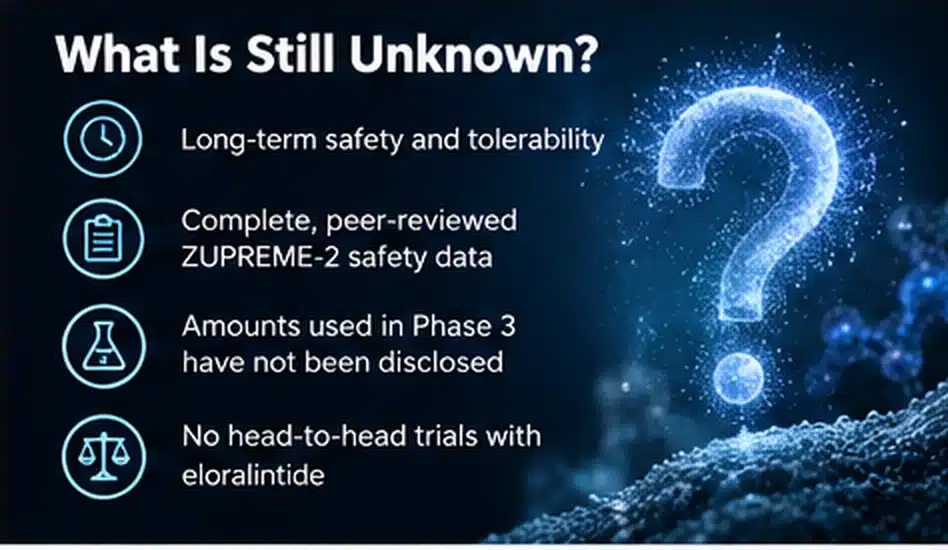
Long-term safety, complete ZUPREME-2 safety reporting, and additional Phase 3 details remain important evidence gaps. And while petrelintide and eloralintide both involve amylin-related research, no head-to-head trial establishes that one outperforms the other.
Petrelintide Research FAQ
What is petrelintide?
Petrelintide (ZP8396) is an investigational, long-acting amylin analog studied for receptor activity and metabolic outcomes.
Is petrelintide approved?
No. As of October 2026, it has not been approved by any regulatory authority.
What did ZUPREME-1 report?
At week 28, mean body-weight changes ranged from −7.9% to −9.8% across petrelintide groups versus −1.7% with placebo.
How is petrelintide different from eloralintide?
Both are investigational amylin-related compounds, but their receptor profiles and study designs differ. No direct comparative trial establishes superiority.
Are the Phase 3 results available?
No. ZUPREME-3, ZUPREME-4 and ZUPREME-5 are registered studies with no completed Phase 3 outcome report as of October 2026.
Primary Research Sources
- Phase 1 pharmacology paper, Diabetes, Obesity and Metabolism, 2026. DOI: 10.1111/dom.70753.
- ZUPREME-1 Phase 2 publication, The Lancet Diabetes & Endocrinology, online September 29, 2026. DOI: 10.1016/S2213-8587(26)00213-5.
- Zealand Pharma ZUPREME-2 company announcement, October 7, 2026.
- ClinicalTrials.gov registrations: ZUPREME-3, ZUPREME-4, ZUPREME-5.
All products supplied by Xcel Research LLC are chemical reference materials intended solely for in vitro laboratory research. They are not drugs, foods, dietary supplements, cosmetics, or medical devices, and have not been approved by the FDA for the diagnosis, treatment, cure, or prevention of any disease or condition. These materials are not for human or veterinary use and may not be administered to humans or animals under any circumstances.