
A report arrives and it looks perfect. The fonts are clean, the trace is handsome and the figure is tidy. Appearance costs almost nothing to produce, so a careful reader asks questions that appearance cannot answer.
This is a guide for readers who receive reports. It lists three layers of checks, says what each layer can catch and what it cannot, and ends with a short test you can run today. It describes how a reader verifies and gives no help to anyone building a document. Terms are in the The testing glossary: 14 lab terms in plain English.
A forged page can copy how a report looks. It cannot copy a laboratory’s willingness to answer your call.
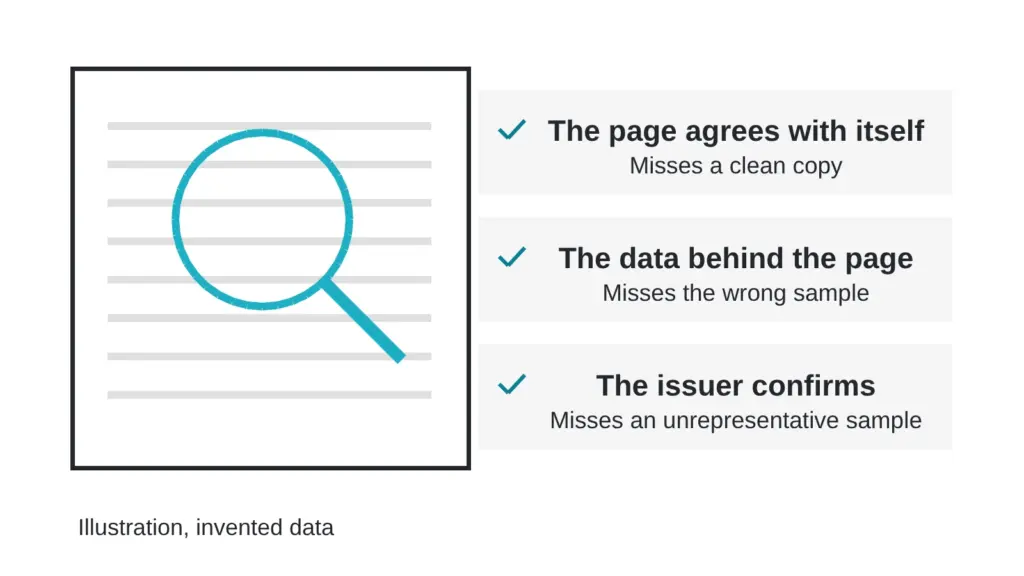
Layer one: does the page agree with itself?
Start with the cheapest checks, the ones that need nothing outside the document.
- Arithmetic. Do the peak areas in the table add up to the stated total, and does the percentage in the summary match the table?
- Identifiers. Do the sample name, lot and run labels match on every page and in every file name?
- Time order. Does the sequence run in a possible order: sample received, then analyzed, then reported? Five dates on a COA and what each one really means sorts out the dates a report can carry.
- Matching details. Does the retention time quoted for the main peak match the trace? Does the mass quoted in the text match the label on the spectrum?
- Units and axes. Are they consistent from the first page to the last?
This layer catches carelessness and reused templates. It cannot catch a fabrication that was built to agree with itself, and it will sometimes flag an honest clerical slip. A mismatch is a question for the issuer and never a verdict.
Layer two: what is the data behind the page?
A summary page is the last link in a chain that starts with raw data. Ask for the instrument software’s own export or the native data file for the run, with time stamps, the integration table and any audit trail. A person independent of the issuer can then reprocess it.
Data-integrity research supports the idea. A pharmaceutical paper showed in a case study that manipulation or backdating of reported values can be detected when each version of the data is tracked, and that an auditor can follow the data flow from a report back to the original raw data (Steinwandter and Herwig, 2019). Journals apply similar logic. One retraction notice cited figures that did not match the stated subject of a paper, and chromatography-based claims that lacked validation details and chromatograms to verify identity and purity (PubMed ID 39278452).
This layer catches reports with no trail behind them. Its limits are skill and access: reading raw data takes training, and a refusal to provide it is itself information. See Seven red flags on a lab report (and none of them is the purity number) for the gaps that usually accompany such a refusal.
Layer three: does the issuer confirm it?
This is the layer that decides the matter. Find the issuing laboratory’s contact details on your own, through the accreditor’s public directory or an independent search, and never from the document under review. Send the report number, the lot and the headline figure. Ask the laboratory to confirm that it issued the report and that the content matches its records.
Also check the scope. A laboratory’s accreditation covers named methods, so confirm in the accreditor’s directory that the method on the report sits inside it.
This layer catches a document the laboratory never issued. It cannot tell you whether the vial you hold is the vial that was tested, which brings in the lot identifier and, ideally, a test of your own container. Identity is usually established by several methods that complement one another, including nuclear magnetic resonance, mass spectrometry and chromatography (McCarthy et al., 2023). Is that lab report real? Six checks that take minutes walks through the full routine.
The three layers side by side
| Layer | Reader’s check | Catches | Cannot catch |
|---|---|---|---|
| The page | Arithmetic, identifiers, time order, matching details | Careless edits, reused templates | A self-consistent fabrication |
| The data | Native file, integration table, audit trail | Reports with nothing behind them | Anything without expert reading or access |
| The issuer | Independent confirmation of report number, lot and figure | Documents the laboratory never issued | Whether your container matches the tested sample |
When a check fails
Write down exactly what failed, with page and line. Send that note to the issuer along with your confirmation request, so the reply addresses the specific problem. Hold the report out of any decision until the issuer answers.
If the issuer says it never produced the document, keep the original file and the message that delivered it, and tell whoever supplied it that the report could not be confirmed. If the issuer confirms it and explains the mismatch, file the reply with the report. Either way, the paper trail you built is more useful than any hunch.
Myth versus reality
Myth: a report that fails a check is a forgery. Reality: a report that fails a check is unverified. Clerical errors, template glitches and file conversions produce mismatches too. Ask first, and conclude only after the issuer answers.
Quick check you can do today
Take one report on file and spend fifteen minutes on three things. Add the peak areas and compare them with the stated total. Compare the sample or lot name on every page and in the file name. Then write to the issuing laboratory, using contact details you found independently, and ask: “Please confirm that you issued report number ___ for lot ___ on date ___, and that it states ___ .” Keep the reply with the report. More questions worth asking are listed in The questions a good testing lab answers without flinching.
Sources
- Steinwandter V, Herwig C. PDA Journal of Pharmaceutical Science and Technology, 2019, volume 73(4), pages 373-390. PubMed ID 30770485. DOI 10.5731/pdajpst.2018.009407. Descriptor: data-integrity paper with a case study on detecting manipulation or backdating of reported values and auditing data flow back to raw data.
- PubMed ID 39278452, International Journal of Biological Macromolecules, 2024, DOI 10.1016/j.ijbiomac.2024.135654. Descriptor: retraction notice for a journal article, citing mismatched figures and chromatography-based claims without validation or chromatograms.
- McCarthy D, Han Y, Carrick K, Schmidt D, Workman W, Matejtschuk P, Duru C, Atouf F. Pharmaceutical Research, 2023, volume 40(6), pages 1317-1328. PubMed ID 36949371. DOI 10.1007/s11095-023-03493-1. Descriptor: report on producing and characterizing reference standards for synthetic peptides, including identity testing.
Want the catalog? Register free