
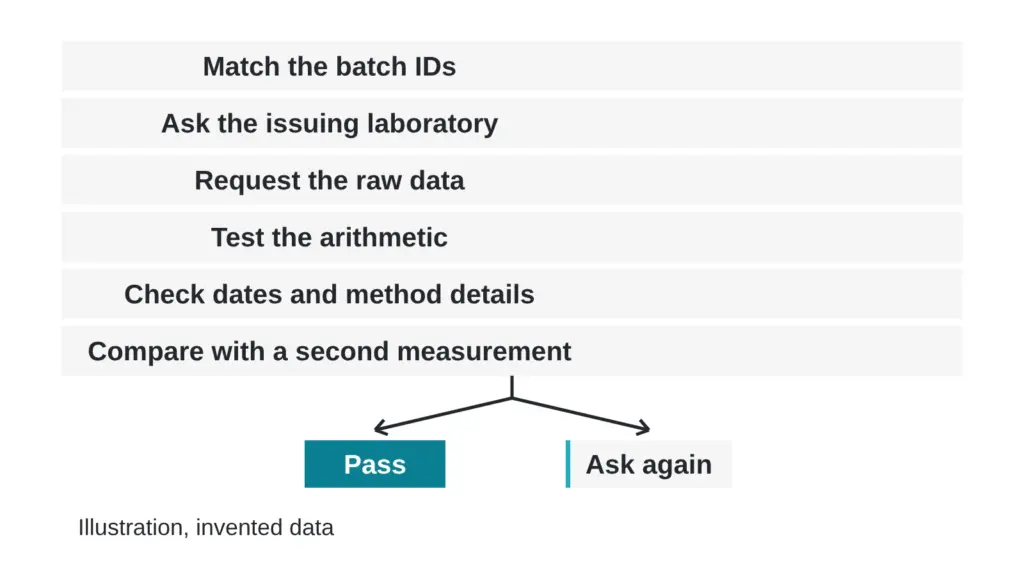
You hold a PDF. It has a logo, a tidy layout and a method line. Is it genuine? Looking professional costs nothing, so appearance cannot settle the question. Six checks can, and none of them needs special equipment.
This article gives the verification logic in the order that saves the most time. It applies to any laboratory and any report, and it names no one. Terms are in the The testing glossary: 14 lab terms in plain English.
A real report can answer questions. A copied one can only repeat itself.
Check 1: do the batch IDs match?
Put the lot or batch ID from the report next to the ID on the container label and on the paperwork that came with it. Compare them character by character. A transposed digit or a missing letter is a reason to ask, not a reason to guess.
Also ask which container the tested sample came from and on what day it was taken. A matching ID shows the report is about your lot. It does not show the tested sample was drawn from the container you hold.
Check 2: ask the issuing laboratory directly
Find the laboratory’s contact details yourself, from its own website or from an accreditation body’s public directory. Do not use the phone number or email printed on the report, and do not route the question through whoever handed you the report.
Then ask three things: did you issue report number X, on date Y, for sample ID Z, and will you send me that file directly? A real laboratory can answer in a sentence. A laboratory that cannot find the report number has given you an answer too.
Check 3: ask for the raw data
A picture of a chromatogram can be made by anyone. A data file carries a sequence name, a time stamp, an instrument identifier and an integration table, and all of these must agree with the page. Ask for the native file or the software’s full export, plus the method file.
Reference-standard programs treat this as ordinary practice. A review of peptide reference standards describes how data from several laboratories are integrated to assign a value to a final vial (McCarthy et al., 2023), which only works when the underlying data are shared.
Check 4: do the numbers agree with each other?
Arithmetic catches more problems than suspicion does. Three tests take a minute each. Every figure below is invented.
| Test | Invented report says | Your arithmetic | Verdict |
|---|---|---|---|
| Peak table against headline | Peak areas 930, 41, 18, 11. Headline purity 94.2 area percent | 930 divided by 1,000 is 93.0 | ask: the headline and the table disagree |
| Parts of the powder | Content 84.0, water 6.2, counterion 14.8 percent | 84.0 + 6.2 + 14.8 = 105.0 | ask: parts of one powder cannot exceed 100 |
| Mass error | Calculated 1,234.56, observed 1,234.57, stated error 80 ppm | 0.01 divided by 1,234.56, times one million, is about 8 | ask: stated error is ten times too large |
Rounding can shift a figure in the last digit. A gap of a whole point is a different matter. None of these tests proves a report is genuine, because a careful forger can make numbers agree. They catch the careless errors, and a report that passes all three has earned a closer look at the raw files.
The component sums rest on the idea that dry powder holds the target plus water, counterions, inorganic material and volatile solvents, each measured by its own technique (Wang et al., 2021).
Check 5: do the dates and method details fit together?
Walk the timeline: the lot was made, then sampled, then received, then analyzed, then reported. Any date out of that order is a question. Five dates on a COA and what each one really means sorts the kinds of date.
Then test the method line for sense. A trace that runs 25 minutes under a method listing a 20 minute gradient needs an explanation. So does a column size that cannot fit the stated flow, or a detection wavelength that does not suit the molecule type.
Check 6: compare with a second, independent measurement
The strongest check is a second laboratory measuring a sample of the same lot. Agreement within normal method variation supports the first report. Disagreement starts a conversation about methods, which The questions a good testing lab answers without flinching helps you frame.
Expect some spread. A published comparison of four content assays on one freeze-dried peptide drug substance found that amino acid analysis and liquid chromatography varied depending on the laboratory, while elemental analysis was more precise in that study (Vemuri, 2005). Differences between laboratories are information, not proof of fraud.
What a verified report proves
Passing these checks shows that the laboratory issued the report and that its numbers agree with each other. It leaves three questions open: whether the tested sample represents the whole lot, whether the method suits the question, and how the material has been kept since the test. Reading the content of the report is covered in Stop at the big number and you miss the report: how to read a COA, and the gaps that should make you pause are listed in Seven red flags on a lab report (and none of them is the purity number).
Quick check you can do today: copy the report number and lot ID from a report you hold into an email to the laboratory, using contact details you found yourself, and ask them to confirm both. Keep the reply with the report.
Sources
- McCarthy D, Han Y, Carrick K, Schmidt D, Workman W, Matejtschuk P, Duru C, Atouf F. Pharmaceutical Research, 2023, volume 40(6), pages 1317-1328. PubMed ID 36949371. DOI 10.1007/s11095-023-03493-1. Descriptor: peptide reference standards, with data from multiple laboratories integrated into a value for the vialed material.
- Wang S, Wu P, Li M, Huang T, Shi N, Feng L, Li H. Journal of Pharmaceutical and Biomedical Analysis, 2021, volume 207, article 114401. PubMed ID 34656934. DOI 10.1016/j.jpba.2021.114401. Descriptor: mass balance purity assignment for a synthetic peptide, including water, counterion, inorganic and volatile solvent determinations.
- Vemuri S. Journal of Peptide Research, 2005, volume 65(4), pages 433-439. PubMed ID 15813890. DOI 10.1111/j.1399-3011.2005.00225.x. Descriptor: comparison of four content assays on one lyophilized peptide drug substance across laboratories.
Want the catalog? Register free