
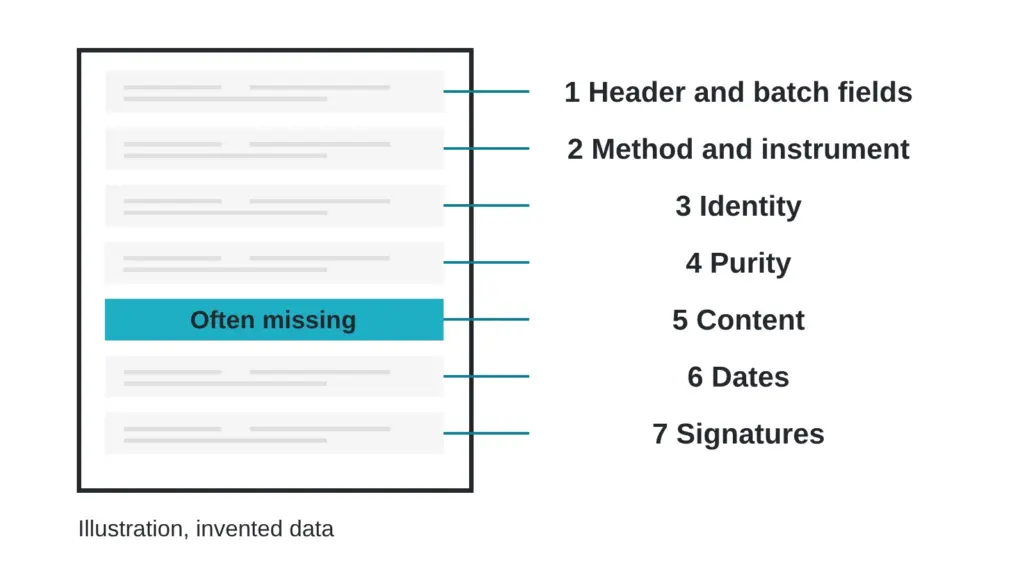
A certificate of analysis usually has one large number near the top and a lot of small print underneath. Most readers stop at the large number. The small print is where a report earns trust or loses it.
This article walks down an invented one-page report from header to signature. For each block you will see what it should contain and what a gap in it tells you. Terms are defined in the The testing glossary: 14 lab terms in plain English.
The whole page at a glance
Everything in this table is invented for teaching. It shows a typical layout and describes no real material.
| Block | Invented entry | What it tells you |
|---|---|---|
| Header | Report DEMO-0412, issued 14 March, laboratory name and address | who stands behind the page |
| Sample fields | Lot L-2417-B, one sealed vial, received 3 March, condition intact | which physical item was tested |
| Method | Reversed-phase liquid chromatography, C18 column 2.1 x 100 mm, 1.7 micrometer particles, gradient 5 to 60 percent organic over 20 minutes, UV at 214 nm | how the purity number was made |
| Instrument | Instrument UHPLC-03, data software version 4.2, analyst initials | where the raw data live |
| Identity | Calculated mass 1,234.56, observed 1,234.57, error 8 ppm | whether the main peak carries the expected mass |
| Purity | Main peak 93.1 area percent, 6 minor peaks, reporting threshold 0.1 percent | share of the integrated UV signal |
| Content | Peptide 78.4 percent by weight, water 6.2, counterion 14.8, other 0.6 | share of the powder’s mass |
| Dates | Analyzed 8 March, issued 14 March, retest date a year later | when each event happened |
| Signatures | Analyst, reviewer, dates | who is accountable |
A certificate of analysis is a receipt for a measurement, and a receipt with no item list proves nothing.
Start with the boxes that name the sample
The report number, lot or batch ID, description, receipt date and arrival condition come first. The lot ID is the thread that ties the page to a physical container. If the ID on the page cannot be matched to the ID on the label, nothing below it describes the item in your hand. Is that lab report real? Six checks that take minutes covers the matching step in detail.
Method and instrument: where the number is born
Look for the column chemistry and size, the mobile phase and gradient, the detection wavelength, the instrument identifier and the software. A purity number without these has no address. Same material, two purity numbers: why labs disagree shows how each setting can move the figure by itself, so two reports can only be compared when these lines are filled in.
Identity: does the main peak carry the right mass?
Mass spectrometry measures the mass of what comes off the column. The report lists a calculated mass, an observed mass and an error, usually in parts per million. In the invented row above, the gap of 0.01 on 1,234.56 works out to about 8 ppm.
A matching mass confirms the molecular weight of the main species. It cannot confirm that nothing else hides under the same peak. Identity is covered further in How labs confirm what a molecule is: mass, fragments and structure.
Purity: one number, many assumptions
The purity line is normally an area percent: the area of the main peak divided by the area of all integrated peaks, at one wavelength. Read three things beside it: the wavelength, the number of minor peaks and the reporting threshold below which peaks are ignored.
Purity answers a narrow question. Of the signal the detector saw, how much belongs to the main peak? An analytical chemistry article on peptide impurities notes that using a default response factor of 1 for every impurity can overestimate or underestimate the amounts (Kuril, 2025), so even that narrow answer carries an assumption.
Content: the line that is often missing
Content is the share of the powder’s mass that is the target molecule. It sits apart from purity because a dry powder holds more than one thing. In the invented example the powder is 78.4 percent peptide, 6.2 percent water, 14.8 percent counterion and 0.6 percent other material, which adds to 100.
Mass-balance work on reference materials measures those other parts separately. One study describes coulometric Karl Fischer titration for water, ion chromatography for non-volatile counterions, inductively coupled plasma mass spectrometry for inorganic elements and headspace gas chromatography with mass spectrometry for volatile organic compounds (Wang et al., 2021). If your report has a purity line and no content line, ask which of these was measured.
Dates and signatures
A report can carry five different dates, and each records a different event. Sort them with Five dates on a COA and what each one really means. Then find the signatures. A named analyst and a named reviewer give you someone to ask. A report with nobody behind it has no one to ask.
Reference-standard programs show what thorough looks like. A review of peptide reference standards describes value assignment by mass balance, identity testing and stability studies, with data from several laboratories combined (McCarthy et al., 2023).
Quick check you can do today: take any report you hold and look for seven items. Lot ID, method, instrument, observed mass, purity with its wavelength, a content or water line, and a named signer. Count the blanks. Each blank is a question for the laboratory.
Sources
- Kuril AK. Analytical Chemistry, 2025, volume 97(24), pages 12480-12485. PubMed ID 40499007. DOI 10.1021/acs.analchem.5c02149. Descriptor: article on relative response factors in peptide impurity quantification by liquid chromatography with UV detection.
- Wang S, Wu P, Li M, Huang T, Shi N, Feng L, Li H. Journal of Pharmaceutical and Biomedical Analysis, 2021, volume 207, article 114401. PubMed ID 34656934. DOI 10.1016/j.jpba.2021.114401. Descriptor: mass balance purity assignment for a synthetic peptide, including water, counterion, inorganic and volatile solvent determinations.
- McCarthy D, Han Y, Carrick K, Schmidt D, Workman W, Matejtschuk P, Duru C, Atouf F. Pharmaceutical Research, 2023, volume 40(6), pages 1317-1328. PubMed ID 36949371. DOI 10.1007/s11095-023-03493-1. Descriptor: peptide reference standards, value assignment by mass balance, identity testing and stability studies.
Want the catalog? Register free