
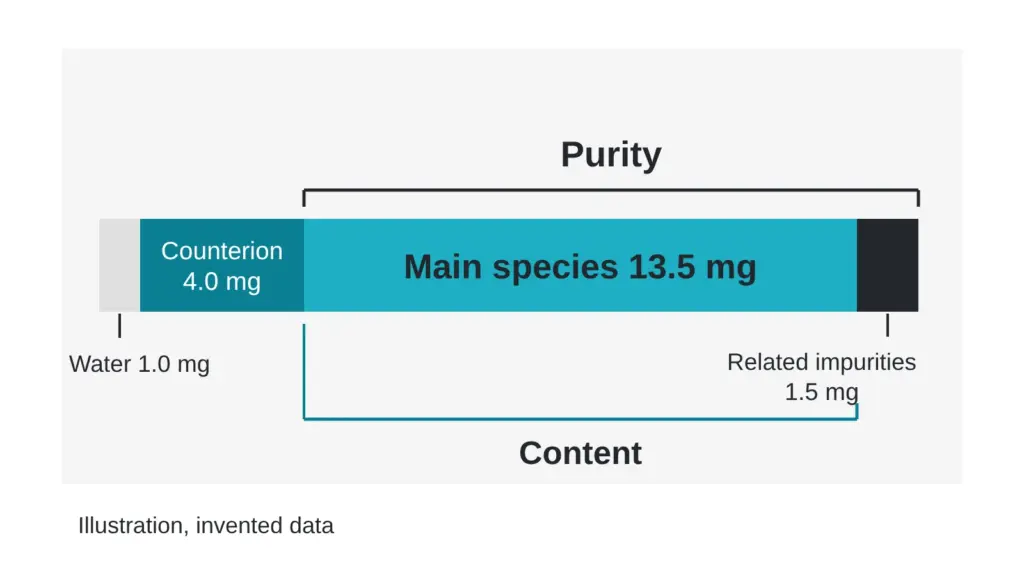
Two vials carry the same fill weight and the same purity figure on their reports. Open both and weigh the actual molecule inside, and one holds nearly a quarter more than the other. Nobody made an error. The reports answered a question that nobody asked.
This article gives you the two questions that separate purity from content, a worked vial with invented numbers, and a short checklist for any report that lands on your desk. If you want the background first, The salt nobody lists: how a counterion changes what a vial really holds and How a reference standard gets its number, and who checks the math cover the parts. Here we put the parts to work. Terms are in the The testing glossary: 14 lab terms in plain English.
Two ratios, two denominators
Purity is a ratio inside the peptide. Content is a ratio inside the vial.
Purity asks what share of the peptide-related material is the intended molecule, as seen by one chromatographic method. Content asks what share of the whole powder, by mass, is the intended molecule. The powder also holds water and counterions, and neither shows up in a routine purity run.
A pharmacopeial review of reference standards describes this split directly: a quantitative value is assigned to a bulk material by mass balance, and that material then serves as the standard for the vialed material (McCarthy et al., 2023).
The invented vial
Every number below is invented for teaching. The vial holds 20.0 mg of dry powder.
| Component | Mass | Share of the powder |
|---|---|---|
| Water, by Karl Fischer titration | 1.0 mg | 5.0 percent |
| Counterion | 4.0 mg | 20.0 percent |
| Peptide-related material | 15.0 mg | 75.0 percent |
| Main species at 90.0 percent purity | 13.5 mg | 67.5 percent |
| Related impurities | 1.5 mg | 7.5 percent |
The report could truthfully print “purity 90.0 percent.” It could also truthfully print “content 67.5 percent.” Those are different sentences about the same vial, and only one of them tells you how much of the intended molecule you hold.
The arithmetic is short. Take the peptide-related share (75.0 percent), multiply by purity (0.900) and you get content (67.5 percent). Drop the water and counterion lines from the report, and the buyer is left to guess at 75.0.
Now go back to the two vials in the opening. Same purity, different counterion load and moisture, and the content differs. A paper that compared four assay types on one dry material found that content values depended on the method and the laboratory, and that elemental analysis gave the most precise numbers in that study (Vemuri, 2005).
A second invented vial
Now take a second vial, also 20.0 mg of powder and also reported at 90.0 percent purity. Its water is 0.4 mg and its counterion load is 1.0 mg.
| Component | Vial 1 | Vial 2 |
|---|---|---|
| Fill weight | 20.0 mg | 20.0 mg |
| Water | 1.0 mg | 0.4 mg |
| Counterion | 4.0 mg | 1.0 mg |
| Peptide-related material | 15.0 mg | 18.6 mg |
| Main species at 90.0 percent purity | 13.5 mg | 16.7 mg |
| Content | 67.5 percent | 83.7 percent |
The purity line is identical. The amount of intended molecule differs by about a quarter. Nothing in a purity figure could have told you.
The two-question checklist
- Purity of what, by which method? Look for the column, gradient and wavelength behind the figure. Without them, the number cannot be compared with anything.
- Content of what, and how measured? Look for a line that reports mass of the intended molecule per mass of powder, and for the method behind it: mass balance, amino acid analysis, nitrogen analysis or quantitative nuclear magnetic resonance.
If the report answers only the first question, it is a clean-up report, and the amount stays unknown.
Why the counterion line matters most
The counterion is often the largest missing line. Synthetic peptides commonly leave production as salts of a strong acid, and a study of that salt form emphasizes that counterion quantification and specification matter for any work with synthetic peptides (Erckes et al., 2025). Salts are a general issue, too: a mass balance study on a small-molecule salt treated the chloride content as the main impurity in the mass fraction of the free base, with water measured by coulometric Karl Fischer titration alongside it (Lee et al., 2023).
What a good report line looks like
A complete entry names the quantity, the basis and the method in one sentence. “Content: 67.5 percent by mass of powder, assigned by mass balance, with water, counterion and related impurities measured separately.” The wording is plain on purpose. If you cannot tell what the denominator is, the number has not finished its job.
Myth versus reality
A vial labeled with a mass holds that mass of the molecule. Reality: the label mass usually refers to the powder, and the powder includes water and counterions. The number that tells you how much of the molecule you hold is the content line.
Quick check you can do today
Take any report on your desk and write two sentences from it. First: “Purity is X percent, by this method.” Second: “Content is Y percent, by this method.” If you can only write the first, ask for the second, or ask which parts of the powder were measured. Then compare the fill weight on the label with the content line. They are different quantities. The CHNS, liquid chromatography or LC-MS: which test answers which question? article shows which test answers which doubt.
Sources
- McCarthy D, Han Y, Carrick K, Schmidt D, Workman W, Matejtschuk P, Duru C, Atouf F. Pharmaceutical Research, 2023, volume 40(6), pages 1317-1328. PubMed ID 36949371. DOI 10.1007/s11095-023-03493-1. Descriptor: review of how reference standards for synthetic peptides are valued, including a two-step mass balance process for bulk and vialed material.
- Vemuri S. Journal of Peptide Research, 2005, volume 65(4), pages 433-439. PubMed ID 15813890. Descriptor: comparison of four assay types for peptide content in a freeze-dried material, covering precision and laboratory dependence.
- Erckes V, Streuli A, Chamera Rendueles L, Kramer SD, Steuer C. Pharmaceuticals, 2025, volume 18(8), article 1163. PubMed ID 40872554. DOI 10.3390/ph18081163. Descriptor: study of analyzing and exchanging a strong-acid counterion in synthetic peptides, with validated detection methods.
- Lee S, Baek SY, Kwon HJ, Choi KH, Han J. Molecules, 2023, volume 28(22), article 7568. PubMed ID 38005289. DOI 10.3390/molecules28227568. Descriptor: mass balance purity method for a small-molecule salt, with chloride, related impurities, water, solvents and non-volatiles measured by separate techniques.
Want the catalog? Register free