
One container says “use by.” Another says “retest by.” A third report mentions a “shelf life of 24 months” without saying who decided that. The phrases sound interchangeable, and a reader who treats them as interchangeable will misjudge what the date actually supports.
This article sets out what each term means, what data stands behind it, and how to read the wording on a report. Terms are defined in the The testing glossary: 14 lab terms in plain English.
Two terms, two promises
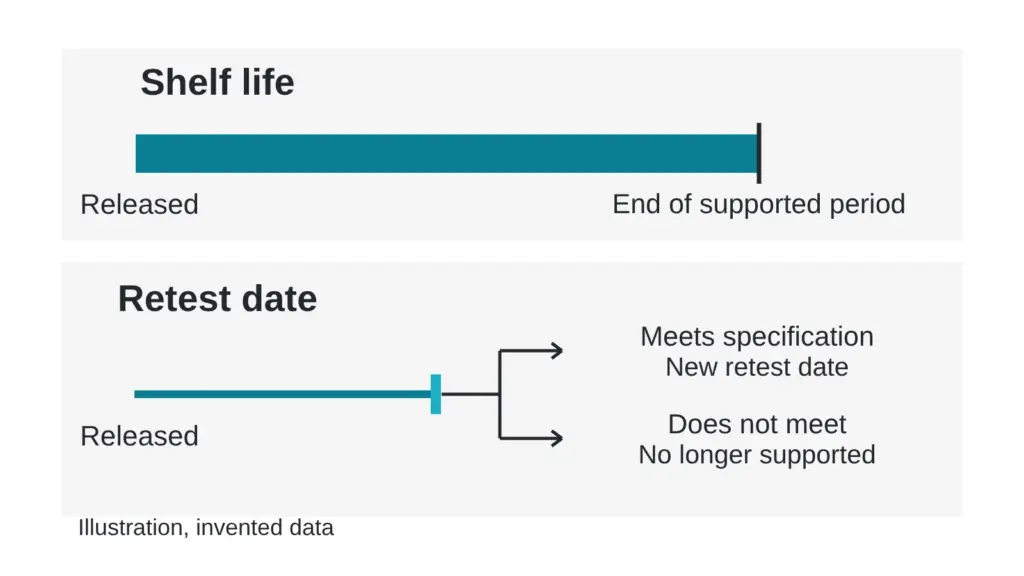
A shelf life is a period during which a material is expected to stay within its specification when it is stored as stated. After that period, the material is no longer supported. A retest date is the point at which the material should be examined again. If the new measurements still meet the specification, the material can be supported for a further stated period.
A shelf life is a promise about the future. A retest date is an appointment to check.
| Shelf life | Retest date | |
|---|---|---|
| What it states | Period of expected fitness | Date for the next examination |
| At the date | Support ends | Examination decides whether support continues |
| Usually seen on | Finished, packaged items | Bulk materials and reference materials |
| Needs a stated storage condition | Yes | Yes |
Conventions differ between organizations, and the document that issued a date defines its own wording. A laboratory that writes “expiry” and one that writes “retest” may mean the same thing or different things, and the quickest way to tell is to ask.
What evidence stands behind the date?
Both terms rest on stability data, which means measurements of the same material at planned time points under stated conditions. Programs that certify reference materials show what that looks like.
One program for candidate reference materials in powder form tested short-term stability at 4, 18 and 40 degrees Celsius, with measurements at 0, 1, 2 and 4 weeks. It tested long-term stability at minus 20 and 4 degrees Celsius, with measurements at 0, 6, 12 and 18 months. It found no significant trends, and it calculated stability error margins of 7.4 and 6.3 percent for a shelf life of 6 years at minus 20 degrees Celsius. The authors also noted that monitoring over a long period was continuing (Josephs et al., 2005).
For synthetic peptides, a review from the United States Pharmacopeial Convention describes reference standard programs that assign a value to the bulk material by mass balance, then vial it and run stability studies on the vialed material (McCarthy et al., 2023).
A comparison of liquid reference standards from ten manufacturers makes the monitoring point sharply. Its authors recommended continuous long-term monitoring, noting that without it a product may show a target value of only 80 percent, as seen in one instance. They also proposed limits on the stated measurement error that depend on shelf life: 3 percent for a shelf life of one year or less, and 5 percent for longer ones (Steiner et al., 2024). That study concerns a different class of material, but the principle carries: a date on paper is only as good as the monitoring behind it.
Phrases you will meet
| Wording on a document | Plain reading |
|---|---|
| Expiry or use by | Support ends at the date |
| Retest by | Support ends unless a new examination renews it |
| Re-evaluation date | Same idea as retest, different label |
| Valid until | Ambiguous: ask whether it is a shelf life or a retest date |
Wording alone does not tell you how strong the evidence is. Two documents can carry the same phrase, one backed by years of time points and the other by a few weeks of accelerated data. The date is the visible tip, and the stability file is the part underneath.
A date also assumes the storage condition was held. A container that sat warm for a long weekend is no longer described by data collected at the stated condition, and that gap is what a retest closes.
Worked example with invented dates
All values below are invented for teaching.
| Month | Event |
|---|---|
| 0 | Material released with a retest date at month 12 |
| 12 | Retest: measurements meet the specification |
| 12 | New retest date set at month 24 |
| 24 | Retest: one measurement falls outside the specification |
| 24 | Material no longer supported for the stated purpose |
Notice what the retest did at month 12. It generated fresh data, and the new date came from that data. A retest date can be extended only when the retest supports it. A shelf life, by contrast, is set in advance and ends when the period ends, usually without a second look.
Three traps in the wording
- No storage condition: a date means little unless the report says the condition it assumes. Storage principles are in Storage mistakes that quietly add water to a dry sample.
- Unclear starting point: the clock may start at manufacture, release or receipt, and the three can sit months apart. The timeline of dates on a report is covered in Five dates on a COA and what each one really means.
- No study named: a date with no stability data behind it is an assertion. A laboratory should be able to say which study supports it, and The questions a good testing lab answers without flinching lists other questions of that kind.
Quick check you can do today
Pick one report and find its date. Write down four things: the exact word used (shelf life, expiry or retest), the storage condition it assumes, the day the clock started, and the study or retest record that supports it. Any blank is a question for the issuing laboratory.
Sources
- Josephs RD, Ulberth F, Van Egmond HP, Emons H. Food Additives and Contaminants, 2005, volume 22(9), pages 864-874. PubMed ID 16192073. DOI 10.1080/02652030500166537. Descriptor: homogeneity and short- and long-term stability testing of candidate certified reference materials in powder form.
- McCarthy D, Han Y, Carrick K, Schmidt D, Workman W, Matejtschuk P, Duru C, Atouf F. Pharmaceutical Research, 2023, volume 40(6), pages 1317-1328. PubMed ID 36949371. DOI 10.1007/s11095-023-03493-1. Descriptor: peptide reference standards, value assignment by mass balance, vialing and stability studies.
- Steiner D, Bartok T, Sulyok M, Szekeres A, Varga M, Horvath L, Rost H. Toxins, 2024, volume 16(9), article 397. PubMed ID 39330855. DOI 10.3390/toxins16090397. Descriptor: multi-supplier comparison of liquid reference standards, with recommendations on error limits and continuous stability monitoring.
Want the catalog? Register free