
This page defines the terms that come up most often when laboratory staff read analytical reports for synthetic peptide materials. Each entry gives a short definition and says where the term usually appears. Where an article on this site covers the term in more depth, the entry links to it.
Jump to a term: Area percent | Certificate of analysis | Chromatogram | Co-elution | Content | Counterion | Deletion sequence | Identity | Lyophilized material | Mass balance | Mass spectrometry | Mobile phase | Purity | Reference standard
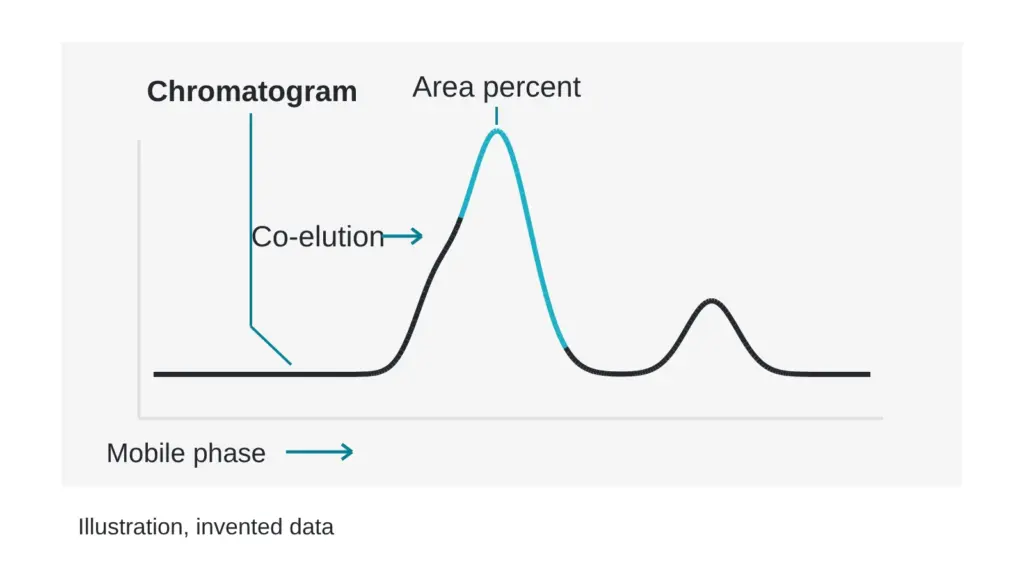
Area percent
The area of one chromatographic peak divided by the total area of all integrated peaks, multiplied by 100. It compares detector signals. It does not give a mass fraction, because different species can respond differently to the same detector.
Where it appears: the purity line of a liquid chromatography report. See Same material, two purity numbers: why labs disagree.
Certificate of analysis
A document from a laboratory that lists the tests run on a sample, the methods used, the readings and the date. It describes the sample that was tested. Its value depends on the method detail and the raw data behind it.
Where it appears: the front page of a report package, usually next to a sample identifier. See The questions a good testing lab answers without flinching.
Chromatogram
A plot of detector signal against time as components leave a chromatography column. Each peak is one component, or a group of components that travel together. Peak position helps to identify a species, and peak area is used to estimate its amount.
Where it appears: attached to any liquid chromatography report. See What a UHPLC purity number actually measures, and what it skips.
Co-elution
Two or more components leave the column at the same time and show up as one peak. An impurity hidden under the main peak is counted as main material in area percent. Mass spectrometry, or a second method with different selectivity, can reveal it.
Where it appears: in notes about a broad peak or a shoulder, or when mass spectrometry shows more than one mass under a single peak. See Same material, two purity numbers: why labs disagree.
Content
The mass fraction of the target molecule in a material, for example grams of peptide per gram of powder. Content counts water, counterions and other non-peptide mass that a chromatographic purity number leaves out. It is sometimes called net content.
Where it appears: in reports of amino acid analysis or elemental analysis, usually apart from the purity line. See The salt nobody lists: how a counterion changes what a vial really holds.
Counterion
An ion of opposite charge that balances the charge on a peptide in the solid. Common examples are trifluoroacetate, acetate and chloride. Routine liquid chromatography with ultraviolet detection does not report on counterions.
Where it appears: in ion analysis or elemental analysis reports, and rarely on a routine purity report. See The salt nobody lists: how a counterion changes what a vial really holds.
Deletion sequence
An impurity from chemical synthesis in which one amino acid residue is missing from the intended sequence. Its mass is lower by one residue mass, and it often behaves much like the intended molecule on a column. It is a common type of structurally related impurity.
Where it appears: in mass spectrometry impurity lists, as a species lighter than the main one, and as a possible co-eluting peak. See Same material, two purity numbers: why labs disagree.
Identity
Confirmation that the material is the intended molecule. Laboratories compare a measured mass, fragment pattern or spectrum with the expected values. Identity says what the material is. It does not say how much of it is present.
Where it appears: the mass spectrometry or nuclear magnetic resonance section of a report. See CHNS, liquid chromatography or LC-MS: which test answers which question?.
Lyophilized material
The solid left after freeze-drying. It is usually a dry, porous cake that can hold residual water, salts and other non-volatile additives along with the molecule of interest.
Where it appears: in sample descriptions as the physical form. See Inside a freeze-dried cake: what lyophilization leaves behind.
Mass balance
A way to assign a value to a material by accounting for all of its parts. The analyst takes the total mass, subtracts water, residual solvents, counterions and inorganic residue, and multiplies what is left by the chromatographic purity.
Where it appears: in documents that describe how a reference standard was value-assigned. See How a reference standard gets its number, and who checks the math.
Mass spectrometry
A technique that measures the mass-to-charge ratio of ions. For a peptide it gives the molecular mass, which supports identity and helps to find impurities by their masses. Signal strength varies between species, so it is not a simple measure of amount.
Where it appears: the identity section and impurity lists of a report. See What a UHPLC purity number actually measures, and what it skips.
Mobile phase
The solvent mixture that carries a sample through a chromatography column. Its composition, which often changes during a run as a gradient, controls how species separate.
Where it appears: the method section of a report, usually as solvent A and solvent B with the named acid additive. See Same material, two purity numbers: why labs disagree.
Purity
In routine reports, the share of the detector signal that belongs to the main peak, given as area percent. It answers a different question from content.
Where it appears: the purity line of a chromatography report. See Same material, two purity numbers: why labs disagree.
Reference standard
A well-characterized material with an assigned value, used to calibrate an instrument or to check a measurement. Its own value usually comes from several methods that are compared with each other.
Where it appears: the method section of a report, as the material used for calibration or for checking the system before a run. See How a reference standard gets its number, and who checks the math.
Sources
- McCarthy D, Han Y, Carrick K, Schmidt D, Workman W, Matejtschuk P, Duru C, Atouf F. Pharmaceutical Research, 2023, volume 40(6), pages 1317-1328. PubMed ID 36949371. DOI 10.1007/s11095-023-03493-1. Descriptor: review with case studies on preparing, testing and assigning values to reference standards for synthetic peptides.
- Wang X, Wu L, Huang Y, Su P, Yang Y, Yang B, Zhang N. Analytical and Bioanalytical Chemistry, 2022, volume 414(11), pages 3443-3457. PubMed ID 35201368. DOI 10.1007/s00216-022-03965-0. Descriptor: development of a certified reference material for a small protein using mass balance and amino acid analysis with isotope dilution mass spectrometry.
- Li M, Josephs RD, Daireaux A, Choteau T, Westwood S, Wielgosz RI, Li H. Analytical and Bioanalytical Chemistry, 2018, volume 410(20), pages 5059-5070. PubMed ID 29862433. DOI 10.1007/s00216-018-1155-y. Descriptor: liquid chromatography with high-resolution mass spectrometry for structurally related impurities in a synthetic peptide calibrator.
Want the catalog? Register free