
A report arrives with an accreditation mark in the corner. Does the mark vouch for the number in the middle of the page? The honest answer is “maybe.” It depends on a document most readers never open: the scope.
This article covers what the standard is about, why accreditation attaches to methods and not to buildings, what to look for on a scope document, and what no accreditation can promise. It stays general. Terms are in the The testing glossary: 14 lab terms in plain English.
What the standard is
ISO/IEC 17025 sets general requirements for the competence of testing and calibration laboratories. One laboratory paper describes it as a widely accepted route to quality management and objective evidence of technical competence, knowledge and skills (Franic et al., 2020).
Accreditation is a finding by an outside accreditation body that a laboratory meets the standard for stated work. It is an assessment, repeated on a schedule, and it can be narrowed or withdrawn.
Accreditation belongs to methods
An accreditation is a license for named methods, and it stops at the edge of the list.
The published examples show the pattern. One institute describes accreditation for specific scopes, such as determination of radioactivity and ambient air quality testing, covering three of its laboratory units (Franic et al., 2020). A public-health laboratory paper reports that a validated method for animal tissues is accredited for official control analyses (Moragues et al., 2024). A food-safety laboratory describes adding a new screening method to its existing accreditation after validating it (Baidas et al., 2026).
Notice the verbs: added, validated, accredited for. A laboratory can hold accreditation and still run methods that sit outside it.
What the standard looks at
A survey of forensic laboratories checked compliance against eight criteria drawn from the standard: personnel management, equipment management, equipment calibration, method validation, proficiency testing, internal auditing, risk management and critical review. The survey found uneven compliance, and the weakest areas included proficiency testing through accredited providers (Bezerra et al., 2025). That list gives a feel for what an assessor examines. The standard also contains requirements on impartiality and confidentiality.
Reading a scope document
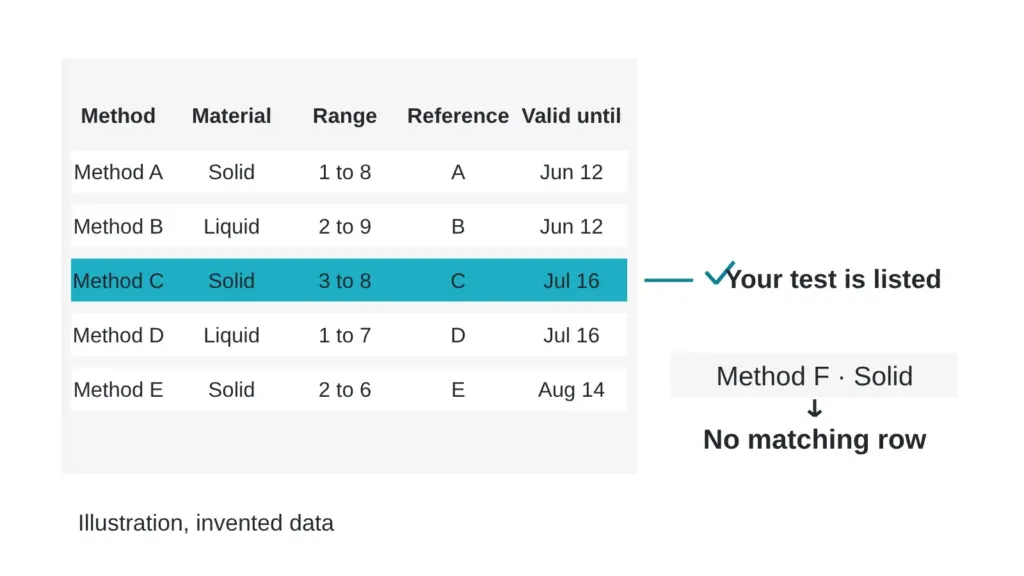
A scope document is usually a short table. Here is what to check:
| Field | Why it matters |
|---|---|
| Laboratory name and site | Accreditation attaches to a named location, so a sister site may not be covered |
| Test or method | Your test has to appear, not only a similar one |
| Material or matrix | A method listed for one material type may not cover yours |
| Range or limits | A reading outside the listed range sits outside the scope |
| Method reference | Shows which published or in-house procedure was assessed |
| Validity dates | Scopes change; check that the document is current |
If the scope uses a flexible format, the laboratory may be allowed to add methods inside a defined family. In that case, ask for the laboratory’s list of methods currently within its scope.
A worked match with invented lines
A report lists “water content by coulometric Karl Fischer titration” (see How labs weigh the water in a dry sample: Karl Fischer explained). The laboratory’s scope document, an invented one, lists “water determination in solid pharmaceutical materials, coulometric titration, range 0.05 to 10 percent.” That row matches the method, the material type and the range, so the water line sits inside the scope. The same report also lists a purity figure by a method with no row on the scope. The water line carries outside examination. The purity line is the laboratory’s own work, which may be excellent and still has no outside check behind it.
Myth versus reality
An accredited laboratory means every number it issues is accredited. Reality: accreditation applies to the methods on the scope. Reports often carry a mix, and a well-run report marks which lines fall under accreditation. A report with no such marking leaves the reader guessing.
Three wording traps
- “Tested at an accredited laboratory” names the building. It says nothing about the method behind your number.
- “Tested by an accredited method” names the method. Check that the material and range match.
- “Accredited” with no body or document named gives you nothing to look up.
These are our reading of how wording can slip, not claims about any specific report. The fix is the same each time: ask for the scope document and match the row.
What no accreditation promises
Accreditation does not confirm that a particular number is right. It says the laboratory has a system for getting numbers right and has been examined on it.
It also does not describe the sample. If the sample was chosen badly or stored badly before it arrived, the best-run laboratory reports faithfully on the wrong material. It does not assess what you plan to do with the result, and it does not turn a method that answers one question into a method that answers another. For that distinction, see CHNS, liquid chromatography or LC-MS: which test answers which question?.
Finally, accreditation is not the same as independence. A laboratory can be accredited and owned by a seller. That question has its own article: Independent testing: what independence proves and what it does not.
Quick check you can do today
Take any report that shows an accreditation mark and ask four things. Does the report say which of its tests fall under accreditation? Can you find the matching row on the laboratory’s current scope document, with the right material and range? Is the scope document dated and issued by the accreditation body? If no row matches, treat the number as an unaccredited reading. It may still be good work. It simply has no outside examination behind it. The The questions a good testing lab answers without flinching list adds more.
Sources
- Franić Z, Bituh T, Godec R, Čačković M, Meštrović T, Šiško J. Archives of Industrial Hygiene and Toxicology (Arhiv za higijenu rada i toksikologiju), 2020, volume 71(4), pages 312-319. PubMed ID 33410772. DOI 10.2478/aiht-2020-71-3449. Descriptor: institutional experience paper on accreditation against the standard for specific testing scopes.
- Bezerra LSA, Souza-Neto AC, Chaves PB, Poltronieri CF. Forensic Science International, 2025, volume 371, article 112489. PubMed ID 40318431. DOI 10.1016/j.forsciint.2025.112489. Descriptor: survey of laboratories against eight criteria drawn from the standard, including proficiency testing.
- Moragues F, Miralles P, Igualada C, Coscollà C. Heliyon, 2024, volume 10(6), article e27889. PubMed ID 38515656. DOI 10.1016/j.heliyon.2024.e27889. Descriptor: validated chromatography-mass spectrometry method for animal tissues, reported as accredited under the standard for official control analyses.
- Baidas H, Begzad M, Muneem S, Urban S. Food Chemistry, 2026, volume 528, article 151037. PubMed ID 42731167. DOI 10.1016/j.foodchem.2026.151037. Descriptor: validation of an X-ray fluorescence screening method that was added to the authors’ existing accreditation.
Want the catalog? Register free