
A dry powder in a sealed vial looks the same whether it holds half a percent water or five. A balance cannot tell the difference, and neither can the eye. Yet water is often the first line that moves when a lab reports how much of a powder is the molecule of interest.
This article explains the one method built to count water specifically: Karl Fischer titration. You will see how the two main versions differ, why dry samples need it, and why the handling of a few milligrams can change the answer. Terms are in the The testing glossary: 14 lab terms in plain English.
Water is always trying to join the sample
Many dry solids take up moisture from room air. In a study of substances used as calibrants for quantitative nuclear magnetic resonance, researchers used coulometric Karl Fischer titration to track water uptake in a sealed chamber at 100 percent relative humidity. Most compounds resisted. One absorbed about 25 mass percent water over five weeks, enough to compromise measurements that assumed a dry material (Suiter and Widegren, 2021).
A freeze-dried cake is often hygroscopic as well, which is why the topic keeps coming up in Inside a freeze-dried cake: what lyophilization leaves behind and Storage mistakes that quietly add water to a dry sample.
How the method works
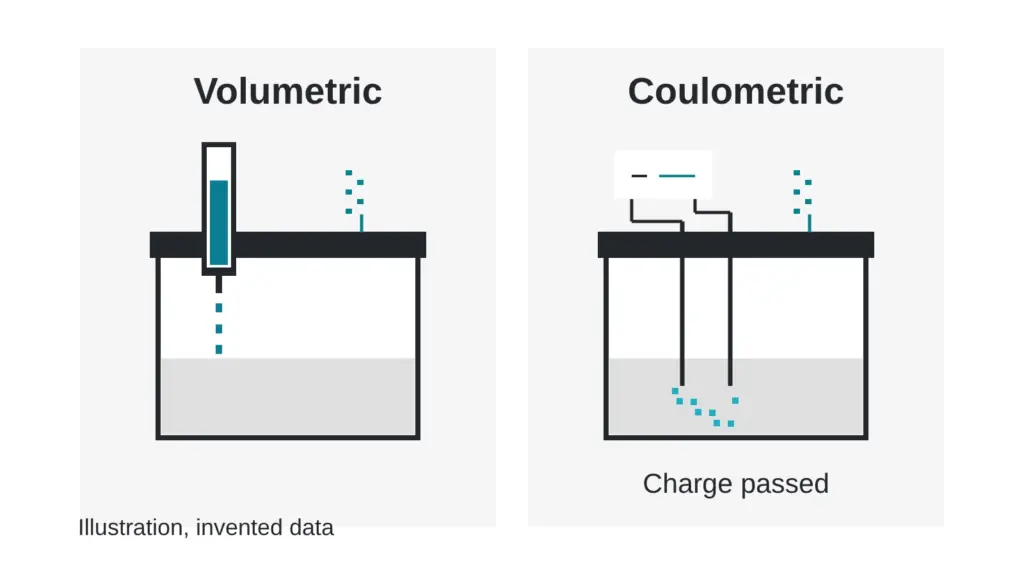
Karl Fischer chemistry uses iodine, which reacts with water in a fixed ratio. Measure the iodine consumed and you know the water. In the coulometric version, the iodine is generated electrically inside the cell, and the end point is detected when a slight excess of iodine appears at an electrode (Cedergren, 1974). The amount of water follows from the charge passed.
Volumetric or coulometric
| Feature | Volumetric | Coulometric |
|---|---|---|
| How iodine arrives | Added as a titrant solution from a burette | Made electrically at an electrode inside the cell |
| Suited to | Larger amounts of water | Trace amounts of water |
| Typical sample | Tens of milligrams or more of a wetter material | A few milligrams of a very dry material |
| Calibration | Titrant strength is checked against a water standard | Based on the charge passed |
One older paper on the coulometric approach analyzed samples containing 0.05 to 200 micrograms of water, with a standard deviation of 0.015 micrograms in the lower range, and a run time of one to four minutes depending on sample size (Cedergren, 1974). That sensitivity is why coulometric titration is the usual choice for very dry solids.
Why dry samples need it
Other mass-loss methods count anything that leaves when a sample is heated, including solvents. Karl Fischer chemistry is built to react with water, which makes it the usual tool for the water line in a mass balance, where water is subtracted along with counterions and other mass that is not the molecule of interest. See How a reference standard gets its number, and who checks the math for how that water number feeds a final value.
Sample size and handling
Small samples magnify small errors. Here is an invented example. A sample of 10.0 mg holds 0.40 mg of water, which is 4.0 percent. If the powder picks up another 0.10 mg of moisture while it sits on the balance, the reading becomes 5.0 percent. One tenth of a milligram moved the figure by a full percentage point.
Three handling issues follow from that arithmetic:
- Exposure time. The sample is weighed and transferred in room air unless the lab uses a dry box or dry gas, so every extra minute adds water.
- Representativeness. The method destroys the sample, so only a few vials per batch are usually tested. A paper on freeze-dried products notes that batch freeze-drying has high intra-batch variability, which means a few vials may not describe the rest (Bobba et al., 2021).
- Interfering substances. Anything else that reacts with iodine can inflate the reading. A study of gas analysis found that a sulfur-containing compound consumed iodine and pushed coulometric readings high, and the authors had to correct for it (Zhi et al., 2019).
Some laboratories heat the sample in an oven and carry the released water into the cell with dry gas, so that a solid never dissolves in the reagent. That is a routine option for samples that interfere with the reagent.
Myth versus reality
A vial sealed under vacuum cannot hold much water. Reality: sealing stops new moisture from entering. It does not remove water already inside the cake, and a cake that was not dried fully at the start starts with its water on board. Only a measurement tells you how much is there.
As received or dry basis
Laboratories sometimes report a value “as received” and sometimes on a “dry basis,” which means the water has been subtracted out. The same vial can produce two different-looking percentages. If a report quotes one, find out which, and use the water line to convert between them. Mixing the two bases is a quiet way for two honest reports to disagree.
What to look for on a report
A water value is easier to trust when the report gives the method (coulometric or volumetric), the sample mass, the number of replicate determinations, and how the sample was handled before and during the run. Without those lines, a single percentage hides most of what shaped it.
Quick check you can do today
Find the water value on a report and write down three things: the method, the sample mass used and the number of replicates. Then ask what the fill weight on the label would be if the water were one point higher. For a 20 mg fill, one extra percentage point of water is 0.2 mg of mass that was never the molecule of interest. If the report gives no sample mass, ask for it.
Sources
- Suiter CL, Widegren JA. Analytical Chemistry, 2021, volume 93(51), pages 16977-16980. PubMed ID 34898163. DOI 10.1021/acs.analchem.1c04268. Descriptor: study using coulometric Karl Fischer titration to measure moisture uptake in calibrant compounds held in a humidity chamber.
- Cedergren A. Talanta, 1974, volume 21(6), pages 367-375. PubMed ID 18961472. DOI 10.1016/0039-9140(74)80164-5. Descriptor: analytical paper describing coulometric Karl Fischer determination of trace water with potentiometric end-point detection.
- Bobba S, Zinfollino N, Fissore D. Journal of Pharmaceutical Sciences, 2021, volume 111(5), pages 1437-1450. PubMed ID 34678272. DOI 10.1016/j.xphs.2021.10.015. Descriptor: study of a near-infrared method for residual moisture in freeze-dried products, noting that Karl Fischer titration is destructive and that batches vary internally.
- Zhi X, Wang H, Liu B, Song X, Li Z, Li J. Analytical Sciences, 2019, volume 35(7), pages 777-782. PubMed ID 30905902. DOI 10.2116/analsci.18P575. Descriptor: study of an interfering sulfur compound in coulometric Karl Fischer titration of a gas.
Want the catalog? Register free