
🚚 Free shipping on orders over $200

Uncategorized

amylin agonists including Eloralintide and Cagrilintide representing the growing metabolic and obesity research market.

Why Big Pharma Is Suddenly Obsessed With Amylin Agonists

The Next Massive Wave in Metabolic Research After GLP-1? For years, GLP-1-focused compounds dominated nearly every conversation surrounding metabolic and obesity-related research. Then something interesting happened. Pharmaceutical companies quietly started shifting enormous amounts of money, development resources, and clinical attention toward a different category entirely: Amylin receptor agonists. What was once considered a relatively niche area of metabolic signaling research is now rapidly becoming one of the hottest sectors in the entire pharmaceutical industry. According to recent industry reports from Fortune Business Insights and Precedence Research, the global amylin analog drug market is projected to grow dramatically over the coming decade as […]

Why Big Pharma Is Suddenly Obsessed With Amylin Agonists Read More »
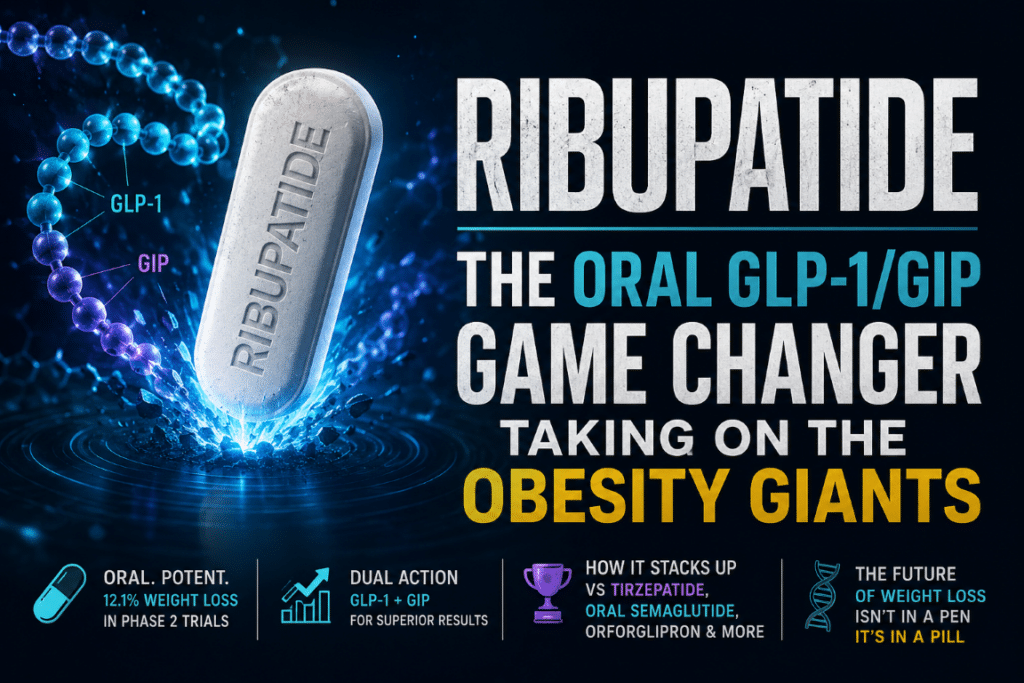
Ribupatide oral GLP-1/GIP weight loss drug compared to semaglutide, tirzepatide, and other obesity medications

Ribupatide: The Next Major Oral GLP-1/GIP Weight Loss Drug?

The obesity treatment market is evolving rapidly, with pharmaceutical companies racing to develop more effective and convenient weight management therapies. One of the newest names gaining attention is Ribupatide, an investigational oral GLP-1/GIP receptor agonist currently being developed by Kailera Therapeutics and Hengrui Pharma. Following encouraging Phase 2 obesity trial data, Ribupatide has quickly become one of the most discussed next-generation oral obesity drugs among investors, researchers, and healthcare analysts. The growing interest stems from its potential to combine: significant weight loss efficacy oral tablet convenience dual GLP-1/GIP activity faster dose escalation competitive positioning against current market leaders As oral obesity

Ribupatide: The Next Major Oral GLP-1/GIP Weight Loss Drug? Read More »

2839-lb-quintuple-agonist

Beyond Retatrutide: First Quintuple Agonist Obesity Drug Could Change the Weight Loss Race

The obesity treatment market is moving faster than ever. First came GLP-1 medications like semaglutide. Then dual agonists such as tirzepatide changed expectations. After that, triple agonists like retatrutide and other next-generation compounds pushed the category even further. Now the next phase may be arriving: The first publicly discussed quintuple agonist obesity drug. If successful, this new therapy could go beyond appetite suppression alone and target multiple pathways linked to body weight, blood sugar control, satiety, energy expenditure, and long-term metabolic health. That is why obesity medicine researchers, investors, and industry watchers are paying close attention. What Is the First Quintuple

Beyond Retatrutide: First Quintuple Agonist Obesity Drug Could Change the Weight Loss Race Read More »

buy retatrutide glp-3

Retatrutide (GLP-3) Explained: Why This Triple Agonist Is Getting So Much Attention in Research

Retatrutide has rapidly become one of the most discussed investigational compounds in modern peptide and metabolic research. Much of that attention comes from its triple agonist mechanism, which sets it apart from traditional GLP-1 agonists and even many newer dual agonist compounds. In online discussions, Retatrutide is sometimes casually referred to as “GLP-3.” While that is not an official scientific classification, the nickname reflects why the compound has generated so much interest: it is commonly described as interacting with three major receptor pathways rather than one or two. For laboratories, peptide-focused researchers, and those following newer developments in this category, Retatrutide

Retatrutide (GLP-3) Explained: Why This Triple Agonist Is Getting So Much Attention in Research Read More »

Do peptides need to stay cold during shipping myth

Peptide Shipping Myth: Do Peptides Need Ice or Cold Shipping?

The Truth About Summer Shipping, Delays, and Lyophilized Peptide Stability Every year—especially during summer—we get the same worried message: “My package was delayed and it’s hot outside… are my peptides ruined?” Short answer? Usually, no. And in most cases, not even close. This is one of the biggest myths in the peptide world: the idea that if a shipment gets warm for a few days, the contents are automatically compromised. That sounds logical on the surface. But in the real world, that’s usually not how lyophilized peptides behave in transit. Let’s break down what actually matters—and what usually doesn’t. The Big

Peptide Shipping Myth: Do Peptides Need Ice or Cold Shipping? Read More »

Feature image for Structure’s Aleniglipron showing oral GLP-1 capsules, study results graphics, and comparison to Wegovy, Zepbound, and orforglipron

Structure’s Aleniglipron: Study Results, Oral GLP-1 Comparison, and Key Data

Structure Therapeutics has officially entered the serious oral GLP-1 conversation. Its once-daily oral study drug, aleniglipron, delivered one of the more notable obesity readouts seen so far in this category, immediately putting it into comparison with other major names in the space. That includes: For searchers looking for a simple answer, here it is: Aleniglipron now looks like one of the most important oral GLP-1 study drugs currently in development. That does not make it the category leader. But it absolutely makes it worth paying attention to. What Is Aleniglipron? Aleniglipron is an investigational oral small-molecule GLP-1 receptor agonist being developed

Structure’s Aleniglipron: Study Results, Oral GLP-1 Comparison, and Key Data Read More »

Buy dihexa 5mg capsules

Dihexa Research Compound: Mechanism, BDNF, HGF/c-Met & Laboratory Research

What Is Dihexa? Dihexa is a synthetic angiotensin IV-derived peptidomimetic compound that has become a topic of interest in preclinical neuroscience, neuropharmacology, and molecular signaling research. In laboratory settings, Dihexa has been studied for its relationship to cell signaling pathways, receptor interaction, synaptic architecture, and neurobiological communication systems in non-human experimental models. Unlike larger, more traditional peptide chains, Dihexa is often described as a small-molecule peptidomimetic, meaning it is structurally derived from amino acid–based design principles while exhibiting characteristics that make it relevant for compound stability, receptor targeting, and pathway-mapping applications in research environments. As interest in Dihexa research continues to

Dihexa Research Compound: Mechanism, BDNF, HGF/c-Met & Laboratory Research Read More »

Amycretin vs GLP-1 based therapies comparison including semaglutide, tirzepatide and retatrutide research overview”

Amycretin vs GLP-1-Based Peptides: A Research-Based Comparison Guide (2026)

The Evolution of Metabolic Research Compounds The metabolic research space has shifted rapidly from single-pathway compounds to multi-mechanism designs aimed at enhancing satiety signaling, energy balance, and metabolic regulation. Early compounds targeting GLP-1 receptors established a strong foundation. Newer candidates now combine multiple biological pathways in an effort to amplify outcomes. One of the most closely watched investigational compounds in this category is amycretin, currently under development by Novo Nordisk. What Is Amycretin? Amycretin is an investigational compound designed as a unimolecular dual agonist targeting: This dual-pathway approach aims to influence: Unlike combination approaches that utilize multiple separate agents, amycretin integrates

Amycretin vs GLP-1-Based Peptides: A Research-Based Comparison Guide (2026) Read More »

RFK Jr discussing 14 peptides and the FDA Category 2 list following comments made on the Joe Rogan Experience podcast

RFK Jr., 14 Peptides, and FDA Category 2: Were Any Peptides Actually Approved?

In early March 2026, headlines began circulating across the biotechnology and peptide research community claiming that 14 peptides had been approved by the FDA. The story spread rapidly across social media, newsletters, and industry forums. Researchers, peptide vendors, and industry observers began asking the same question: Did the FDA really approve 14 peptides? The answer is straightforward. No new peptides have been approved by the FDA. As of March 1, 2026, there is no official FDA publication confirming that any peptides were approved or reclassified. Many readers began searching whether “14 peptides were FDA approved” after comments from Robert F. Kennedy

RFK Jr., 14 Peptides, and FDA Category 2: Were Any Peptides Actually Approved? Read More »

CT-388 dual GLP-1 GIP receptor mechanism

CT-388 Peptide: Mechanism, Clinical Trial Results, and the Future of Metabolic Research

The field of metabolic research peptides has advanced dramatically in the last decade. Scientists studying appetite regulation, metabolic signaling, and energy balance have discovered that hormone pathways governing hunger and metabolism are far more complex than originally believed. As a result, modern research is shifting toward compounds capable of influencing multiple metabolic signaling pathways simultaneously. One experimental compound that has recently attracted significant attention in the metabolic research community is CT-388, an investigational peptide studied for its ability to influence appetite regulation, metabolic signaling, and body-weight dynamics in controlled research models. Early trial results have generated substantial discussion among researchers studying

CT-388 Peptide: Mechanism, Clinical Trial Results, and the Future of Metabolic Research Read More »

Scroll to Top