
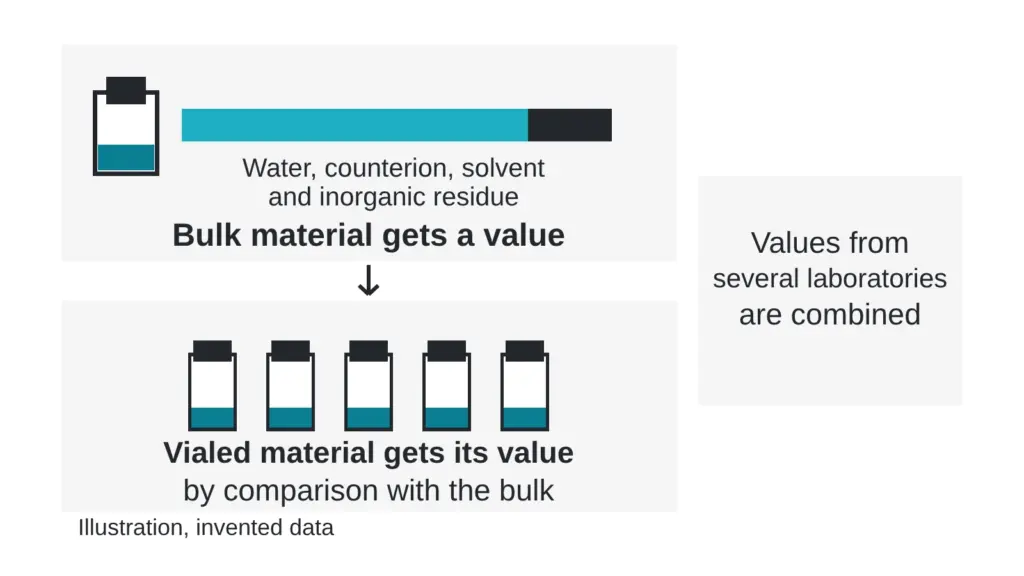
A vial of reference standard arrives with one number on its label, the assigned value. Everything measured against that vial inherits the number. Somebody had to decide it, and the 2023 paper summarized here explains how that decision is built in two steps. The second step is the one most readers skip.
This is a journal club piece. It follows one paper through five questions: what it set out to do, how it did it, what it found, what that means for reading a laboratory report, and what the paper cannot tell you. It draws only on the published abstract and its PubMed record (PubMed ID 36949371), and it describes the paper by type, as a report on how reference standards for synthetic peptides are produced and characterized. Terms are defined in the The testing glossary: 14 lab terms in plain English.
What did the paper set out to do?
The authors wanted to describe how peptide reference standards are made and checked, from vialing and freeze-drying through analytical testing and stability studies. Their starting point is that many analytical tests of peptide quality depend on well-characterized reference standards to determine identity, purity and strength. A reference standard works like a ruler, and the paper’s subject is how the ruler gets its markings.
How did it go about it?
The report uses case studies to illustrate the analytical approaches. According to the abstract, those cover methods for value assignment, content uniformity and identity testing.
The abstract does not say why the authors chose two steps. A practical reason is plausible: mass balance needs several separate measurements and a lot of material, so doing it once on the bulk and then comparing each vialed lot against that bulk saves effort and keeps every vial tied to the same value. That reasoning is ours and not the authors’ statement.
On the methods side, the abstract lists nuclear magnetic resonance, mass spectrometry and chromatography for identity testing, and liquid chromatography and gas chromatography methods for assessing peptide content and impurities. It also describes how findings from multiple laboratories are integrated to assign a value to the final lyophilized vial.
What did it find?
The paper is a methods report, so its output is a strategy and not a measurement. The abstract states the central idea, a two-step process for value assignment.
- Step one uses a mass balance approach to assign a quantitative value to a bulk peptide material.
- Step two uses that bulk material as a standard to assign a final value to the vialed material.
The abstract adds that testing to confirm identity and to ensure consistency of the vialed material is described, along with considerations for handling variability, identifying outliers and running stability studies. The authors present the methods and case studies as a benchmark for preparing, testing, handling and storing peptide reference standards. They also note that some peptide features, such as chirality or isobaric residues, may need additional techniques for a full characterization.
A vialed standard is a copy of a measurement. The original measurement happened one step earlier, on the bulk.
What does it mean for reading a laboratory report?
Mass balance subtracts what is not the peptide from the whole. Water, counterions, residual solvent and inorganic residue come off the total, and the remainder is the assigned content. The method is laid out in How a reference standard gets its number, and who checks the math, and a worked arithmetic example is in Why a 10 mg label can hold only 6.9 mg of the molecule: a worked example.
Two published studies of peptide reference materials, cited here by PubMed ID only, show why the subtractions matter. In one (PubMed ID 41916078, 2026), the mass balance deductions included 5.46 percent water and 15.48 percent trifluoroacetate ion, which made the counterion the largest single deduction. A second method, based on amino acid analysis with isotope dilution mass spectrometry, assigned a value within about one percentage point of the mass balance value (78.60 and 77.58 percent). In the other (PubMed ID 30143839, 2018), a trifluoroacetic acid counterion measured by a fluorine nuclear magnetic resonance method made up nearly 25 percent by mass and was treated as an impurity, and three different methods agreed.
A reader can turn the two-step idea into four questions for any report on a vialed standard:
| Question to ask | Why it matters |
|---|---|
| Was the value assigned by mass balance or by comparison with another standard? | A value set against another standard carries that standard’s error forward |
| Which deductions are listed? | A mass balance with no counterion line is an incomplete subtraction |
| How many laboratories contributed? | The paper describes integrating findings from several laboratories |
| Is the lot the same on every line? | Values from different lots cannot be added together |
The ongoing debate about which standard to trust is covered in Reference standards: the quiet argument behind every purity number.
What can the paper not tell you?
- It cannot tell you the value of any particular material. The abstract reports no assigned numbers, and a strategy is different from a measurement.
- It cannot confirm that any given report followed the two-step process. A report that cites a reference standard needs to say how that standard was assigned.
- It cannot settle features unique to a given peptide. The authors themselves flag that some features need extra techniques.
- It cannot replace the full text. This summary rests on the abstract, and the full paper holds details of the case studies that are not summarized here.
Quick check you can do today
Take a report that names a reference standard and look for the sentence that says how that standard got its value: mass balance, amino acid analysis, quantitative nuclear magnetic resonance, or a comparison with another standard. If the sentence is missing, the number cannot be traced, and that is the first question to send.
Sources
- McCarthy D, Han Y, Carrick K, Schmidt D, Workman W, Matejtschuk P, Duru C, Atouf F. Pharmaceutical Research, 2023, volume 40(6), pages 1317-1328. PubMed ID 36949371. DOI 10.1007/s11095-023-03493-1. Descriptor: report on producing and characterizing synthetic peptide reference standards, including a two-step mass balance process for value assignment.
- PubMed ID 41916078, 2026. Descriptor: purity assignment of a peptide reference material by mass balance and by a second method based on amino acid analysis.
- PubMed ID 30143839, 2018. Descriptor: purity assignment for a candidate peptide reference material that combines quantitative nuclear magnetic resonance and amino acid analysis with a mass balance prior.
Want the catalog? Register free