
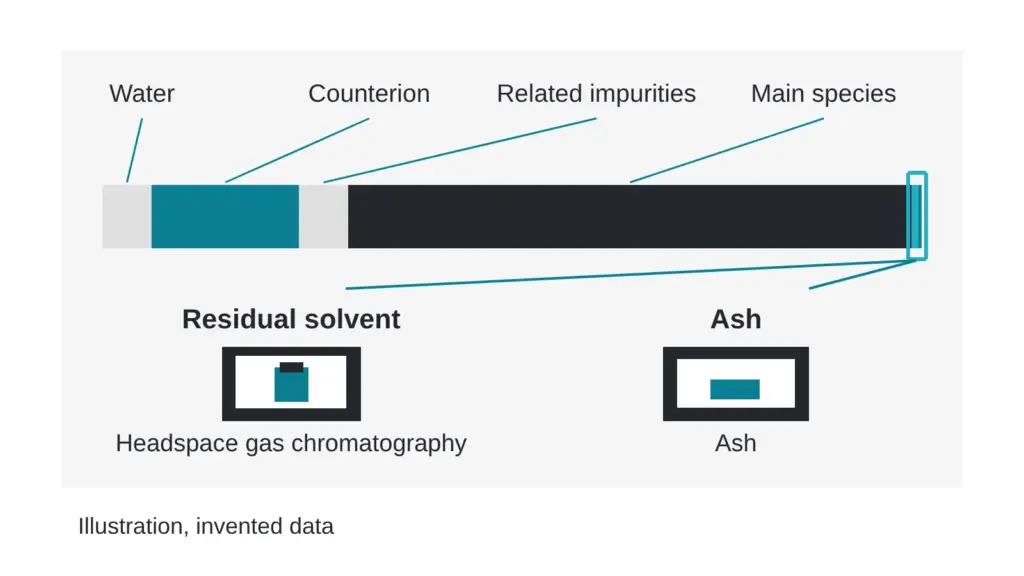
Scroll down a mass balance table and the big lines get all the attention: water, counterion, related impurities. Then come two rows that look like rounding errors. In the invented example used below they read residual solvents 0.8 percent and ash 0.4 percent. It is tempting to skip them. This article explains what those two rows measure, how a lab gets numbers that small, and why a mass balance that omits them quietly stops balancing.
Every figure in the tables below is invented for teaching. Terms are in the The testing glossary: 14 lab terms in plain English, and the full subtraction logic is in How a reference standard gets its number, and who checks the math.
What is a residual solvent?
A synthetic peptide meets liquids at nearly every stage of its making: during assembly, during cleanup and during final drying. Whatever liquid does not leave with the drying step can stay behind in the solid at trace levels. Those leftovers are residual solvents.
They are different from water. Water is measured by How labs weigh the water in a dry sample: Karl Fischer explained, a titration built to count water and nothing else. Solvents are measured by a different instrument.
How does a lab find a trace of leftover liquid?
The usual tool is headspace gas chromatography. The lab seals a weighed portion in a vial and warms it. Any volatile solvent escapes from the solid into the air above it (the headspace). A sample of that air goes onto a gas chromatography column, which separates the solvents from each other, and a detector counts each one.
The detector is either a flame ionization detector or a mass spectrometer. One published mass balance study of a salt-form compound used headspace gas chromatography with mass spectrometry for its residual solvents, listed as one class of impurity among several, each measured with its own technique (Lee et al., 2023). A separate validation paper developed a headspace method with a flame ionization detector for two process solvents and reported its limit of quantification in parts per million, using a 43-minute run (Chemna et al., 2026).
A single run can cover many solvents. A method paper described a dual-column gas chromatography approach with a mass spectrometer that identified and quantified 57 residual solvents listed in international guidelines in one 30-minute chromatogram. It needed two columns with different chemistry because some solvents co-elute on one column (Arulraj et al., 2026). That is the same overlap problem that affects liquid chromatography, on a different instrument.
What is ash, and why burn a sample to measure it?
Ash is what remains after the organic material is burned away. A lab heats a weighed portion in a furnace until the peptide, and everything carbon-based, is gone, then weighs what is left. The leftover is inorganic: salts, trace metals and similar material that does not burn.
A published paper on microwave-assisted acid digestion describes residue on ignition and sulfated ash as the methods used to monitor inorganic impurities in pharmaceutical ingredients, and offers a faster digestion route as an alternative to the traditional compendial methods (Pluhacek et al., 2016). Another technique, thermogravimetric analysis, heats a sample on a balance and records the weight change. The mass balance study above used it to measure non-volatile material (Lee et al., 2023).
Why are these rows so small?
| Component | Invented share of powder | Method | What sets its size |
|---|---|---|---|
| Water | 6.0 percent | Karl Fischer titration | Freeze-drying removes most of it, and a dry closure keeps it out |
| Counterion | 18.0 percent | Ion chromatography | Set by chemistry, usually the largest missing line |
| Related impurities | 6.0 percent | Liquid chromatography | Set by synthesis and cleanup quality |
| Residual solvents | 0.8 percent | Headspace gas chromatography | Most volatile liquid leaves during drying |
| Ash | 0.4 percent | Furnace residue | Little inorganic material survives cleanup |
The counterion row is the big one, and The salt nobody lists: how a counterion changes what a vial really holds covers it. The shares of 0.8 and 0.4 look harmless. Together they are 1.2 percentage points of the powder. If a laboratory leaves both off, the invented net content in this example comes out about 1.1 points too high, and the error rides along into every later calculation.
What goes wrong when the rows are missing?
A mass balance works by subtraction. Everything measured comes off the top, and what is left is assigned to the molecule. The reference standard review from the pharmacopeial group describes exactly this two-step design, in which a mass balance gives a quantitative value to the bulk material and that bulk then values the vials (McCarthy et al., 2023). Leave a line out and the subtraction over-credits the molecule.
Two traps show up repeatedly:
- Double counting: thermogravimetric mass change includes water and volatile solvent together, so adding it to a separate water line counts the water twice.
- Silent omission: a report that says “volatiles” in one cell without saying which method produced it has merged lines you cannot separate.
The small numbers are small because a lot of work went into making them so. Report them anyway, because a mass balance only balances when every line is on it.
Quick check you can do today
Take any report that quotes a content figure and list the lines behind it. Do you see a water line, a counterion line, a residual solvent line and an ash line, each with its own method? If solvents and ash are missing, ask whether they were measured and found negligible, or never measured. Then compare the lines you can see with the table above, and read Why a 10 mg label can hold only 6.9 mg of the molecule: a worked example to see how each one moves the final figure.
Sources
- Lee S, Baek SY, Kwon HJ, Choi KH, Han J. Molecules, 2023, volume 28(22), article 7568. PubMed ID 38005289. DOI 10.3390/molecules28227568. Descriptor: mass balance purity method for a small-molecule salt, with solvents measured by headspace gas chromatography with mass spectrometry and non-volatiles by thermogravimetric analysis.
- Arulraj R, Vishwanath V, Duche S, Mathur A, Roy A. Analytical Methods, 2026, volume 18(21), pages 4475-4485. PubMed ID 42171149. DOI 10.1039/d5ay01603g. Descriptor: method paper on one gas chromatography run for 57 residual solvents using dual columns and a mass spectrometer.
- Chemna K, Logoyda L, Rudiuk V. BMC Chemistry, 2026, volume 20(1). PubMed ID 42928349. DOI 10.1186/s13065-026-01888-w. Descriptor: validated headspace gas chromatography method with flame ionization detection for two residual solvents in a drug substance.
- Pluhacek T, Hanzal J, Hendrych J, Milde D. Die Pharmazie, 2016, volume 71(4), pages 177-180. PubMed ID 27209695. Descriptor: method paper on microwave-assisted digestion for heavy metals and for residue on ignition or sulfated ash in pharmaceutical ingredients.
- McCarthy D, Han Y, Carrick K, Schmidt D, Workman W, Matejtschuk P, Duru C, Atouf F. Pharmaceutical Research, 2023, volume 40(6), pages 1317-1328. PubMed ID 36949371. DOI 10.1007/s11095-023-03493-1. Descriptor: review of how reference standards for synthetic peptides are produced and characterized, including a two-step mass balance value assignment.
Want the catalog? Register free