
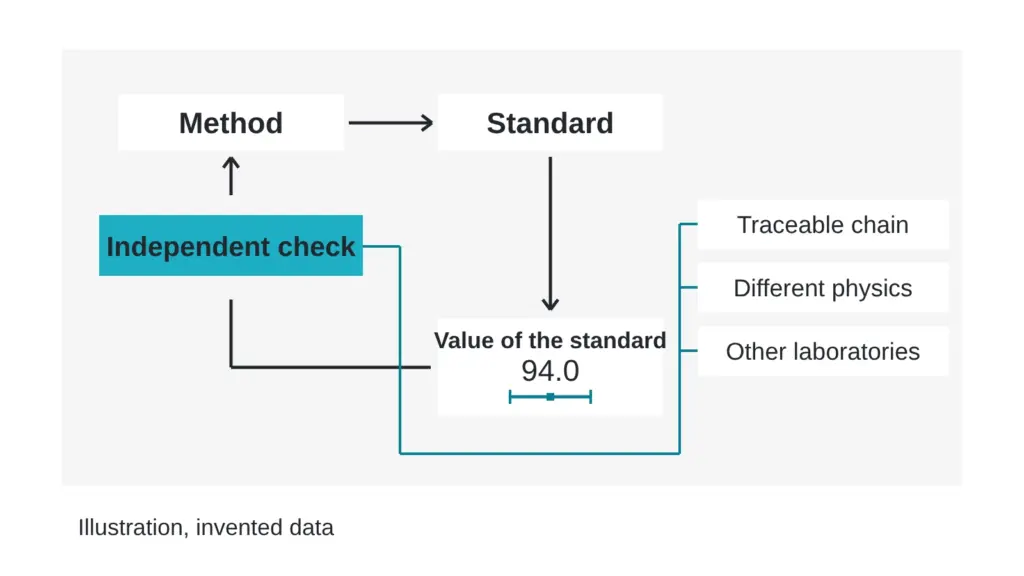
A laboratory runs a sample against a reference vial whose label says 94.0 percent. The number is invented for this article. The sample comes back at 93.5, and everyone nods. Then someone asks an awkward question: who decided the vial was worth 94.0?
That question is the circularity problem. A method is calibrated against a standard, and the standard’s value came from a method. Somewhere the loop has to be broken by something independent, or the whole system agrees with itself and calls that accuracy. This article shows where the loop hides, three ways chemists break it, and what to look for on a report. Terms are in the The testing glossary: 14 lab terms in plain English.
Somewhere down the chain, a person decided what the standard is worth. A good report shows how.
Where the loop hides
A published account of how peptide reference standards are made describes two steps. First, a mass balance approach assigns a value to a bulk material. Then the bulk material serves as the standard that assigns the value to each vialed lot (PubMed ID 36949371). Mass balance means starting from the whole and subtracting everything that is not the target: water, counterions, inorganic material and related impurities, each measured by its own method (How a reference standard gets its number, and who checks the math). Every later measurement inherits that value and its margin.
Nothing is wrong with a chain like that when the chain is documented. The loop becomes a problem when the same method sits at both ends with the same blind spot, or when the margin on the standard goes unreported.
Agreement can come from sharing a ruler. A multi-laboratory collaborative study compared three ways of quantifying a peptide. The assay that used the same bulk material as its own standard showed the lowest variability between laboratories, and the authors note that this spread was calculated without counting the margin attached to the standard’s purity assignment (PubMed ID 30640042). Read plainly, tight agreement among laboratories shows that they share a reference. It cannot show that the reference is right.
Three ways to break the loop
A traceable chain. Each value links to a higher reference through a documented step, with a margin stated at every link. Margins add up as the chain lengthens, so the final figure gets wider. That widening is honest, and a number with no margin has simply left the arithmetic out. This idea is general metrology, and Reference standards: the quiet argument behind every purity number shows where the arguments start.
Independent methods. Methods built on different physics have different blind spots. One reference-material study combined quantitative nuclear magnetic resonance, amino acid analysis by isotope dilution mass spectrometry and mass balance, and reported excellent agreement among the three. It also notes that the first two methods are susceptible to interference from related peptide impurities, which must be measured and accounted for (PubMed ID 30143839). Another reference-material study assigned purity by mass balance and by quantitative nuclear magnetic resonance, then verified the final value by isotope dilution mass spectrometry. Water came from Karl Fischer titration, anions from ion chromatography and inorganic elements from inductively coupled plasma mass spectrometry (PubMed ID 40536667). Several methods that agree are much harder to explain by shared error than one method repeated.
Other laboratories. When several laboratories measure the same material, a bias unique to one of them shows up as an outlier. This is the logic behind Labs grading labs: how proficiency testing keeps numbers honest.
What each safeguard catches
| Safeguard | What it catches | What it cannot catch |
|---|---|---|
| Documented chain | A value with no parentage, or a margin left out | A wrong value at the top of the chain |
| Independent methods | Blind spots that belong to one method | A dependency all methods share, such as unidentified related impurities |
| Comparison across laboratories | Bias at a single laboratory | A bias every laboratory shares, such as one common standard |
The third row of that table is the quiet one. If every laboratory in a comparison uses the same standard, they can agree with each other perfectly and still agree on the same error.
What to look for on a report
Five questions open the loop on any report.
- What material served as the standard, and is it the same bulk or lot as the sample?
- How was the standard’s value assigned, and by which methods?
- What margin goes with that value?
- What is the date of the assignment?
- Has the laboratory checked its result against an independent method or taken part in a comparison with other laboratories?
A report that names its standard, its way of assignment and a margin lets a reader judge the loop. A report that says only “against reference standard” asks for faith. “Research grade” has no agreed definition. Here is what a useful grade statement would say takes up what happens when a grade label stands in for these answers.
Myth versus reality
Myth: a standard is a fact. Reality: a standard is a measurement with a margin, made by people using methods, and kept honest by independent checks.
Quick check you can do today
Pick one report and find the sentence that names the standard. On a sticky note, write four answers: what material it was, where its value came from, which methods assigned it, and what margin goes with it. Every blank is a question for the laboratory. If the report names no standard at all, that is the first question.
Sources
- McCarthy D, Han Y, Carrick K, Schmidt D, Workman W, Matejtschuk P, Duru C, Atouf F. Pharmaceutical Research, 2023, volume 40(6), pages 1317-1328. PubMed ID 36949371. DOI 10.1007/s11095-023-03493-1. Descriptor: report on producing and characterizing reference standards for synthetic peptides, including two-step value assignment.
- PubMed ID 30640042, Journal of Pharmaceutical and Biomedical Analysis, 2018, DOI 10.1016/j.jpba.2018.12.028. Descriptor: multi-laboratory collaborative study comparing three peptide quantitation methods.
- PubMed ID 30143839, Analytical and Bioanalytical Chemistry, 2018, DOI 10.1007/s00216-018-1272-7. Descriptor: purity assignment for a candidate peptide certified reference material by combining quantitative nuclear magnetic resonance, amino acid analysis and mass balance.
- PubMed ID 40536667, Analytical and Bioanalytical Chemistry, 2025, DOI 10.1007/s00216-025-05955-4. Descriptor: characterization of peptide certified reference materials, with purity assessed by mass balance and quantitative nuclear magnetic resonance and verified by isotope dilution mass spectrometry.
Want the catalog? Register free