
Lift a cold glass out of the refrigerator on a humid afternoon and it fogs over in seconds. Nothing leaked through the glass. The water came from the air. The same physics applies to a cold container of dry material carried into a warm laboratory, and it explains a habit that most analytical laboratories share: sealed containers come out of cold storage and sit until they reach room temperature before anyone opens them.
This article explains the physics in plain terms, then shows why it matters to a dry, water-hungry solid. It is about laboratory handling of dry sealed material only. Terms are defined in the The testing glossary: 14 lab terms in plain English.
What is the dew point?
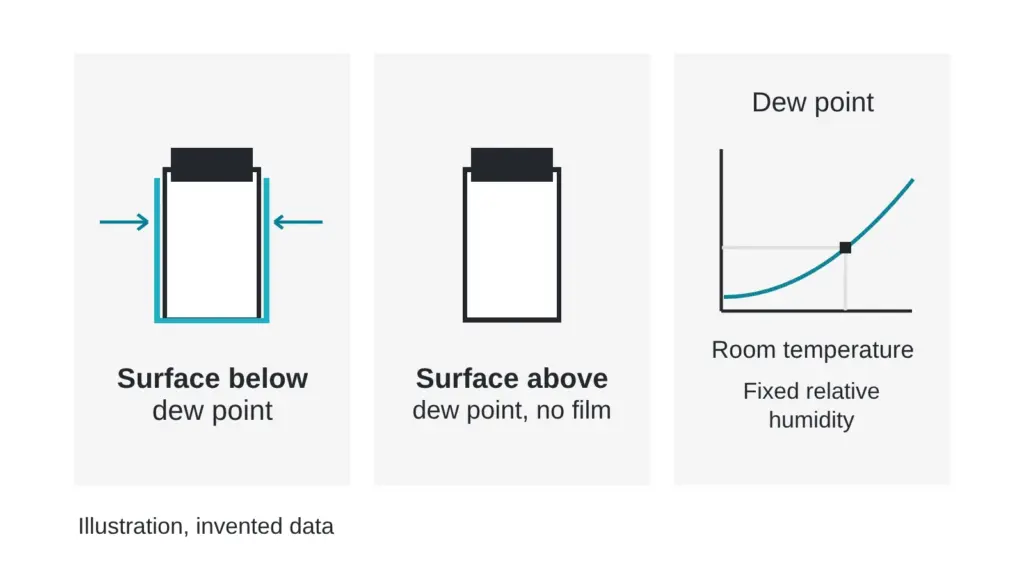
Air always carries some water vapor, and warm air can carry more than cold air. Relative humidity says how full the air is compared with the most it could hold at its current temperature. The dew point is the temperature at which the air you have would be completely full. Cool the air below that point, or cool a surface below it, and the excess vapor turns into liquid droplets.
A cold surface does exactly that to the layer of air touching it. If the surface sits below the dew point of the room, a film of water forms on it. The surface does not have to be wet to begin with, and the film does not have to come from a leak.
Rounded physical estimates make this concrete. Room air at 22 degrees Celsius and 50 percent relative humidity has a dew point near 11 degrees Celsius.
| Container surface temperature | Room air at 22 degrees Celsius, 50 percent humidity |
|---|---|
| 4 degrees Celsius | Below the dew point: water film forms |
| 8 degrees Celsius | Below the dew point: water film forms |
| 15 degrees Celsius | Above the dew point: no film |
| 22 degrees Celsius | Same as the room: no film |
The temperatures are illustrative values and not a procedure. The point is the threshold: a container surface only needs to be a few degrees colder than the room for water to appear on it.
Why does a dry solid care?
Many dry solids are hygroscopic. They bind water vapor from their surroundings, and the more vapor available, the more they take up. In one closure study, an extremely hygroscopic powder was used as a humidity indicator because it liquefies on contact with humid air (Birrer et al., 2000). A cold container that has just been opened is a place where humid room air can meet a cold powder and cold glass at once, which is the setup for water to condense inside.
The consequences follow the chemistry of moisture. In a study of a freeze-dried antibody formulation, residual moisture between 1 and 8 percent lowered the glass transition temperature from 80 degrees Celsius to 25 degrees Celsius, and higher moisture lowered chemical stability (Breen et al., 2001). A study of dry powders made from lipid nanoparticles found that residual moisture above about 3 to 3.5 percent harmed particle size or encapsulation depending on the formulation (AboulFotouh et al., 2023). Those materials differ from any particular sample, but the direction is the same: a little extra water changes how a dry solid behaves.
There is a measurement effect too. A cold container on a balance collects a film on its outside, and the reading climbs as the film grows. Weighing a container that is still colder than the room can add mass that has nothing to do with the sample. The water content then drifts, as covered in The variable nobody lists: how moisture moves a dry sample’s weight.
The amounts are not trivial. A small vial has an outer surface of roughly 40 square centimeters. A film of water one micrometer thick, thin enough to look like light fog, would hold about 4 mg of water across that surface. That is a rounded physical estimate, and it is on the same scale as all the water inside a weighed portion of dry solid.
Why do laboratories wait before opening?
Cooling a sealed container does not add water to the solid. The air inside the vial was sealed in at some humidity, and as long as the closure holds, the interior stays the way it was. The risky moment is the opening. A container that has reached room temperature has no surface below the dew point, so room air meeting it cannot deposit liquid. A container that is still cold does.
Warming takes time, because glass, powder and air have thermal mass and a bigger container takes longer to equilibrate than a small vial. A laboratory handling procedure usually writes down a rule for waiting, sets it by container size, and records the time the container left storage and the time it was first opened. The rule is deliberately dull. Dull rules are how a result stays the same on a Monday and a Friday.
Myths and plain statements
Cold slows chemistry, and nothing about cold storage dries a material. The moment a container opens is when its water content can change. Wiping the outside removes the film on the glass, and the interior was never exposed while the closure held. A tight closure keeps the interior as it was; Stoppers, seals and the small leaks that matter explains how that works.
Heat during shipping is a separate question with its own data, covered in A hot truck and a dry sample: what heat in transit can and cannot change.
Quick check you can do today
Look at any handling record and find three things: the time the container left cold storage, the time it was first opened, and the room humidity. If the first two are missing, the record cannot show that the container had equilibrated. Storage principles are in Storage mistakes that quietly add water to a dry sample.
Sources
- Birrer GA, Liu J, Halas JM, Nucera GG. PDA Journal of Pharmaceutical Science and Technology, 2000, volume 54(5), pages 373-382. PubMed ID 11057094. DOI not listed in the record. Descriptor: closure integrity test model using a hygroscopic indicator powder that liquefies on contact with humid air.
- Breen ED, Curley JG, Overcashier DE, Hsu CC, Shire SJ. Pharmaceutical Research, 2001, volume 18(9), pages 1345-1353. PubMed ID 11683251. DOI 10.1023/a:1013054431517. Descriptor: effect of residual moisture and glass transition temperature on a freeze-dried antibody formulation.
- AboulFotouh K, Southard B, Dao HM, Xu H, Moon C, Williams RO, Cui Z. International Journal of Pharmaceutics, 2023, volume 650, article 123688. PubMed ID 38070660. DOI 10.1016/j.ijpharm.2023.123688. Descriptor: study of residual moisture in freeze-dried lipid nanoparticle powders.
Want the catalog? Register free