
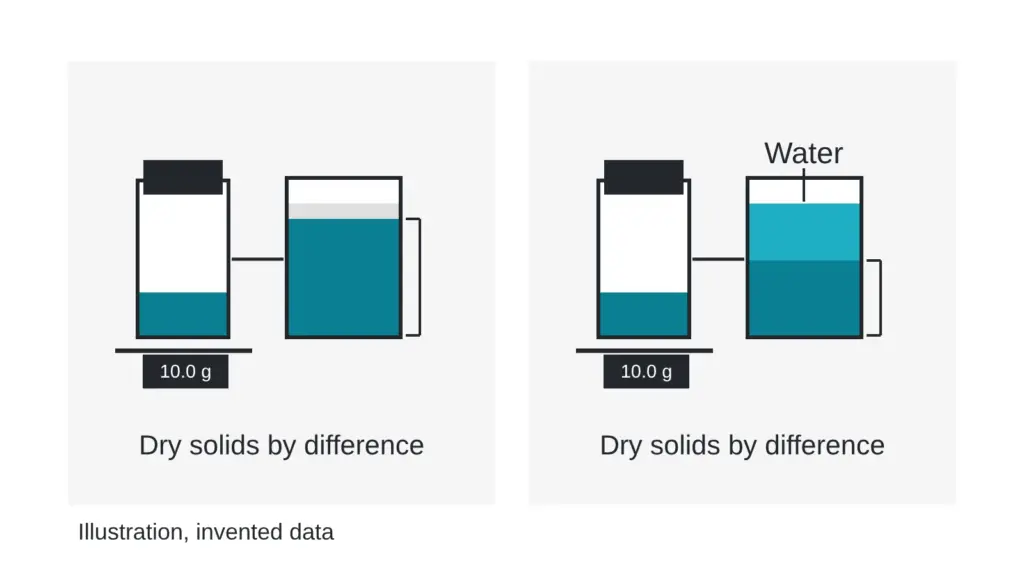
A powder sits on an analytical balance. The display creeps up by a few hundredths of a milligram every minute, and nobody has touched anything. That drift is water arriving from the air. It is the same quiet variable that shifts a content value, softens a freeze-dried cake and speeds up slow chemistry.
This article covers three things: how water changes the mass you weigh, how it changes the stability of a dry solid, and how laboratories measure it. Terms are defined in the The testing glossary: 14 lab terms in plain English.
Why does water change the mass you weigh?
Many dry solids are hygroscopic, which means they pull water vapor out of the air and hold it. Water is a real component of the sample, but it is rarely the component anyone cares about. Water is the one ingredient nobody lists and everybody weighs.
Here is an invented teaching example. Two samples of the same material are each weighed at 50.0 mg. The drier one holds 2.0 percent water and the wetter one holds 6.0 percent. Assume the target molecule makes up 80.0 percent of the dry solids in both.
| Quantity (invented) | Drier sample | Wetter sample |
|---|---|---|
| Weighed mass | 50.0 mg | 50.0 mg |
| Water content | 2.0 percent | 6.0 percent |
| Water mass | 1.0 mg | 3.0 mg |
| Dry solids | 49.0 mg | 47.0 mg |
| Target molecule | 39.2 mg | 37.6 mg |
Both samples weigh the same, yet the wetter one holds about 4 percent less of the target molecule. A laboratory that skips the water measurement will carry that gap straight into a content value. This is why mass balance subtracts water before anything else; see How a reference standard gets its number, and who checks the math.
Where does the water live?
Not all water in a dry solid sits in the same place. Some is adsorbed on the surface of the particles and leaves easily. Some is bound inside the solid, held to polar groups or trapped in the structure, and leaves only when the solid is warmed or placed under vacuum. Some materials also carry water in their crystal lattice. A freeze-dried cake is usually amorphous, so its water is mostly the first two kinds. This is general chemistry, and it is the reason secondary drying exists in the freeze-drying process covered in Inside a freeze-dried cake: what lyophilization leaves behind.
Surface water also explains the balance drift from the opening scene. The surface layer exchanges with room air quickly, so the water value of a powder follows the humidity around it until the container is sealed again.
What does water do to the chemistry?
Water takes part in degradation reactions directly, and it also loosens the solid so molecules can move and meet. The loosening is easiest to picture through the glass transition temperature. Below it, an amorphous solid behaves like a rigid glass. Above it, the solid turns rubbery and molecular motion jumps.
Water lowers that temperature. In a study of a freeze-dried antibody formulation with residual moisture between 1 and 8 percent, the glass transition temperature measured by calorimetry fell from 80 degrees Celsius at 1 percent moisture to 25 degrees Celsius at 8 percent. The authors reported that high moisture lowered chemical stability whether the solid was glassy or rubbery (Breen et al., 2001).
Drier does not always mean better. A study of dry powders made from lipid nanoparticles found that residual moisture at or below 0.5 percent, or above about 3 to 3.5 percent, harmed particle size or encapsulation depending on the formulation (AboulFotouh et al., 2023). Those materials differ from every other dry solid, so the numbers do not transfer. The point that does transfer is that each material has a moisture range it tolerates, and the range comes from data.
How is water measured?
Karl Fischer titration is the usual laboratory answer. It is a chemical titration specific to water, so it counts water and ignores other volatile substances. It comes in coulometric and volumetric forms, covered in How labs weigh the water in a dry sample: Karl Fischer explained. A published case study of freeze-dried vials listed it as the method for residual moisture, next to protein concentration, sterility and container closure integrity (Mehta et al., 2018).
Loss on drying is the older approach. It weighs a sample, heats it and weighs it again. The mass that leaves includes water and anything else that evaporates, such as residual solvent, so a loss-on-drying figure and a Karl Fischer figure can differ on the same material.
Sample handling decides how far a moisture number can be trusted. Laboratories weigh small portions, so a few seconds of exposure in humid air can move the reading. A water value is a snapshot of one portion on one day, and it is strongest when the report names the method and the date.
Reading a moisture value on a report
| Detail on the report | Why it matters |
|---|---|
| Method named (Karl Fischer or loss on drying) | The two methods count different things |
| Date of measurement | Moisture can change after the test |
| Sample portion and handling | Small portions react quickly to room air |
| Same lot as the purity and content lines | Mixed lots make the subtraction meaningless |
Quick check you can do today
Pick one report and find the water line. Ask four questions: is the method named, is the date shown, does the lot identifier match the label, and does the content value on the same page account for water? If any answer is no, that gap is worth a question to the laboratory. Storage principles that keep water out are covered in Storage mistakes that quietly add water to a dry sample.
Sources
- Breen ED, Curley JG, Overcashier DE, Hsu CC, Shire SJ. Pharmaceutical Research, 2001, volume 18(9), pages 1345-1353. PubMed ID 11683251. DOI 10.1023/a:1013054431517. Descriptor: effect of residual moisture and glass transition temperature on a freeze-dried antibody formulation.
- AboulFotouh K, Southard B, Dao HM, Xu H, Moon C, Williams RO, Cui Z. International Journal of Pharmaceutics, 2023, volume 650, article 123688. PubMed ID 38070660. DOI 10.1016/j.ijpharm.2023.123688. Descriptor: study of residual moisture in freeze-dried lipid nanoparticle powders.
- Mehta SB, Roy S, Yang HC. Journal of Pharmaceutical Sciences, 2018, volume 107(6), pages 1736-1740. PubMed ID 29432763. DOI 10.1016/j.xphs.2018.02.001. Descriptor: case study of freeze-dried vials that lists residual moisture by Karl Fischer among tested quality attributes.
Want the catalog? Register free