
Two vials hold the same dry material from the same lot. One has a flat, fully seated stopper under a tight metal crimp. The other has a stopper sitting a fraction of a millimeter high under a crimp with a lifted edge. From arm’s length they look alike. Six months later, one of them may hold noticeably more water than the other.
This article covers the parts of a vial closure, the routes water vapor can take into a sealed vial, and what to look at when you inspect one. It is about sealed dry material only. Terms are defined in the The testing glossary: 14 lab terms in plain English.
What is a closure made of?
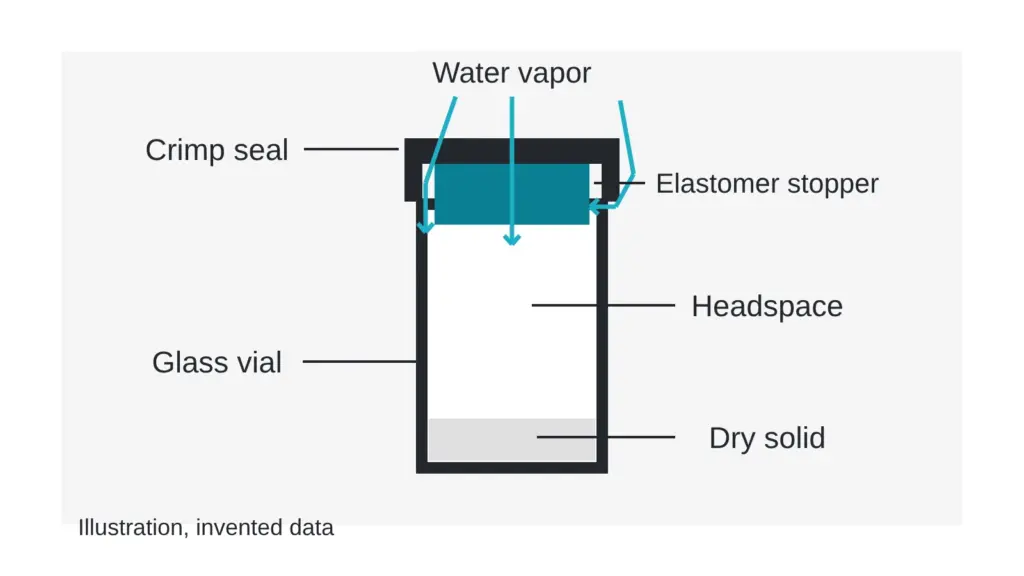
A vial closure has three parts working together.
- The vial: a glass container with a neck whose rim is shaped to receive a stopper.
- The stopper: a plug of elastomer, a rubbery polymer, that seals against the inside or the rim of the neck.
- The crimp seal: a thin aluminum band, often with a plastic cap, pressed over the stopper so that it stays compressed against the glass.
The space between the solid and the stopper is the headspace. It contains whatever gas was in the vial when it was closed, and for a dry material that is usually the point: the less water vapor in the headspace at closure, the less the solid can take up.
How much water is in the headspace?
Not much, and that matters for the argument. At 22 degrees Celsius and 50 percent relative humidity, room air carries roughly 10 micrograms of water vapor per milliliter. A vial with 10 milliliters of headspace closed in that air starts with under 0.1 milligram of water vapor, from rounded physical figures. Against a 50 mg dry solid, that is a fraction of one percent even if every molecule were taken up.
The headspace at closure is therefore a small supply. The bigger risk is a supply that keeps coming: vapor that moves in slowly across months because the closure is not tight, or because the stopper itself lets a little through.
Where does moisture get in?
There are three routes, and a good closure controls all of them.
- Through the stopper. Elastomers are not perfectly impermeable, and some formulations let more vapor pass than others. This route is slow and steady.
- Along the stopper-glass interface. If the stopper is not seated evenly, or the glass finish is rough, vapor moves along the contact line.
- Under a loose crimp. A crimp that has relaxed no longer holds the stopper compressed, and the interface route opens.
Temperature changes can add a pumping effect. When a sealed vial cools, the gas inside contracts and the internal pressure drops slightly below room pressure, which pulls on any weak point in the seal. This is general physics and not a measurement from a specific study.
A cosmetic flaw can be a closure flaw. In a case study of freeze-dried vials, about 40 percent had product residue around the stopper after processing. Protein concentration, aggregation and residual moisture did not differ between those vials and the clean ones, but container closure integrity, tested by blue dye ingress, was compromised in the vials with residue. The authors concluded that a seemingly cosmetic defect can affect quality (Mehta et al., 2018).
Can you test a closure without opening it?
Yes, and several non-destructive methods exist. One evaluation filled vials with an extremely hygroscopic powder that liquefies on contact with humid air and used it as an indicator of water vapor entry. Near-infrared spectroscopy then confirmed that no additional water vapor was detectable after two autoclave treatments, which the authors used as worst-case stress. They described the model as an easy, rapid and non-destructive closure test (Birrer et al., 2000).
The takeaway for a reader is that closure integrity is something people measure with instruments, and that a good-looking vial is only a first screen.
A review of reference standard programs lists vialing and storage next to analytical testing and stability studies as parts of the same quality system (McCarthy et al., 2023). The closure is part of the stability claim.
Does the stopper material matter?
Yes. Stoppers differ in how much vapor they let through, how well they recover their shape after being compressed, and how they behave when the temperature swings. Some carry a thin polymer film on the face that meets the contents. Those are general engineering facts about elastomers, and the closure supplier’s data sheet is the place to confirm any of them for a particular vial.
A sister vial from the same lot is the best comparison. If one vial looks different from its neighbors, the difference may sit in the closure, the fill, or the drying, and the three are easier to separate when the lot is shared.
What to look at on a sealed vial
| Check | What a problem looks like |
|---|---|
| Crimp | Loose, lifted edge, or a band that turns freely |
| Stopper | Not seated flat, tilted, or cracked |
| Stopper surface | Powder or residue stuck around the rim |
| Glass | Chips at the neck or fine cracks |
| Contents | Cake that has shrunk, collapsed, or turned sticky compared with a sister vial |
Look-alike vials can differ in appearance for reasons unrelated to the closure; Same batch, different-looking vials: why dry samples vary covers those. Weighing and measuring the water itself is covered in The variable nobody lists: how moisture moves a dry sample’s weight.
Quick check you can do today
Pick up one sealed vial and run the table above in thirty seconds. Then note the storage condition on its label. A good closure keeps vapor out only if the storage condition is also kept, and Storage mistakes that quietly add water to a dry sample explains why. When a sealed container comes out of cold storage, there is one more hazard that has nothing to do with leaks: The cold container trap: why condensation matters the moment a seal opens.
Sources
- Mehta SB, Roy S, Yang HC. Journal of Pharmaceutical Sciences, 2018, volume 107(6), pages 1736-1740. PubMed ID 29432763. DOI 10.1016/j.xphs.2018.02.001. Descriptor: case study of residue around the stopper in freeze-dried vials, with dye ingress testing of closure integrity.
- Birrer GA, Liu J, Halas JM, Nucera GG. PDA Journal of Pharmaceutical Science and Technology, 2000, volume 54(5), pages 373-382. PubMed ID 11057094. DOI not listed in the record. Descriptor: evaluation of a closure integrity test model using a hygroscopic indicator powder with near-infrared confirmation.
- McCarthy D, Han Y, Carrick K, Schmidt D, Workman W, Matejtschuk P, Duru C, Atouf F. Pharmaceutical Research, 2023, volume 40(6), pages 1317-1328. PubMed ID 36949371. DOI 10.1007/s11095-023-03493-1. Descriptor: peptide reference standards, vialing, lyophilization, testing and stability studies.
Want the catalog? Register free