
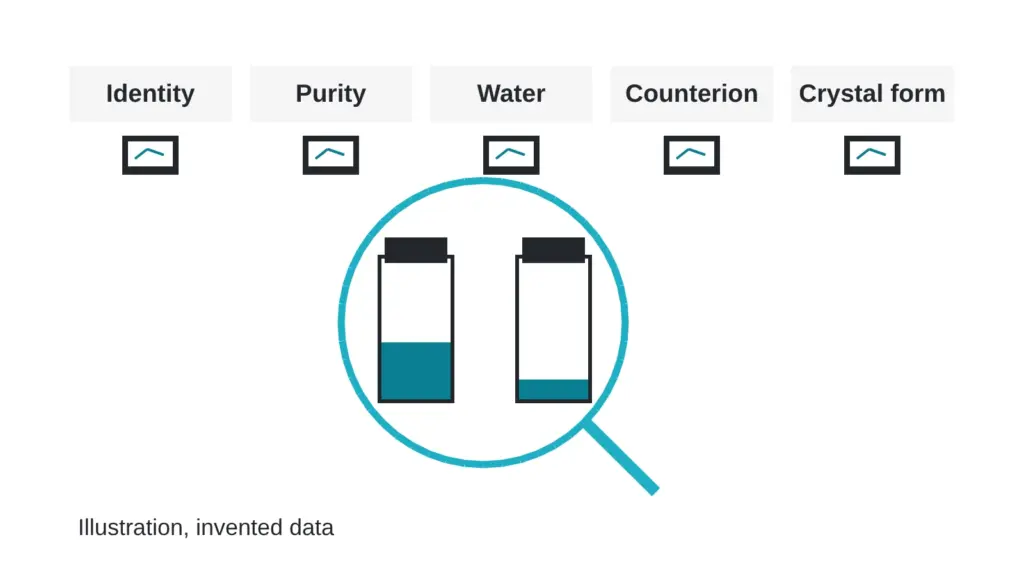
Two vials sit side by side on a shelf. One holds a tall, white, even cake. The other holds a short disk that has pulled slightly away from the glass and turned a shade creamier. Most people would bet the tall cake is the better sample. They might be right. They might also have made a choice on looks alone, which tells nothing about what is inside.
Looking is quick, free and worth doing. It answers a short list of questions. This article lays out that list, shows what falls outside it, and names the instrument that answers each of the other questions. It covers dry samples only. Terms are in the The testing glossary: 14 lab terms in plain English.
Looking is an observation. A test needs a question, a method and a number.
What the eye does well
The eye is the best tool available for a few jobs. It can tell whether the seal is intact, whether the label matches the lot on the paperwork, whether anything foreign is visible, and whether the sample looks different from the last time someone looked. Those checks catch real problems, and they cost nothing.
Record them as observations, in plain words with a date and a lot. The trouble starts when an observation gets filed as a conclusion.
Cake shape records the process more than the quality
Published development work shows how loosely appearance tracks quality, and the studies do not even agree with each other.
In one freeze-drying study, an additive that crystallizes during freezing produced cosmetically elegant cakes while giving little protection to the molecule. Formulations that collapsed during drying were reported with reduced activity, high moisture and poor stability (PubMed ID 8961143). A different study of freeze-dried protein cakes recalls earlier work in which collapse during drying had no major negative effect on stability at elevated temperatures. It then reports that cakes that collapsed later, during storage under stress, were significantly less well protected than cakes that collapsed during drying, and relates the difference to the onset of crystallization, breakdown of the stabilizer and browning (PubMed ID 23727369).
Two formulations, two opposite readings of the word “collapsed”. A cake’s shape is a clue about its history. It does not give a verdict on the contents.
Water hides in plain sight
In a stability study of a freeze-dried protein formulation, residual moisture ran from 1 to 8 percent, and the authors reported no cake collapse across that range. Over the same range, the glass transition temperature fell from 80 degrees C to 25 degrees C (PubMed ID 11683251). Eight times the water, an intact-looking cake, and a very different solid underneath. How that plays out over time is covered in Why colder is not always safer for dry solids and The variable nobody lists: how moisture moves a dry sample’s weight.
Color: worth noting, weak as proof
A color change can mark chemistry. The storage-collapse study above tied the problem cakes to browning along with crystallization and stabilizer breakdown (PubMed ID 23727369), so a shift toward yellow or cream deserves a note in the log. A white sample proves far less. Many changes, including a slow loss of the main component or a small rise in an impurity, carry no color at all.
Invented scale example
Picture two white samples, both invented for this article. One carries 4.0 percent of a single impurity by weight and the other carries 0.4 percent. Under a lamp, they look the same. A sample with a content of 78 percent and one at 94 percent also look the same, because the missing weight sits in water and counterions that have no color. The eye has no scale for any of that.
What answers the questions the eye cannot
| Question | Can the eye answer it? | What does answer it |
|---|---|---|
| Is it the intended molecule? | No | Identity testing, such as mass and fragment data or NMR (How labs confirm what a molecule is: mass, fragments and structure) |
| How much of the material is the main component? | No | Liquid chromatography purity, plus a separate content value |
| How much water is in it? | No | A water-specific method, such as Karl Fischer titration |
| Has the solid changed crystal form? | Rarely | Diffraction, thermal analysis and spectroscopy |
| Which lot is it? | Only if the label is intact | The lot ID matched against the report |
| Is the closure intact? | Yes | The eye |
On the fourth row, a stability study of a freeze-dried peptide formulation used X-ray powder diffraction, thermal analysis and spectroscopy to show an excipient changing crystal form and crystallinity rising over weeks of storage (PubMed ID 25636302). Those are changes the instruments measure directly. Appearance is one column in a stability record, never the whole record. Why two vials from one lot can look different at all is explained in Same batch, different-looking vials: why dry samples vary.
Myth versus reality
Myth: a sample that looks fine is a sample that is fine. Reality: a sample that looks fine has passed the questions the eye can ask, which are about the seal, the label and gross change. Everything else needs a method and a number.
Quick check you can do today
Open the log for a stored sample. For every line that says “looks fine”, “normal” or “unchanged”, look for a partner line that gives a method, a number and a date. Lines without a partner are observations. Keep them, label them as observations, and ask which measurement would answer the question you were really asking.
Sources
- PubMed ID 8961143, Journal of Pharmaceutical Sciences, DOI 10.1021/js960146p. Descriptor: freeze-drying development study on collapse temperature, additives and cake appearance.
- Schersch K, Betz O, Garidel P, Muehlau S, Bassarab S, Winter G. European Journal of Pharmaceutics and Biopharmaceutics, 2013, volume 85(2), pages 240-252. PubMed ID 23727369. DOI 10.1016/j.ejpb.2013.05.009. Descriptor: study of freeze-dried cake collapse during drying and during storage at elevated temperatures.
- Breen ED, Curley JG, Overcashier DE, Hsu CC, Shire SJ. Pharmaceutical Research, 2001, volume 18(9), pages 1345-1353. PubMed ID 11683251. DOI 10.1023/a:1013054431517. Descriptor: stability study of a freeze-dried protein formulation across a range of residual moisture levels.
- Srinivasan C, Siddiqui A, Korang-Yeboah M, Khan MA. International Journal of Pharmaceutics, 2015, volume 481(1-2), pages 104-113. PubMed ID 25636302. DOI 10.1016/j.ijpharm.2015.01.044. Descriptor: stability study of a freeze-dried peptide formulation using diffraction, thermal and spectroscopic methods.
Want the catalog? Register free