
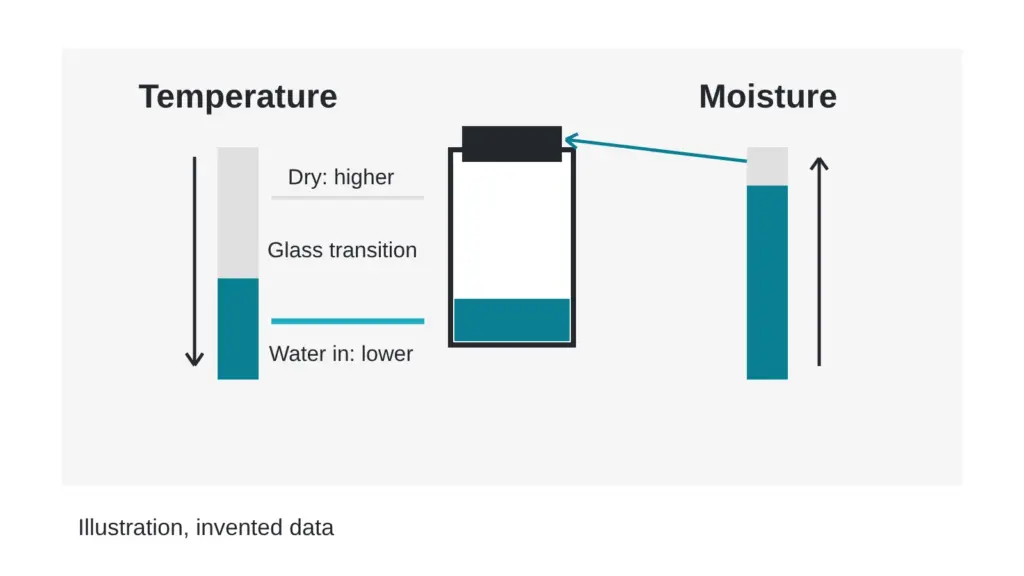
A glass container comes out of a deep freezer and into a warm room. Within seconds its surface turns cloudy with fog. Nothing is wrong with the container. The fog is water from the room air, and the cold glass is collecting it.
That small scene holds the whole argument. Cold is a powerful tool for dry solids, and “colder is always safer” is still a myth. Temperature controls how fast reactions run. It has no say over how much water is already inside the solid, how much arrives later, or how many times the container travels between cold and warm. This article sorts out what a lower temperature protects, what it leaves untouched, and why one idea from solid-state chemistry, the glass transition, explains the difference. Terms are in the The testing glossary: 14 lab terms in plain English. It covers general chemistry only and gives no handling instructions for any material.
A freezer slows the clock. It does not shut the door.
What a lower temperature really does
Reactions in a solid run slower as it cools. In a published stability study of a freeze-dried protein formulation, chemical and physical degradation both followed Arrhenius kinetics while the solid stayed in its glassy state, and every formulation in the study was stable at 5 degrees C (PubMed ID 11683251). Cold buys time, and nobody serious disputes that.
The trouble starts when temperature is treated as the only dial.
Water moves the goalposts
Many dry research samples are amorphous solids, a disordered arrangement that behaves like a rigid glass when cold and dry. Above a characteristic temperature, the glass transition temperature, the solid softens toward a rubbery state and molecules move far more freely. Water is the dial that moves that temperature.
In the study above, the glass transition temperature fell from 80 degrees C at 1 percent moisture to 25 degrees C at 8 percent moisture. Samples with high moisture aggregated faster than drier ones when stored above their glass transition, and high moisture lowered chemical stability whether the solid was glassy or rubbery (PubMed ID 11683251).
Now put room temperature next to those numbers. A solid holding 8 percent water has a glass transition close to ordinary room temperature. A solid holding 1 percent has 55 degrees of headroom. The storage temperature is identical and the water is not. A separate solid-state study of a freeze-dried protein found that aggregation rose with temperature and with water content, and tracked water uptake directly (PubMed ID 8140052).
Humidity and temperature also act together on the physical form. Amorphous sugar blends stayed amorphous at 11 and 23 percent relative humidity at 22 degrees C, but the time to crystallization varied once humidity reached 33 percent, or temperature reached 40 degrees C (PubMed ID 30320406).
The door is the weak point
Moisture arrives at predictable moments. A cold container opened in a humid room sits below the dew point of the air around it, so water vapor condenses on the cold surfaces it meets. The physics is laid out in The cold container trap: why condensation matters the moment a seal opens.
The closure counts as well. A freeze-drying development study noted that moisture can diffuse from a stopper into the dry product, raising its water content and lowering the temperature at which the solid collapses (PubMed ID 8961143). A closure is a material with its own water history, which is the subject of Stoppers, seals and the small leaks that matter.
Round trips add up
Every trip from cold storage to room air and back repeats the door problem. A cold surface meets humid air on the way out. A warming container may close again with whatever moisture came in on the way. Ten trips give ten chances, and a log that records only the freezer setpoint never shows them. The wider picture of moisture as a variable is in The variable nobody lists: how moisture moves a dry sample’s weight, and ordinary storage reasoning is in Storage mistakes that quietly add water to a dry sample.
What temperature controls, and what it does not
| Factor | Does a lower temperature change it? | What actually sets it |
|---|---|---|
| Speed of chemical reactions in the solid | Yes, they slow down | Temperature, plus water content |
| Water already inside when sealed | No | How the solid was dried and filled |
| Water that enters later | No, and cold surfaces can add condensation | Closure, headspace, time exposed to air |
| Glass transition temperature | No | Water content and composition |
| Number of cold-to-warm trips | No | Handling history |
Read down the middle column. Only the first row responds to a lower setpoint. The other four respond to how the solid was dried, what the closure is made of and how often the container moves. That is why a steady, modest storage setup can beat an extreme one that is opened often.
Myth versus reality
Myth: the coldest setting is the safest setting. Reality: the safest history is the steadiest one, with low temperature, little water at sealing, a tight closure and few trips. A sample held at a moderate, steady temperature can carry a drier history than a colder one that traveled every week.
Quick check you can do today
Pull the storage record for one dry sample and write down four things: the temperature range it has seen, how many times it left cold storage, whether anyone noted how long it sat out, and what the closure is made of. If the second and third lines are blank, the water history is a guess. Then ask what the real exposure was, as opposed to what the setpoint said.
Sources
- Breen ED, Curley JG, Overcashier DE, Hsu CC, Shire SJ. Pharmaceutical Research, 2001, volume 18(9), pages 1345-1353. PubMed ID 11683251. DOI 10.1023/a:1013054431517. Descriptor: stability study of a freeze-dried protein formulation across a range of residual moisture levels, with glass transition measurements.
- Costantino HR, Langer R, Klibanov AM. Pharmaceutical Research, volume 11(1), pages 21-29. PubMed ID 8140052. DOI 10.1023/a:1018981208076. Descriptor: solid-state study of moisture-induced aggregation in a freeze-dried protein.
- Adams GD, Ramsay JR. Journal of Pharmaceutical Sciences, volume 85(12), pages 1301-1305. PubMed ID 8961143. DOI 10.1021/js960146p. Descriptor: freeze-drying development study on collapse temperature, formulation and moisture.
- Thorat AA, Forny L, Meunier V, Taylor LS, Mauer LJ. Journal of Food Science, 2018, volume 83(11), pages 2827-2839. PubMed ID 30320406. DOI 10.1111/1750-3841.14357. Descriptor: study of amorphous sugar blends and crystallization under controlled humidity and temperature.
Want the catalog? Register free