
Everything Researchers Need to Know About This Investigational Amylin Analogue
Original guide: July 2026. Selected research updates are dated below; other sections may require further review.
Research Status: Investigational Research Peptide
Eloralintide alone: In a published 48-week Phase 2 study, 263 adults with obesity or overweight and a related condition, without type 2 diabetes, were randomized. The highest reported eloralintide groups had approximately 20% mean weight reduction versus 0.4% with placebo under the efficacy estimand. Nausea and fatigue were among the reported adverse events, with rates varying by group. This separate single-agent study does not establish the safety or identity of a research sample.
Eloralintide plus tirzepatide: In Lilly’s Phase 2b report, 367 adults with overweight or obesity and type 2 diabetes were randomized across multiple groups. At week 48, the highest reported combination group had a mean weight reduction of 23.3%, compared with 14.8% for tirzepatide alone and 3.0% for placebo, using the efficacy estimand. Lilly reported adverse-event discontinuations of 10.8% to 27.0% across combination groups, versus 2.9% with tirzepatide and 16.7% with placebo; group sizes and regimens differ. These sponsor-reported clinical results concern the investigational medicines, not the identity or properties of separately supplied laboratory materials.
Research update, November 6, 2026: Lilly reports that eloralintide is in Phase 3 studies as a single agent. Lilly has also reported a separate Phase 2b study with tirzepatide. Phase 3 studies of the coformulation are registered; AMPLIFY-2 was listed as recruiting on November 6, 2026, in adults with overweight or obesity and type 2 diabetes. Recruitment does not mean Phase 3 results are available. See our eloralintide and tirzepatide research update for study designs and comparisons. An active research program does not establish approval or the properties of separately supplied research materials.
When most people think about hormones involved in metabolism, insulin usually comes to mind first.
That makes sense. Insulin has been studied for more than a century and plays a well-known role in helping the body process glucose.
But insulin doesn’t work alone.
Every time a healthy pancreas responds to a meal, it releases another hormone alongside insulin called amylin. While insulin helps regulate glucose, amylin sends its own set of signals related to fullness, digestion, and the pace at which food leaves the stomach.
For decades, amylin lived in insulin’s shadow.
Today, that’s beginning to change.
Researchers now recognize that metabolism isn’t controlled by a single hormone. Instead, it’s an intricate communication network involving multiple hormones working together. That realization has sparked growing interest in amylin and in laboratory-designed compounds that allow scientists to study this pathway more closely.
One of the newest investigational compounds attracting attention is Eloralintide.
Designed as a long-acting amylin analogue, Eloralintide is helping researchers explore how prolonged amylin receptor activation may influence metabolic signaling, appetite regulation, and digestive physiology.
This guide explains what Eloralintide is, how it works, why researchers are interested in it, and where current research stands. Whether you’re new to peptide research or already familiar with metabolic science, you’ll find straightforward explanations that are easy to follow while remaining scientifically grounded.
Eloralintide at a Glance
| Category | Details |
|---|---|
| Compound Type | Synthetic amylin analogue |
| Research Status | Investigational |
| Primary Research Area | Metabolic research |
| Hormone Mimicked | Amylin |
| Primary Target | Amylin receptor complexes |
| Current Interest | Appetite regulation, digestive signaling, energy balance |
What Is Eloralintide?
Short Answer
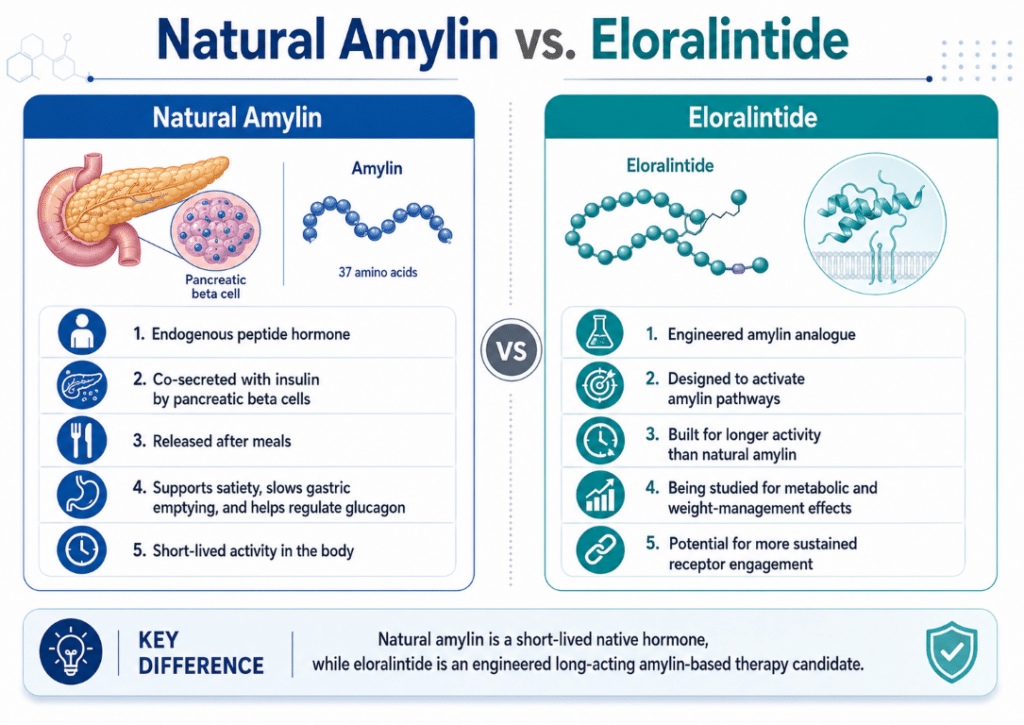
Eloralintide is an investigational synthetic amylin analog and selective amylin receptor agonist. A Phase 1 study describes it as long acting; the modified molecule is not identical to naturally occurring amylin.
Natural amylin has one major limitation for researchers.
It doesn’t stay active very long.
Once released by the pancreas, the hormone is rapidly broken down by the body. While that’s perfectly normal from a biological perspective, it makes detailed research more challenging.
Eloralintide was designed to solve that problem.
By modifying the molecule to remain stable for longer periods, scientists can observe amylin signaling over an extended timeframe. This makes it easier to study how the hormone communicates with different organs and how it interacts with other metabolic pathways.
Although Eloralintide shares important characteristics with natural amylin, it is not identical. It was engineered as an investigational long-acting amylin receptor agonist for clinical development.
Researchers study its receptor activity and clinical effects to understand how its modified design behaves. Findings about the investigational medicine do not establish the identity or properties of a separate research sample.
Key Takeaways
- Eloralintide is a laboratory-engineered amylin analogue.
- It is designed to remain active longer than naturally occurring amylin.
- Researchers are studying how it affects amylin receptor signaling.
- It remains an investigational research compound.
Why Is Everyone Suddenly Talking About Amylin?
Short Answer
Because scientists now recognize that metabolism is controlled by multiple hormones working together, not just one. Amylin has become one of the most important pieces of that puzzle.
Obesity and metabolic research have changed dramatically over the past decade.
Early research often focused on individual hormones in isolation. Today, researchers understand that the body’s appetite and energy systems function more like a conversation than a series of independent signals.
Imagine trying to understand how an orchestra performs by listening to only the violins.
You would miss most of the music.
The same idea applies to metabolism.
Insulin, GLP-1, GIP, glucagon, leptin, ghrelin, and amylin all communicate continuously. Each hormone contributes different information, helping the brain and body coordinate hunger, fullness, digestion, and energy use.
As scientists filled in more of that picture, amylin quickly moved from a relatively overlooked hormone to one receiving significant research attention.
That growing interest has fueled the development of newer investigational analogues, including Eloralintide.
Did You Know?
Amylin was first identified in the 1980s, but advances in peptide engineering have dramatically expanded research into its biological role over the past several years.
Researchers Are Investigating Questions Like:
- How does amylin communicate with the brain?
- How does it influence feelings of fullness?
- What role does it play in gastric emptying?
- How does it interact with GLP-1 signaling?
- Can long-acting analogues provide new research insights?
Want to Learn More?
Explore our complete guide to Understanding Amylin and Why It Matters in Metabolic Research.
How Does Eloralintide Work?
Short Answer
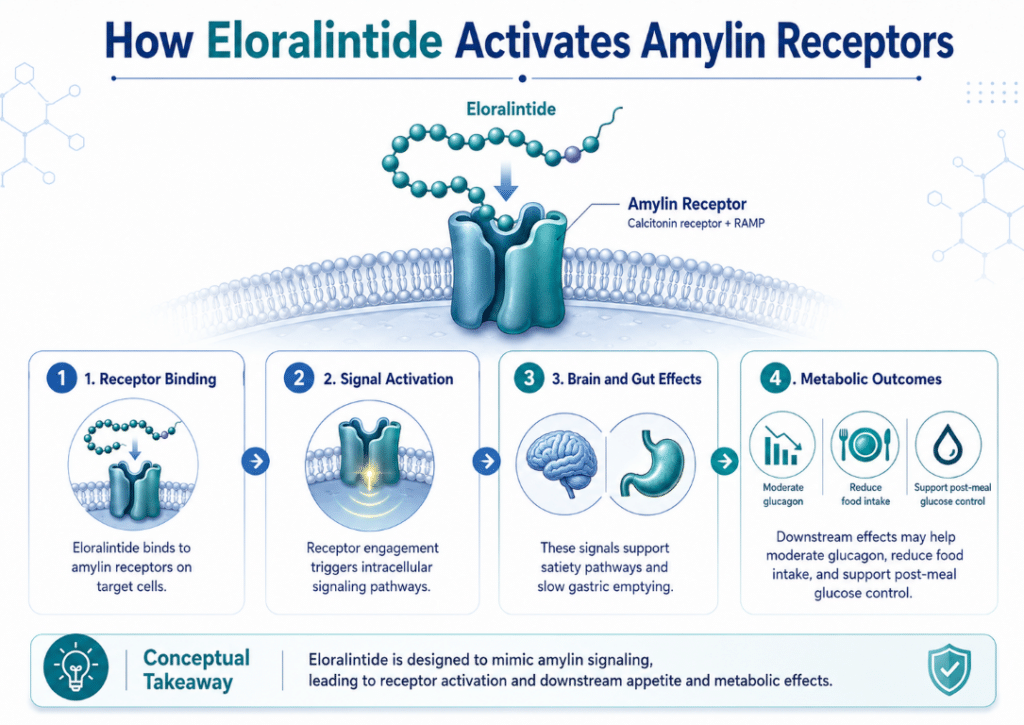
Eloralintide is designed to activate amylin receptor complexes, allowing researchers to study how amylin signaling influences digestion, appetite regulation, and metabolic communication.
Hormones act like biological messengers.
They travel throughout the body carrying instructions to specific cells. Those instructions are only received if the cell contains the appropriate receptor.
Think of a receptor as a lock.
The hormone acts as the key.
Only the correct key can unlock the message.
Eloralintide was engineered to bind with amylin receptor complexes, which are found throughout regions involved in appetite regulation and digestive control.
Once these receptors are activated, researchers can observe how signals travel through the body’s metabolic network.
Importantly, Eloralintide is not simply another version of a GLP-1 compound.
Although both pathways are involved in metabolic regulation, they work through different biological mechanisms. Researchers are increasingly interested in understanding how these separate pathways complement one another.
Rather than asking which hormone is “better,” modern research is asking how different hormonal systems communicate as part of a much larger network.
That represents one of the biggest shifts in metabolic science over the past decade.
Key Takeaways
- Hormones communicate by binding to receptors.
- Eloralintide targets amylin receptor complexes.
- Amylin signaling differs from GLP-1 signaling.
- Researchers are studying how multiple hormonal pathways interact.
What Is Amylin?
Short Answer
Amylin is a naturally occurring peptide hormone released by the pancreas alongside insulin after meals. It helps coordinate signals involved in fullness, digestion, and metabolic regulation.
Insulin often gets all the attention.
Amylin quietly does its job in the background.
Amylin is co-secreted with insulin from pancreatic beta cells in response to nutrient-related signals. Their release and effects depend on physiological conditions, and the two hormones have different roles.
Insulin primarily helps regulate glucose.
Amylin focuses on coordinating digestive and satiety-related signals.
Neither hormone replaces the other.
Instead, they function as teammates, each contributing to the body’s overall response after eating.
Understanding that partnership is one reason researchers have become increasingly interested in amylin analogues like Eloralintide.
The more scientists learn about metabolism, the clearer it becomes that healthy metabolic regulation depends on many hormones working together, not just one.
What Scientists Believe Amylin Helps Regulate
Current research suggests amylin contributes to:
- Signals associated with fullness
- Communication between the digestive system and the brain
- Gastric emptying
- Overall metabolic coordination
- Appetite-related signaling pathways
| Natural Amylin | Eloralintide |
|---|---|
| Produced naturally by the pancreas | Laboratory engineered |
| Short-lived | Designed for longer activity |
| Released after meals | Used for investigational research |
| Rapidly broken down | Greater stability for research |
Why Staying Active Longer Matters
Short Answer
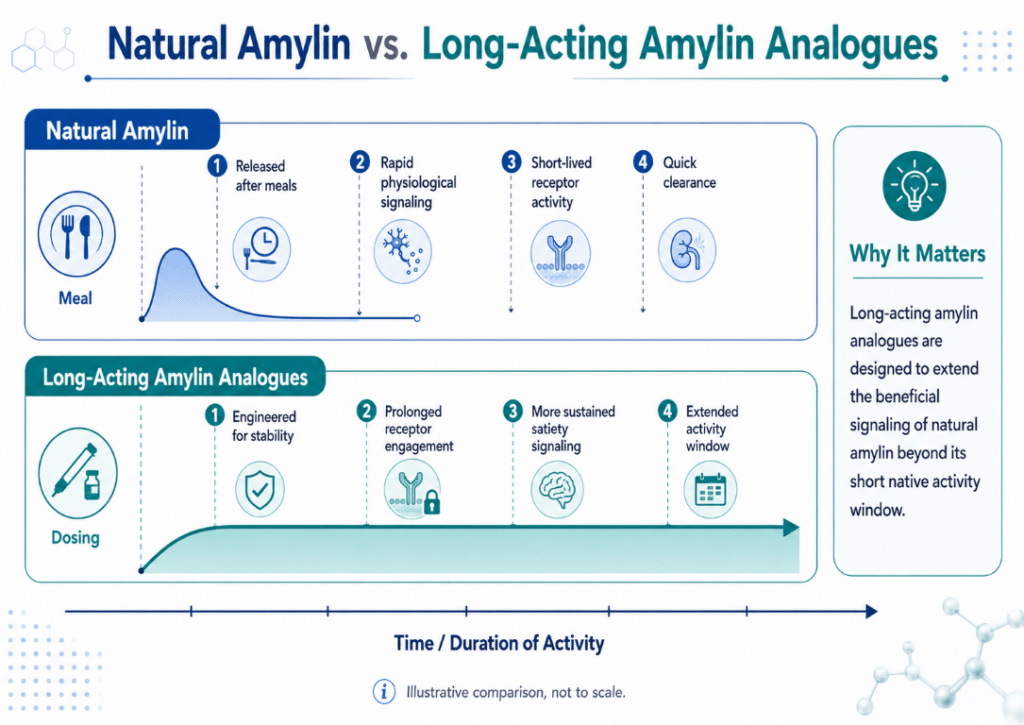
One of the biggest challenges in peptide research is that many naturally occurring hormones don’t remain active for very long. Eloralintide was engineered to provide researchers with a longer window to study amylin signaling.
Nature doesn’t always cooperate with researchers.
Many hormones are designed to do their job quickly before being broken down by the body. That’s an efficient system for normal biology, but it can make scientific research much more difficult.
Imagine trying to study a shooting star.
By the time you’ve pointed your telescope in the right direction, it’s already gone.
Natural amylin presents a similar challenge. Its relatively short lifespan limits the amount of time researchers have to observe its activity.
Long-acting analogues like Eloralintide are designed to overcome that limitation. By extending how long the molecule remains active, scientists can gather more information about receptor activity, signaling pathways, and biological responses.
This doesn’t change what amylin is trying to communicate. Instead, it gives researchers more time to observe the conversation.
Why Researchers Value Longer-Acting Analogues
Longer-lasting compounds can help scientists:
- Observe biological activity over extended periods
- Better understand receptor interactions
- Compare signaling patterns between compounds
- Study hormone communication in greater detail
- Design more informative research protocols
Where Does Eloralintide Fit Into Modern Obesity Research?
Short Answer
Researchers view Eloralintide as part of a broader effort to better understand the biology of appetite, metabolism, and energy regulation through multiple hormonal pathways.
Keep the study designs separate: Eloralintide monotherapy, a combination of eloralintide with another investigational regimen, and studies of different amylin analogs do not form a single head-to-head dataset. Each has its own population, duration, comparator and statistical analysis. For a clearer comparison of a separate amylin research program, read the petrelintide ZUPREME evidence review; that program’s outcomes cannot establish which molecule is superior.
The science of obesity has changed dramatically.
Years ago, excess body weight was often viewed through a simple lens: calories consumed versus calories burned.
Today’s researchers know the story is much more complicated.
Appetite is influenced by the brain, digestive system, hormones, genetics, sleep, stress, and countless signaling molecules communicating every second of the day.
That complexity is one reason peptide research has expanded so rapidly.
Instead of focusing on a single hormone, scientists now investigate how entire hormonal networks work together.
Amylin has become an increasingly important part of that conversation.
Compounds like Eloralintide allow researchers to examine one specific pathway while also exploring how it interacts with others, including GLP-1 and additional metabolic signaling systems.
The goal isn’t simply to study one molecule.
The goal is to better understand the entire biological system.
Did You Know?
Scientists often describe metabolism as one of the body’s most complex communication networks. Dozens of hormones continuously exchange information between the brain, pancreas, stomach, intestines, liver, and fat tissue.
How Is Eloralintide Different From GLP-1 Peptides?
Short Answer
Although both are studied in metabolic research, Eloralintide and GLP-1 compounds activate different receptors and represent different hormonal pathways.
Because GLP-1 medications have received so much public attention, many people assume every new metabolic peptide works the same way.
That isn’t the case.
GLP-1 compounds activate GLP-1 receptors.
Eloralintide is designed to activate amylin receptor complexes.
Those are two different biological systems.
Researchers are interested in both because each contributes unique information about appetite regulation and metabolic signaling.
Rather than competing, these pathways may complement one another, which is one reason combination approaches have become an active area of scientific investigation.
As our understanding of metabolism improves, researchers increasingly recognize that no single hormone explains the entire picture.
Comparison at a Glance
| Eloralintide | Typical GLP-1 Analogue |
|---|---|
| Amylin pathway | GLP-1 pathway |
| Investigational amylin analogue | GLP-1 receptor agonist |
| Studied for amylin signaling | Studied for GLP-1 signaling |
| Different receptor targets | Different receptor targets |
Want to Learn More?
Read our detailed comparison of Eloralintide vs. Cagrilintide and Eloralintide vs. Retatrutide.
Why Researchers Are Watching Eli Lilly’s Amylin Program
Short Answer
Interest in Eloralintide has grown alongside increasing investment by major pharmaceutical companies in next-generation amylin research.
Large pharmaceutical companies rarely commit significant resources to an area of research unless they believe it has meaningful scientific potential.
Over the past several years, amylin has attracted increasing attention.
That includes continued investment in investigational compounds designed to better understand metabolic biology and the role of amylin receptor signaling.
For researchers, this trend is important.
It suggests that amylin is no longer viewed as a niche area of study. Instead, it has become part of a much broader effort to understand obesity, appetite regulation, and energy balance.
While individual research programs differ in their design and objectives, they all contribute to expanding scientific knowledge about this important hormone system.
Fast Facts
- Interest in amylin research continues to grow.
- Multiple investigational compounds are currently being studied.
- Researchers are increasingly exploring multi-hormone approaches.
- Eloralintide represents one area of ongoing scientific investigation.
Why Research Quality Matters
Scientific discoveries depend on more than innovative molecules.
They also depend on reliable research materials.
Even small differences in purity, identity, or manufacturing quality can influence research outcomes and make it more difficult to compare findings across studies.
For that reason, experienced researchers typically place significant importance on sourcing materials that undergo appropriate analytical testing and quality verification.
Reliable research begins long before the first experiment starts.
It begins with confidence in the materials being studied.
Research Checklist
Before beginning any peptide research, investigators commonly verify:
- Identity testing
- Purity analysis
- Proper storage conditions
- Batch consistency
- Supporting analytical documentation
Frequently Asked Questions About Eloralintide
Is Eloralintide FDA Approved?
No.
At the time of this writing, Eloralintide remains an investigational research compound. It is being studied to better understand amylin biology and metabolic signaling. Researchers continue to evaluate its characteristics as additional scientific data becomes available.
Is Eloralintide the Same as Amylin?
Not exactly.
Eloralintide was designed to mimic many of the biological properties of naturally occurring amylin, but it is not identical to the hormone produced by the pancreas.
Instead, it is a laboratory-engineered analogue created to provide greater stability for scientific research.
Why Are Researchers Interested in Amylin?
Interest in amylin has grown because researchers now understand that metabolism is regulated by many hormones working together.
Amylin plays an important role within that network, particularly in communication related to digestion and feelings of fullness.
As scientists learn more about these interconnected pathways, amylin continues to receive increasing research attention.
Does Eloralintide Work Like GLP-1?
No.
Although both compounds are studied within metabolic research, they activate different biological pathways.
GLP-1 compounds primarily target GLP-1 receptors.
Eloralintide is designed to activate amylin receptor complexes.
Researchers are studying both pathways to better understand how they contribute to the body’s overall metabolic communication system.
Why Was Eloralintide Developed?
Natural amylin performs its biological role for only a relatively short period before being broken down.
Eloralintide was engineered to remain active longer, giving researchers additional time to study amylin signaling and receptor activity.
That extended duration makes certain types of scientific investigation easier than would be possible with natural amylin alone.
Is Eloralintide a Peptide?
Yes.
Eloralintide is a synthetic peptide analogue designed for investigational research involving the amylin pathway.
Like many research peptides, it was engineered to provide characteristics that make laboratory investigation more practical.
Is Eloralintide Still Being Studied?
Yes.
Interest in amylin research continues to expand.
As scientists publish additional findings and pharmaceutical research programs evolve, our understanding of Eloralintide and related compounds will continue to grow.
Why Trust This Guide?
The field of peptide research changes quickly.
New studies are published every year, investigational compounds continue to evolve, and our understanding of metabolic biology grows with each discovery.
Our goal is simple.
To present complex scientific topics in a way that’s accurate, understandable, and useful for researchers without exaggerating conclusions or making unsupported claims.
Whenever possible, we recommend reviewing primary scientific literature alongside educational resources like this guide.
Science moves forward through evidence, and every new study adds another piece to the puzzle.
About Xcel Peptides
As interest in Eloralintide began to grow within the research community, Xcel Peptides became one of the earliest confirmed U.S. research suppliers to publicly offer Eloralintide for research purposes.
As new investigational peptides emerge, maintaining high quality standards remains just as important as following the latest scientific developments.
Continue Your Research
If you’d like to explore the science behind Eloralintide in greater detail, these guides are the perfect next step.
Start Here
- What Is Eloralintide?
- How Does Eloralintide Work?
- Understanding Amylin
- Why Long-Acting Amylin Analogues Matter
Compare Related Compounds
Learn More About Peptide Science
- Molecular Structure
- Pharmacokinetics
- Eli Lilly’s Amylin Research Program
- Frequently Asked Questions About Eloralintide
Key Takeaways
If you only remember five things from this guide, remember these:
- Eloralintide is an investigational synthetic amylin analogue designed for research.
- It was engineered to remain active longer than natural amylin, making scientific study easier.
- Researchers are studying its interaction with amylin receptor complexes and its role in metabolic signaling.
- Growing interest in amylin reflects a broader shift toward understanding metabolism as a network of interacting hormones.
- Eloralintide remains an investigational compound, and scientific knowledge will continue to evolve as new research is published.
References
This guide is based on publicly available scientific literature covering:
- Amylin physiology
- Peptide engineering
- Metabolic signaling pathways
- Obesity research
- Investigational amylin analogues
- Peer-reviewed endocrine and metabolic research
Readers are encouraged to consult primary scientific publications for the most current findings as research continues to advance.