
A small paper packet rattles at the bottom of a shipping box. It says do not eat, and almost everyone throws it away without asking what it was for. It was placing a bet about water, and the bet has limits that matter to anyone who studies dry material.
This article covers what a drying agent changes, what it leaves alone, and why a lower humidity reading on the air is a different thing from a drier sample. It is general laboratory science. Terms are defined in the The testing glossary: 14 lab terms in plain English.
What is a desiccant actually doing?
A desiccant is a drying agent: a solid that holds water vapor more strongly than the surrounding air does. Familiar chemistry examples are silica gel, molecular sieves, anhydrous calcium chloride and calcium sulfate. Some hold water on a vast internal surface, like a sponge made of rock. Others bind it chemically as a hydrate. Either way, the job is to pull vapor out of the air in a closed space until that air sits at a lower humidity than it started with.
Which number does it change?
Relative humidity compares the water vapor in the air with the most that air could hold at its temperature. Chemists also use water activity, the same idea written as a fraction between 0 and 1, so a water activity of 0.5 corresponds to 50 percent relative humidity once everything has reached balance.
Every dry solid trades water with the air until the two match. The water content a solid settles at, for each humidity, is plotted as a sorption isotherm. One study of a freeze-dried protein powder measured that curve and reported that the extent of aggregation correlated directly with the water the powder had taken up (Costantino et al., Pharmaceutical Research). Another held dried encapsulated powders at three water activities, 0.32, 0.57 and 0.70, and found that higher humidity raised the mobility of water in the powder and raised the rate at which a living component lost viability during storage (Ying et al., 2010).
So a drying agent buys a lower humidity in the air. Whether the sample follows depends on three limits.
Limit one: capacity
A drying agent holds a finite amount of water. Once it is loaded, it has nothing left to take, and a closed space with a spent agent behaves like any other closed space. Laboratories tell the two apart with humidity indicators or by weighing the agent, because looking at it rarely settles the question.
Limit two: speed
Water inside a solid leaves slowly. It has to travel to the surface and enter the air before any drying agent can touch it. That slowness is the reason freeze-drying ends with a secondary drying stage that uses warmth and vacuum, and the reason a packet placed beside a damp solid dries the air far faster than it dries the solid.
Limit three: the seal
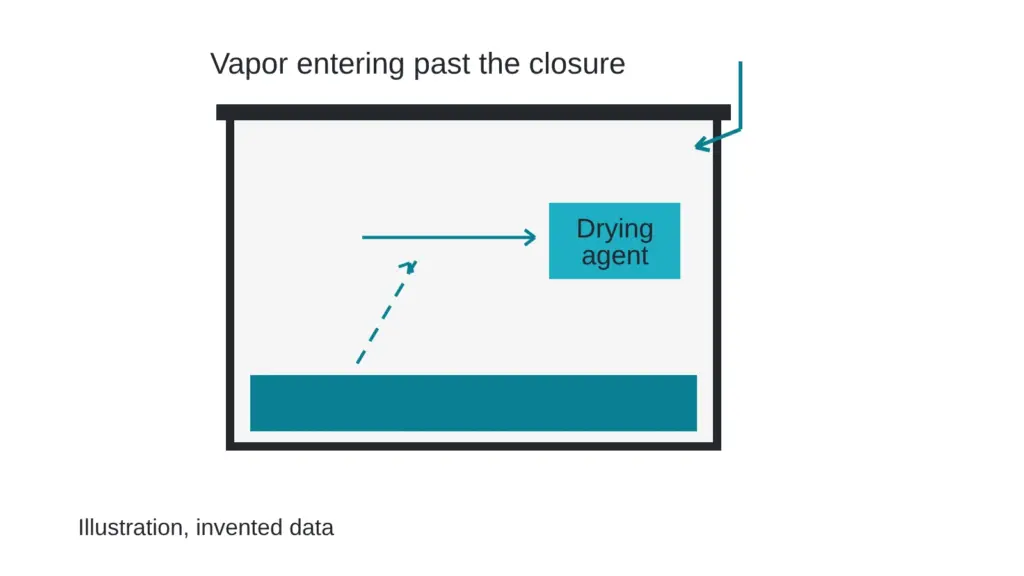
A drying agent inside a leaky container is racing the leak. The closure sets how much vapor arrives from outside, and no amount of drying agent changes the fact that a poor seal keeps refilling the account. See Stoppers, seals and the small leaks that matter for the three paths vapor takes in.
A worked example with invented numbers
All values below are invented for teaching.
| Quantity (invented) | Value |
|---|---|
| Water in the air of a sealed container | 0.1 mg |
| Weighed sample | 50.0 mg |
| Water in the sample at 2.0 percent | 1.0 mg |
The solid holds ten times as much water as the air around it. A drying agent that removes the 0.1 mg from the air has emptied the smaller account. The 1.0 mg in the sample moves only as fast as it can diffuse out, and only as long as the closure keeps new vapor away.
A desiccant manages the air around a sample. The sample keeps its own water account.
Does drier always mean better?
Laboratories do not aim for zero water. A study of a freeze-dried protein formulation with residual moisture between 1 and 8 percent found that high moisture lowered chemical stability, yet the intermediate-moisture vials were more stable against aggregation than the driest vials. The authors concluded that physical stability was not compromised, and might even improve, with more residual moisture when storage stays below the glass transition temperature (Breen et al., 2001). The glass transition temperature is the point where an amorphous solid shifts from a rigid glass to a rubbery state.
That finding belongs to one formulation, and it does not transfer to other materials. What transfers is the principle that the right water range comes from stability data. A humidity number alone cannot supply it.
Myth versus reality
| Common belief | What the evidence and the chemistry support |
|---|---|
| A packet makes the contents dry | A packet lowers the humidity of the air, and the contents follow slowly or partly |
| More packets are always safer | Capacity is finite, and the target water range comes from stability data |
| With a packet inside, the seal matters less | The closure sets how much vapor arrives, so the seal matters at least as much |
| A bone-dry solid is the safest solid | One formulation study found intermediate moisture more stable against aggregation than the driest vials |
What a drying agent cannot touch
- Temperature: warmth speeds most degradation reactions at any humidity.
- Light: photochemical changes do not depend on the water in the air.
- Water already inside: a wet cake sealed with a drying agent is still a wet cake.
- Condensation: a cold container opened in humid air collects water that the drying agent never saw, a problem covered in The cold container trap: why condensation matters the moment a seal opens.
Quick check you can do today
Pick any storage statement on a label, report or specification and look for a humidity condition written as a number, such as percent relative humidity. Then find the water content value, its method and its date, as described in The variable nobody lists: how moisture moves a dry sample’s weight. A stated number can be audited. The word “dry” cannot. Storage principles are collected in Storage mistakes that quietly add water to a dry sample.
Sources
- Costantino HR, Langer R, Klibanov AM. Pharmaceutical Research, volume 11(1), pages 21-29. PubMed ID 8140052. DOI 10.1023/a:1018981208076. Descriptor: study of aggregation in a freeze-dried protein powder, including its water sorption isotherm.
- Breen ED, Curley JG, Overcashier DE, Hsu CC, Shire SJ. Pharmaceutical Research, 2001, volume 18(9), pages 1345-1353. PubMed ID 11683251. DOI 10.1023/a:1013054431517. Descriptor: effect of residual moisture and glass transition temperature on a freeze-dried protein formulation.
- Ying DY, Phoon MC, Sanguansri L, Weerakkody R, Burgar I, Augustin MA. Journal of Food Science, 2010, volume 75(9), pages E588-E595. PubMed ID 21535593. DOI 10.1111/j.1750-3841.2010.01838.x. Descriptor: study of moisture sorption, water mobility and storage stability in dried encapsulated powders.
Want the catalog? Register free